
Executive summary
A model for rare defects needs suitable training examples and an independent test. If synthetic examples are created before the data are split, that independence can be lost. A recent preprint examines this problem using customer data.
The official documentation for the imbalanced-learn software library describes the same underlying failure. This gives quality practitioners a concrete question: can the source records behind every synthetic training example be identified, and do they belong exclusively to the permitted training set? A high detection score alone cannot answer that question.
FQI takeaway
- Check data lineage: Synthetic examples must not incorporate information from the eventual test set.
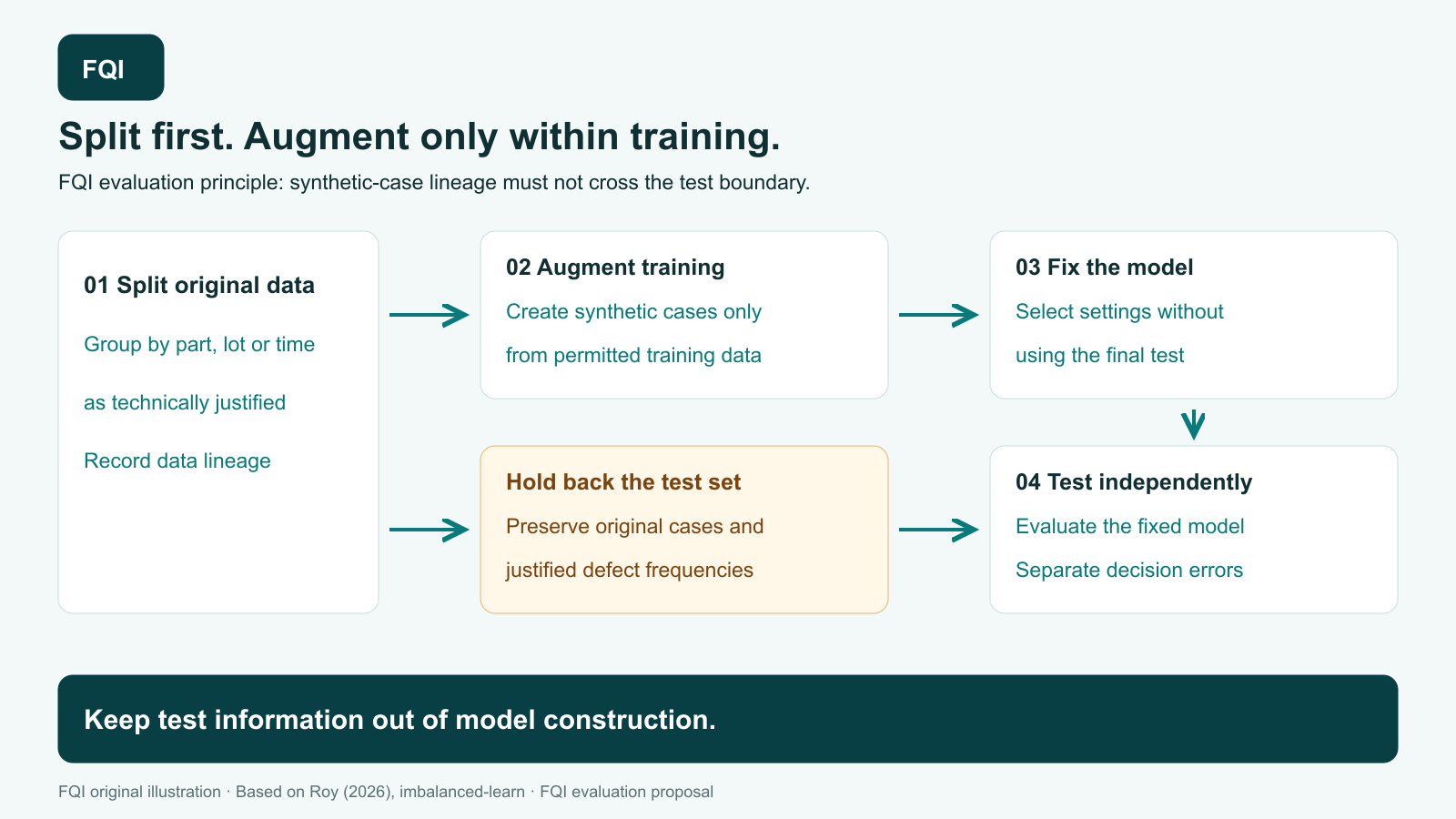
- Control the order: Split the data first, then supplement rare cases exclusively within training.
- Preserve operational relevance: The final test needs realistic defect frequencies; targeted stress tests are reported separately.
The principle at a glance
Artificial intelligence (AI) can learn from labelled examples which parts are suspicious. Rare defects are often poorly represented. SMOTE, the Synthetic Minority Over-sampling Technique, supplements the minority class by constructing intermediate values from existing examples. Its training points therefore depend on relationships between source records.
Those relationships must remain inside the training boundary. The imbalanced-learn documentation distinguishes two consequences of resampling before splitting: information from later test cases can influence model construction, and the test can acquire an artificial class distribution. Separate file lists are therefore insufficient evidence of independence.
Terms explained
- Data leakage: Information influences model construction even though it should have been reserved for independent evaluation.
- SMOTE: A method that creates additional training points from neighbouring examples of the less frequent class.
- Class distribution: The proportions of case groups, such as acceptable parts and different defect types, in a dataset.
Deep dive
In the preprint, Soumyadeep Roy examines a widely used customer churn dataset. The study compares different orders of data splitting, scaling and minority-class resampling. It also considers redundant inputs, the reliability of predicted probabilities and cost-dependent decision thresholds.
Author code is available. This FQI interpretation uses only the traceable data-splitting problem; customer retention and manufacturing inspection remain different applications.
FQI proposes a bounded acceptance exercise for a part-inspection model. First, the team defines the evaluation unit: a part, production lot or another technically justified group. Multiple images of the same part must not silently bridge the split.
Whether separation by lot, machine or time is also necessary depends on the intended use. The decision belongs in the evaluation plan.
Next, the independent test set is fixed. A data log records identifiers, group membership and the purpose of each set. When synthetic examples are created, their source identifiers and the method version are retained.
The central check is that no synthetic training point derives from a held-out test case. If its lineage is missing, independence has not been demonstrated for that version.
A simplified FQI example illustrates the issue. Two similarly damaged parts provide the starting records for a synthetic training example. If one is later assigned to the independent test set, the files are different but their information origins are connected.
The evaluation plan must detect this connection. This is an illustration, not an experimental result from the preprint.
Settings and decision thresholds must also be selected separately from the final test. For repeated internal comparisons, data preparation is fitted only to the permitted training portion each time. Once the selection is complete, the fixed final test is run under the agreed plan. FQI recommends recording unintended reuse as a deviation and reassessing the affected performance evidence.
The results record separates missed defects, unnecessary rejections and their underlying case counts. An additional test containing many rare defects can deliberately probe limits. It does not replace evaluation under a distribution justified for the intended use. Acceptance thus connects data lineage, test conditions and tolerated decision errors.
Limitations and risks
The preprint is not independently confirmed industrial validation. Its aggregate effect statement and separately reported SMOTE comparison use different aggregations; no single percentage-point figure is adopted here. The available code was not executed. Economic savings and general recommendations for probability calibration are also excluded.
The independent software documentation supports the separation principle, but confirms no metric from this study. Even correctly separated data do not establish sufficient coverage of new materials, machine conditions or defect types.
FQI conclusion
The origins of synthetic training cases belong in the evidence supporting a credible model test. FQI recommends a verifiable data flow from each source case to evaluation. The essentials are a technically justified split, traceable derivations and a test set that retains its intended meaning.
A useful next step is to examine an existing model project for these relationships. If overlaps are found, new performance evidence is needed; simply removing duplicate filenames is insufficient.
Sources & transparency
- Soumyadeep Roy: The Hidden Costs of 99% Accuracy, preprint; methods, result tables and limitations reviewed in the HTML full text.
- imbalanced-learn: Common pitfalls and recommended practices, independent first-party technical documentation on data splitting.
- Author repository, accessible supporting material; no independent reproduction performed.
The evaluation plan and part example are FQI interpretations. Prepared with AI assistance. Publication authorized by Johann Fischer on 3 October 2026. The feed announced the paper on 3 October, while the original page reports submission on 9 September 2026. The date discrepancy remains unresolved.