
Executive summary
A measurement can be formally correct yet unusable for the current decision because it is too old. SafeStep demonstrates this with pedestrian monitoring: the system transmits compact position and risk information under variable noise, code length and deliberately selected information age. Task loss rises as delay grows. FQI derives a broader verification principle: data freshness belongs in every time-critical artificial intelligence (AI) or sensor-system test plan as a measurable quality characteristic with a limit, runtime monitoring and a safe response.
FQI takeaway
- Time context is part of the measurement: value, source and timestamp must be assessed together.
- Freshness limits need empirical qualification: permitted information age depends on process dynamics, risk and response time.
- Stale data needs a safe response: warning, replacement measurement or controlled stop is better than apparently current precision.
The principle at a glance
SafeStep processes four live camera feeds, detects pedestrians and transmits a compact movement history through an emulated noisy wireless channel. Users can change signal-to-noise ratio, code length and age of information (AoI), meaning the age of the state represented by the available data. The receiver reconstructs positions, trajectories and risk labels. This makes technical transmission quality and operational freshness visible as two different quality dimensions.
The National Institute of Standards and Technology (NIST), the US standards institute, calls for artificial intelligence (AI) to be tested under deployment-like conditions, monitored in operation and assessed against response times. Information age turns this requirement into a concrete data-quality characteristic.
Terms explained
- Age of information: time elapsed since the state represented by the currently used data.
- SNR: signal-to-noise ratio; the relationship between useful signal and disturbance.
- Semantic communication: transmitting information needed for a task instead of every raw-data bit.
- TEVV: test, evaluation, verification and validation; structured assessment of a system and its intended use.
- AI: artificial intelligence; systems that infer patterns from data or automate parts of a task.
- NIST: National Institute of Standards and Technology, the US standards institute.
Deep dive
The platform processes position records at short intervals and presents four live camera sources. Its Meta-VIB model has 4.16 million parameters and handles different noise levels, code lengths and information ages with one neural network. Against five baselines, the paper reports mean task-loss reductions of up to 92.1 percent, depending on the condition. This is the best result across baseline–condition pairs, not a universal accuracy gain.
The load test exposes another side of freshness. On one high-end graphics processor, the complete application maintains five frames per second through 20 concurrent users. At 100 users there are no failed requests and mean response time remains below one second, yet the mean frame rate for each browser falls to about one frame per second. A system can remain technically available while becoming operationally too slow.
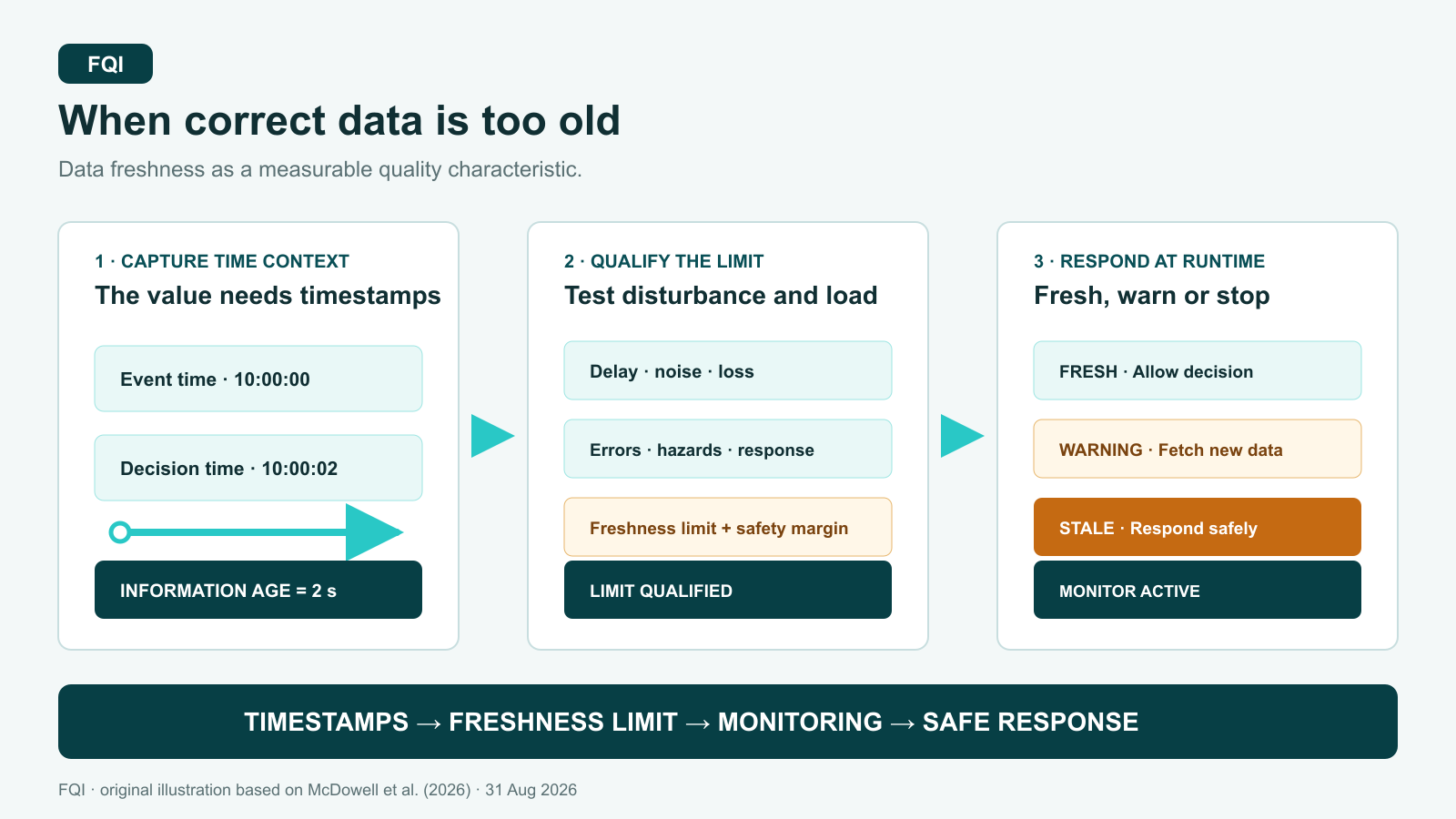
An FQI pilot starts with process dynamics. For every decision, the team establishes how quickly the object can change materially, how long sensing, transmission, processing and human response may take, and what a late decision could cause. Every data record receives at least event time, acquisition time, processing time, model version and decision time. Information age and end-to-end latency are calculated separately.
Qualification uses real or professionally representative movement and disturbance scenarios. Delay, loss, noise and workload are varied systematically. False alarms, missed hazards, position error and response time are measured at every level. The permitted limit is not the point at which the application still responds; it is the point at which specified decision performance remains intact with a safety margin.
During operation, a freshness monitor continuously checks time context. Data beyond the limit is not silently reused. Depending on risk, the response can range from labelling through fallback to local sensing to a safe stop. Changes to cameras, networks, buffering, models or user load trigger renewed end-to-end assessment.
Limitations and risks
SafeStep is a demonstrator, not a validated pedestrian-protection system. The wireless channel is an idealised noise emulation. Reference positions come from automated object detection and are not manually labelled, so misses or poor localisation can arise before transmission. Risk zones are fixed and images come from one intersection. Task loss combines position and classification error but is not a severity-weighted safety measure. The load result also belongs to one server and architecture. The transferable finding is the test principle, not the peak number.
FQI conclusion
Data quality does not end with completeness and accuracy. In dynamic processes, time context determines whether a correct value still matches the current situation. SafeStep makes this often-hidden failure mode measurable. Quality practitioners can build a clear chain: define information age, qualify it under disturbance and load, monitor it during operation, and react in a controlled manner when limits are exceeded. “Real time” then becomes a verifiable process requirement rather than a marketing phrase.
Sources & transparency
- McDowell et al.: SafeStep – An Interactive Demonstration of Semantic Communication for Pedestrian Safety Monitoring, arXiv:2608.27688v1, submitted 27 August 2026.
- National Institute of Standards and Technology (NIST): AI RMF Core – Measure. The transfer to freshness limits, test plans and safe responses is FQI editorial interpretation.
- Evidence status: controlled demonstrator without independent safety field validation. This draft was prepared with AI support; human subject-matter and source approval are still pending.