
Executive summary
An open-access review in Measurement: Sensors describes the shift in dimensional metrology from isolated post-process inspection to integrated, intelligent measurement in cyber-physical production environments. The focus is not only on sensors or automated measuring machines, but also on standards and information models such as STEP AP242, QIF, STEP-NC and OPC UA, which can connect design, manufacturing and quality assurance. For FQI, the key issue is the closed quality control loop: only when requirements, inspection planning, measurement, statistical evaluation and process response share consistent semantics does the system become more than a digital dashboard.
FQI takeaway
- Smart metrology is primarily an integration challenge: the largest leverage comes from a continuous data and semantic structure across engineering, manufacturing and quality, not from one measuring device.
- SPC becomes more valuable when measurements carry context: characteristic, tolerance, process, machine, product revision and history must be linked unambiguously.
- The digital thread can accelerate reaction only when semantics are controlled: interfaces alone are insufficient; units, characteristic identities, revisions and release states must remain consistent.
The principle at a glance
The review frames smart metrology as the interaction of measurement technology, automation, software integration, data models and AI. Standardised information models are intended to connect product definition, manufacturing information and quality assurance. STEP AP242, QIF, STEP-NC and OPC UA are among the standards discussed.
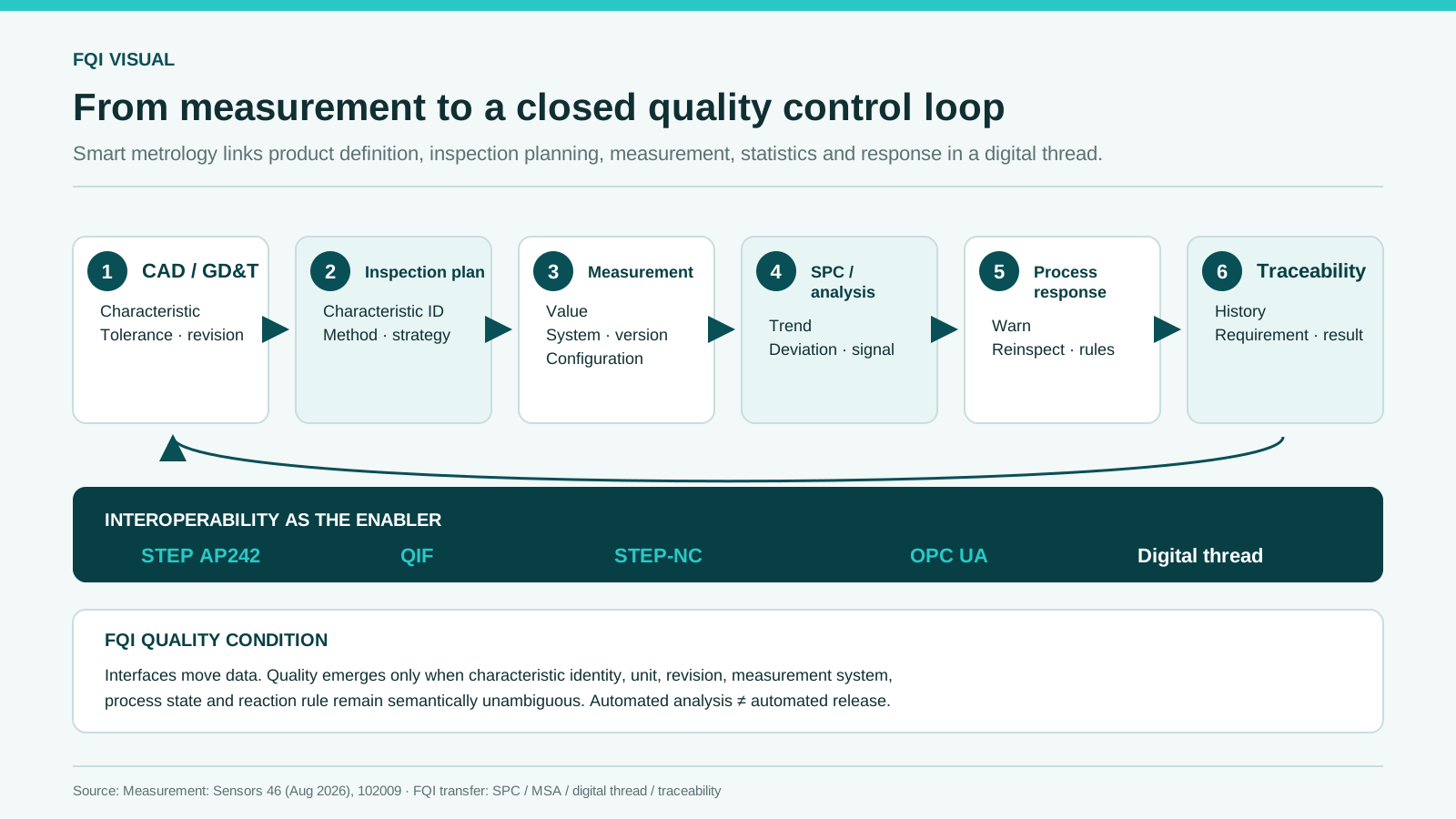
From an FQI perspective, this can be translated into a quality loop: CAD/GD&T → inspection planning → measurement → SPC/analysis → process feedback → history and traceability.
Terms explained
- AI: Artificial intelligence; systems that derive patterns from data or support tasks automatically.
- digital thread: An end-to-end digital information chain spanning design, production, inspection and use.
- SPC: Statistical Process Control; monitoring and controlling processes with statistical methods.
- MSA: Measurement System Analysis; checking whether a measurement system is fit for its intended decision.
- QIF: Quality Information Framework; an open data model for digital quality and metrology information.
- STEP AP242: STEP AP242 and STEP-NC are standards for structured exchange of product and manufacturing data.
- OPC UA: Open Platform Communications Unified Architecture; a standard for secure, vendor-neutral industrial data exchange.
- CAD: Computer-aided design; digital creation and management of design data.
Deep dive
In many production environments, metrology is already highly automated while the information flow remains fragmented. A characteristic may be defined in CAD, named differently in the inspection plan, identified by a local number on the measuring machine and mapped again in the SPC system. For scalable automation, these implicit mappings become a risk: systems can exchange data without reliably knowing whether they refer to the same characteristic.
The review addresses this gap across tactile, optical and hybrid methods and across technical, syntactic, semantic and organisational layers of integration. Standards such as STEP AP242, QIF, STEP-NC and OPC UA represent different parts of this information chain. The review presents them as building blocks for an interoperable digital thread with lifecycle traceability.
For quality management, a continuous link from requirement to measurement can reduce manual transfers and mapping errors. Inspection plans can be derived more directly from the product definition. Measurement results can be associated automatically with the correct characteristic, part revision and process step. SPC then receives not just numerical series, but contextualised measurements.
This context is particularly important for SPC. A control chart is only as valid as the assignment of its data to a controlled process. If different revisions, machine states or characteristic definitions are mixed, a statistically correct chart can still be professionally wrong. Smart metrology can reduce this risk when identities, revisions and metadata are maintained consistently. Master-data and change-management requirements increase accordingly.
When a trend is detected early, the system can trigger a defined response: warning, additional inspection, parameter correction or process stop. Quality management must clearly distinguish between automated analysis and automated decision-making. Not every statistical signal justifies an autonomous process change. Reaction plans, permitted adjustment ranges and release limits remain necessary.
MSA also remains relevant. A perfectly integrated digital thread does not improve an incapable measurement system. Repeatability, reproducibility, resolution, bias and stability still need to fit the inspection purpose. Smart metrology extends this classical measurement-system control with digital aspects: data integrity, timing, synchronisation, revision status and unambiguous characteristic mapping.
Traceability therefore becomes more demanding. It is not sufficient to retain measurements. A useful trace should answer which characteristic, according to which specification, was evaluated by which measurement system under which configuration and at which process state. Only then can later root-cause analysis use the data reliably.
Limitations and risks
The review describes a technological and conceptual development state. It does not establish that the complete end-to-end architecture is currently economical or technically practical in every factory. Standards also do not automatically resolve semantic conflicts between legacy systems. High integration effort, inconsistent master data and proprietary extensions can limit benefits. Automated feedback further increases the criticality of measurement and data errors: an incorrect value may then not only be recorded incorrectly but may directly trigger an inappropriate process reaction.
FQI conclusion
Smart metrology becomes relevant to quality management when metrology evolves from an isolated inspection point into a digital control loop. The central value is not more sensing technology, but the reliable connection of requirement, measurement, statistics, response and history. QIF, STEP AP242, STEP-NC and OPC UA can provide technical building blocks. The quality task remains classical: ensure measurement capability, control data context, define reaction rules and manage change. Digitalisation amplifies a good control loop — or a bad one.
Sources & transparency
- A review of smart metrology in industry 4.0 - 5.0: Standards, interoperability, and automation, Measurement: Sensors, Volume 46, August 2026, article 102009, open access.
- The review discusses STEP AP242, QIF, STEP-NC and OPC UA as information models or standards linking design, manufacturing and quality assurance within an interoperable digital thread.
- The representation as a closed quality loop and the transfer to SPC, MSA, reaction plans and traceability are FQI assessments.
- This article was researched and drafted with AI support. Sources and professional transfers were reviewed; explicit human approval for publication was documented on 15 August 2026.
- Approval status: First-use explanations and the glossary were reviewed by a human and approved for publication on 17 August 2026. Approved by: Johann Fischer.