
Executive summary
Unilever and Accenture announced in June 2026 that they intend to build more than 40 AI-enabled digital twins across the manufacturing network within 18 months. The companies report 20% less waste and 10% more capacity at one site, almost 30% less waste with more stable viscosity in another application, and 30% fewer quality defects over four years in soap production. These are company-reported figures from a joint press release; definitions, comparison periods and statistical assurance are not fully disclosed.
FQI takeaway
- A digital twin is more than a dashboard: it connects the physical process to simulation, prediction and controlled feedback.
- Model quality does not replace process control: sensors, data quality, the system boundary and the response plan determine the quality benefit.
- Autonomy must be released in stages: advice, confirmed adjustment and automatic intervention require different levels of evidence.
The principle at a glance
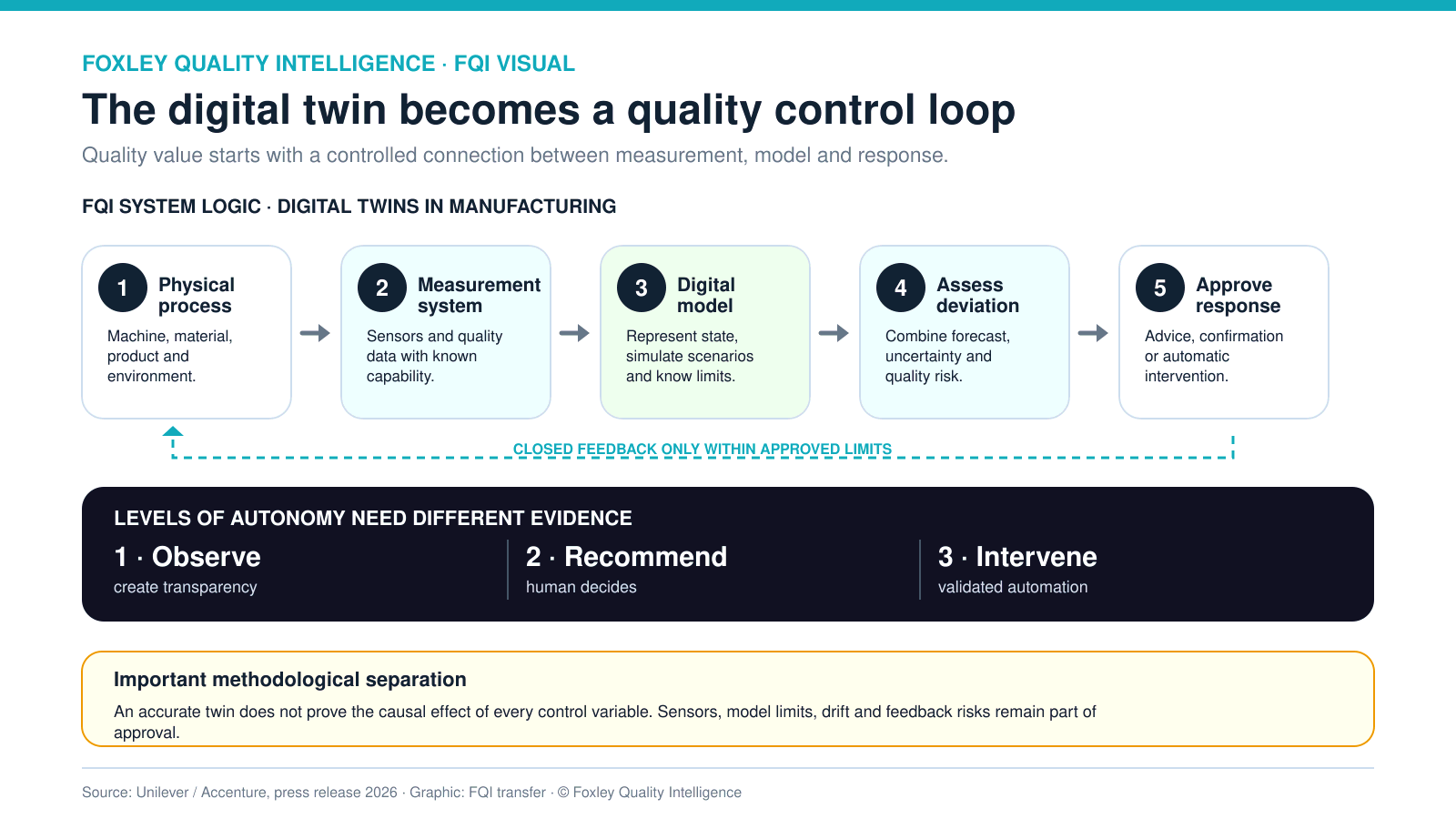
A digital twin is a continuously updated representation of a physical product, asset or process. Its quality value does not come from visual resemblance, but from capturing real states, predicting deviations, simulating options and triggering a controlled response. This makes it an extended quality control loop.
The loop starts with measurement. Sensor readings, laboratory values, inspection characteristics, recipes and process parameters must be time-synchronised, linked to the correct lot or product and suitable for the intended decision. Incorrect timestamps, sensor drift or missing material genealogy can make a model appear precise while its inputs are wrong. Measurement System Analysis and explicit data-quality rules remain essential.
Terms explained
- AI: Artificial intelligence; systems that derive patterns from data or support tasks automatically.
- shadow mode: A test phase in which a system runs alongside operations but does not trigger automatic decisions.
- SPC: Statistical Process Control; monitoring and controlling processes with statistical methods.
Deep dive
The second layer is the model. A digital twin may combine physical equations, data-driven models and hybrid approaches. For quality-related decisions, the validated operating window must be known. A viscosity model for one recipe is not automatically valid for other materials, equipment or ambient conditions. Its system boundary and authorised use should be documented with the same discipline applied to inspection equipment.
The third layer is the response. A twin may first inform, then recommend a set-point change, and later make a limited adjustment automatically. These stages have different risk. A human can reject an incorrect recommendation; an autonomous intervention immediately changes the process and potentially the product. Approval criteria should therefore specify permitted parameters, maximum rate of change, plausibility checks, fallback values and a safe state.
From an SPC perspective, a twin does not replace stability analysis. It can account for more variables and predict future development, but classical statistical rules remain an independent protection layer. If the process becomes unstable, the AI must not merely chase an optimum and hide a special cause.
Effectiveness also needs both technical and economic measures. Scrap, defect rate, variation, complaints and process capability should be separated from false alarms, unjustified interventions, model error, human overrides and response time. A sensible introduction begins in shadow mode: the twin predicts and recommends but does not act. Its advice is compared with real outcomes and expert decisions, followed by assisted operation with mandatory confirmation. Only after demonstrated stability should a narrowly defined automatic adjustment be released.
Limitations and risks
The performance figures are not independent study results. The release does not provide complete baselines, definitions or uncertainty ranges, and results from one process do not transfer automatically to another. Models can drift as materials, recipes, equipment or sensors change. Increasing autonomy also creates feedback risk: a model may optimise the signal it observes while degrading a quality characteristic outside its system boundary.
FQI conclusion
The relevant question is not whether a digital twin looks like the factory. It is whether measurement, model, decision and response form an auditable and controlled loop. Quality-capable deployment starts with reliable data and a documented operating window, progresses through shadow and assisted modes, and grants autonomy only where effectiveness and safe fallback have been demonstrated.
Sources & transparency
- Unilever: Unilever scales digital twins across global manufacturing network with Accenture, 16 June 2026.
- Evidence status: joint corporate press release; reported improvements are not an independently validated general effectiveness claim. The control-loop architecture and staged approval are FQI interpretations.
- This article and its original visualisation were created with AI support, professionally reviewed and explicitly approved for publication on 10 August 2026.
- Approval status: First-use explanations and the glossary were reviewed by a human and approved for publication on 17 August 2026. Approved by: Johann Fischer.