
Executive summary
Terminology note: AI – Artificial intelligence; systems that identify patterns in data or support tasks automatically. · SPC – Statistical Process Control; monitoring and controlling processes with statistical methods. · MSA – Measurement System Analysis; checking whether a measurement system is suitable for the intended decision. · CTQ – Critical to Quality; a characteristic that is essential to customer requirements or process quality. · PFMEA – Process Failure Mode and Effects Analysis; a preventive method for evaluating manufacturing risks.
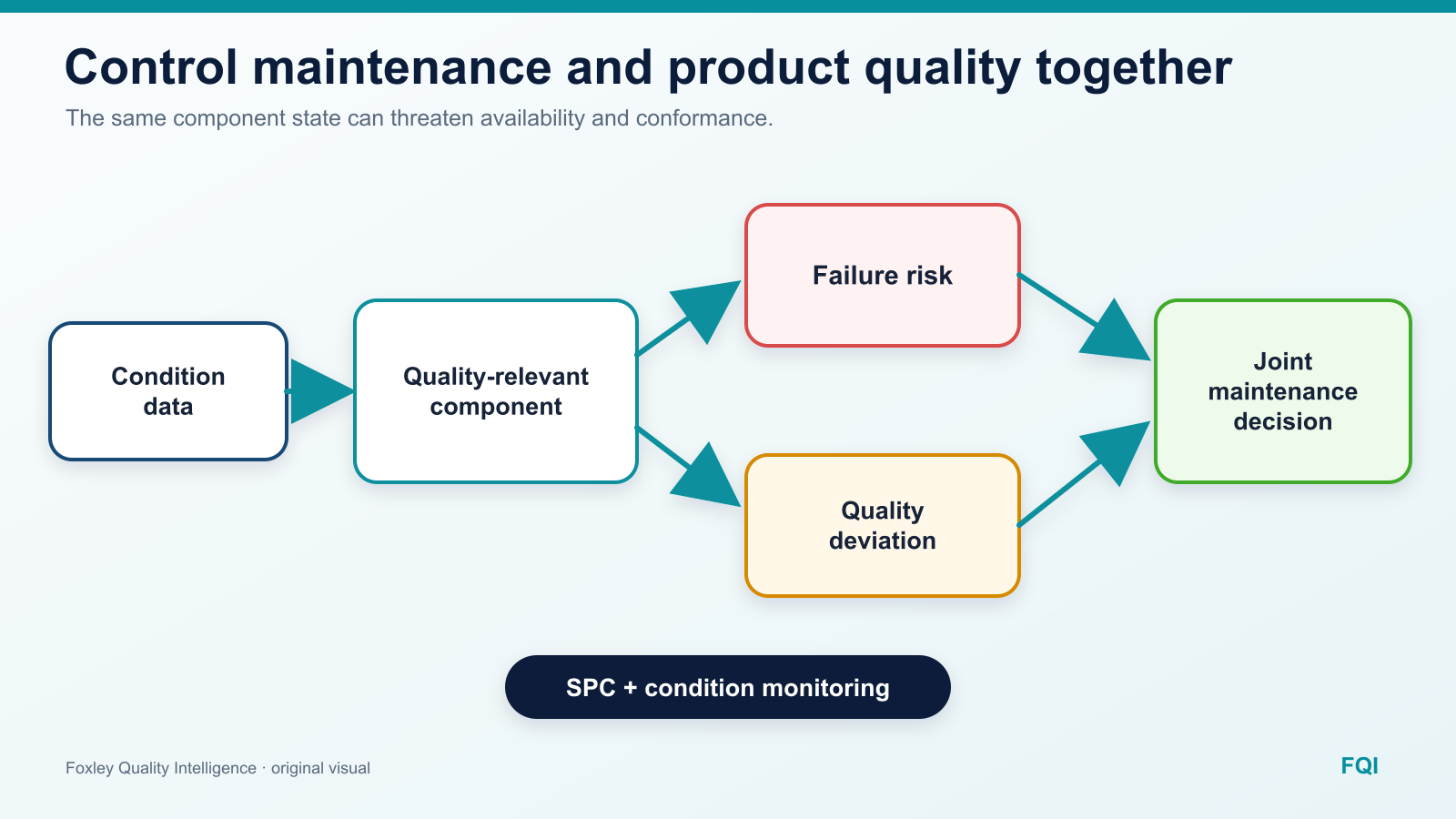
A paper in Reliability Engineering & System Safety connects condition-based maintenance with product-quality control. In the model, quality-relevant components deteriorate under external shocks, while gradual degradation and sudden failure compete. The machine condition therefore affects not only availability but also the deviation of a quality characteristic. The model is validated using a ball-screw manufacturing process. The main practical lesson is clear: maintenance thresholds should account for quality loss instead of responding only when downtime becomes likely.
FQI takeaway
- Availability and quality can share the same causes: A machine may continue running even though wear is already increasing scrap, rework or process variation.
- Condition data need a CTQ link: Sensor readings become relevant to quality only when their relationship with measurable product characteristics has been demonstrated reliably.
- Use joint thresholds instead of data silos: Maintenance, production and quality should decide together using failure risk, quality loss and process capability.
The principle at a glance
Source facts
Zhang and colleagues model quality-related components with two competing failure modes: degradation-related failure and sudden failure. External shocks can increase both the degradation increment and the failure rate. At the same time, the model establishes a quantitative relationship between component condition and product-quality deviation. This creates a joint condition-based maintenance and quality-control policy, which the authors extend to imperfect maintenance and multiple quality-relevant components.
FQI interpretation
The operational question changes from “When will the machine fail?” to “At what condition does either failure risk or quality loss become unacceptable?” This second threshold connects condition monitoring with SPC, process capability and Cost of Poor Quality.
Terms explained briefly
- AI: Artificial intelligence; systems that identify patterns in data or support tasks automatically.
- SPC: Statistical Process Control; monitoring and controlling processes with statistical methods.
- MSA: Measurement System Analysis; checking whether a measurement system is suitable for the intended decision.
- CTQ: Critical to Quality; a characteristic that is essential to customer requirements or process quality.
- PFMEA: Process Failure Mode and Effects Analysis; a preventive method for evaluating manufacturing risks.
Deep dive
What the study actually examines
Traditional maintenance models often optimise reliability and maintenance cost. Product quality is usually handled separately through inspection or SPC. This study links both perspectives mathematically: the condition of a quality-relevant component influences the probability that the machine continues operating and the deviation of a product characteristic.
A ball-screw process is used to test the model. This is a methodological demonstration under defined assumptions. The abstract does not report a universal, measured reduction in scrap across industrial plants. The work should therefore not be read as a finished predictive-maintenance product or a universal business case.
FQI transfer to practice
A pilot starts with a PFMEA-based selection: Which machine components can shift a CTQ before a conventional failure alarm is triggered? Condition variables such as vibration, temperature, force, current or tool condition are then linked over time with product characteristics and process parameters. Without a qualified MSA for the sensors and quality measurements, any correlation remains uncertain.
The analysis should distinguish three relationships: correlation between condition and CTQ, a plausible cause-and-effect chain, and stability across product variants, shifts and environmental conditions. Only after these relationships are reliable should teams define joint warning and intervention limits. A warning may be justified while failure probability is still low if a CTQ is moving systematically towards its specification limit or process variation is increasing.
Effectiveness must be assessed with more than unplanned downtime. Relevant measures include scrap, rework, Cpk/Ppk, quality-loss cost, false alarms, missed events and maintenance effort. After an intervention, the team must verify that the product characteristic has stabilised as well as the machine condition. This turns maintenance into part of process control.
Limitations and risks
- Model dependency: Results depend on assumptions about degradation, external shocks and the relationship between condition and quality.
- Case-study limitation: A ball-screw process does not prove that the method transfers directly to other machines or CTQs.
- Spurious correlation: Product mix, material batch or environmental conditions may affect machine condition and quality at the same time without the machine being the cause.
- Measurement-system risk: Drifting sensors or unsuitable quality measurements can lead to incorrect maintenance decisions.
- Local optimisation: Intervening too early can increase cost and downtime; intervening too late can increase quality loss and customer complaints.
FQI conclusion
The strongest idea in the study is simple: machine health is not limited to availability. Quality management must also identify the condition at which a machine still runs but no longer produces good parts reliably. A practical control loop therefore links condition data, CTQs, SPC, MSA and maintenance. The research approach is not yet a universal recipe, but it provides a clear pilot logic: identify quality-relevant components, validate cause and effect, and control failure and quality risks together.
Sources & transparency
- Zhang, Ji; Liu, Xia; Chen, Xiaohui; Zhao, Xufeng; Zhang, Lin; Feng, Xiaoning: Joint optimization of condition-based maintenance and product quality improvement for deteriorating manufacturing systems in a random environment, Reliability Engineering & System Safety, volume 272, part 3, article 112626, August 2026, DOI: 10.1016/j.ress.2026.112626.
- The model structure and case study are source facts. The pilot design, CTQ linkage, MSA/SPC integration and suggested measures are FQI interpretations.
- This article was researched and drafted with AI assistance. The abstract, bibliographic primary source and technical interpretations were checked on 14 August 2026. The explicit human approval for this English translation is still pending. Factual statements are limited to the publicly available source information and make no additional claims based on full text that was not reviewed.
- Approval status: First-use explanations and the glossary were reviewed by a human and approved for publication on 17 August 2026. Approved by: Johann Fischer.