
Executive summary
Current quality publications describe hybrid strategies combining Statistical Process Control and machine learning as an important 2026 trend. The concept is technically sound when roles remain clear: SPC assesses stability and special causes, while AI processes complex interactions and predicts risk. The industry article is not a controlled effectiveness study, and the academic source examines industry perceptions and adoption conditions rather than proving a general causal benefit.
FQI takeaway
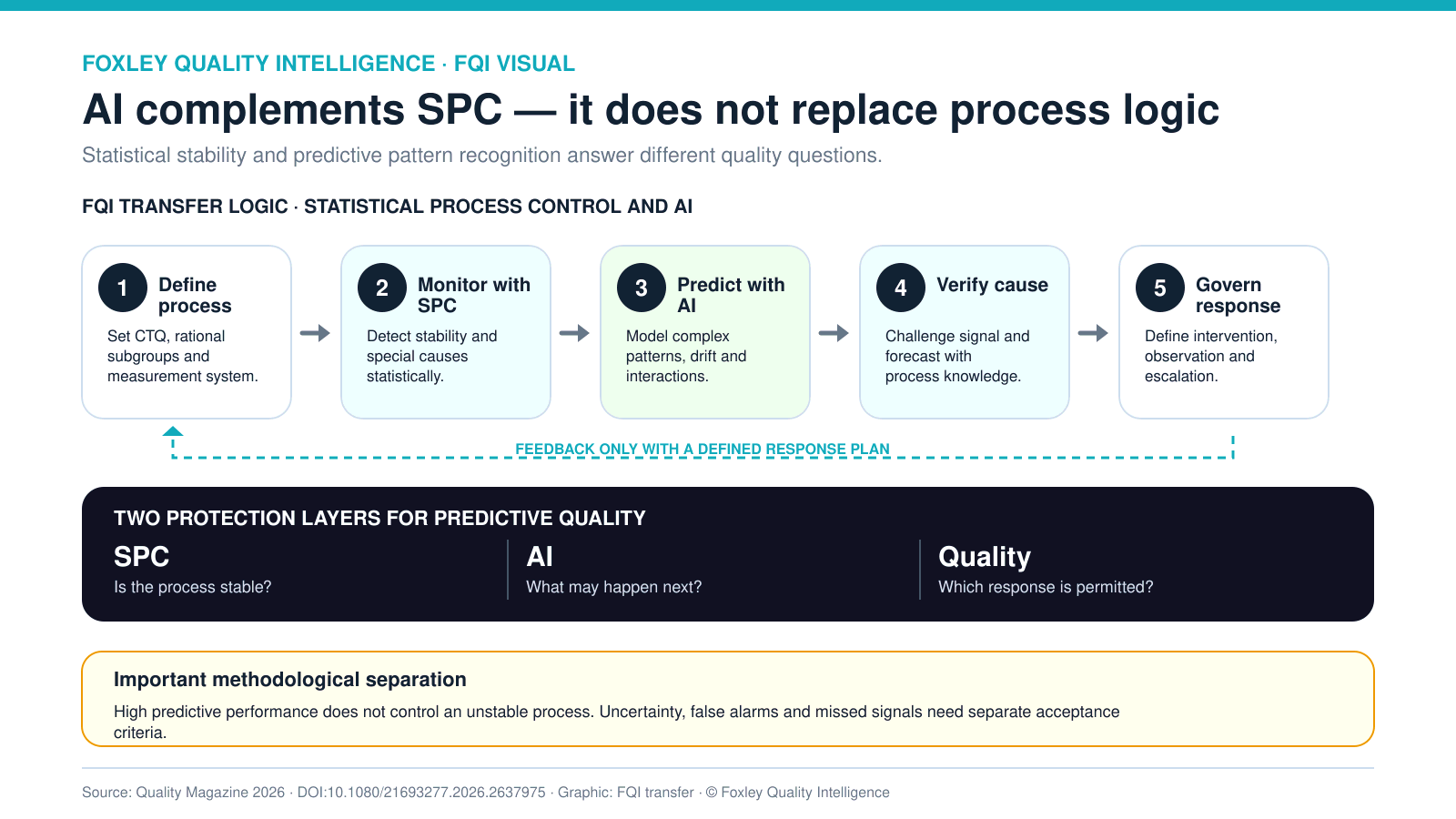
- SPC and AI answer different questions: stability evidence and pattern prediction are complementary, not interchangeable.
- An unstable process remains unstable: a good forecast does not remove unknown special causes.
- Predictive quality needs two protection layers: statistical monitoring plus a validated prediction with uncertainty and a response plan.
The principle at a glance
SPC determines whether a process operates under statistical control. Control charts distinguish expected common-cause variation from signals of special causes. The logic is transparent and robust, but conventional univariate charts may struggle with high-dimensional, nonlinear or delayed interactions. Machine learning can add value in precisely those situations.
A predictive model can combine process parameters, environmental data, material lots and historical quality outcomes to estimate whether a CTQ is likely to become critical. This moves the intervention point forward: a calibrated risk signal may trigger preventive inspection before a present control-rule violation occurs.
Terms explained
- AI: Artificial intelligence; systems that derive patterns from data or support tasks automatically.
- QMS: Quality management system; the controlled organisation of responsibilities, processes and evidence.
- CTQ: Critical to Quality; a characteristic that is decisive for customer requirements or process quality.
- SPC: Statistical Process Control; monitoring and controlling processes with statistical methods.
- COPQ: Cost of poor quality; costs caused by defects, scrap, rework, complaints and their handling.
Deep dive
The connection must not reduce SPC to a decorative dashboard. If a model is trained on an unstable process, it may learn to predict changing special causes without eliminating them. The system then appears capable while the process remains uncontrolled. Sustainable quality requires cause removal before compensation.
A second trap is confusing control limits with specification limits. Control limits come from process behaviour; specification limits come from requirements. A process can be stable yet incapable, or unstable while current parts remain within specification. AI outputs should therefore distinguish whether they predict process drift, future nonconformity or both.
A sensible architecture has two layers. The SPC layer monitors defined characteristics with auditable rules. The AI layer calculates additional risk signals from multivariate data. A response plan specifies what each combination means. An AI early warning without an SPC signal may lead to increased sampling. A combined warning may trigger containment and root-cause analysis. If the layers disagree, the case should be escalated rather than automatically resolved.
Model validation needs more than accuracy or mean error. Relevant measures include warning lead time, calibration of predicted probabilities, false-alarm cost, missed deviations, stability across material and equipment changes, and explicit uncertainty. High uncertainty can itself be a quality signal requiring a conservative response.
A clean pilot separates retrospective development from prospective evidence. Historical data is used for development, followed by a fixed shadow period in which predictions are logged but not acted upon. Only after timeliness and actionability have been demonstrated should defined responses be activated. Economic value should be measured through scrap, COPQ, process capability and intervention cost—not the number of alerts generated.
Limitations and risks
“AI-powered SPC” is not a standardised method and may describe anything from a simple trend forecast to a complex multivariate model. Spurious correlations can produce incorrect interventions, additional complexity raises training and validation effort, and automation bias may cause operators either to over-trust AI warnings or to ignore them after repeated false alarms.
FQI conclusion
AI does not make SPC obsolete. It extends quality monitoring with multivariate pattern recognition and forecasting, while SPC provides transparent stability logic and an independent protection layer. Predictive quality emerges from this division of labour: a controlled process, a validated prediction, explicit uncertainty and a graduated response plan.
Sources & transparency
- Quality Magazine: Top QMS Trends for 2026: AI, eQMS, Predictive Quality & Industry 4.0, 8 April 2026.
- Mayer et al.: Industry perception of machine learning-enhanced statistical process control, 2026. The two-layer architecture and response logic are FQI interpretations.
- This article and its original visualisation were created with AI support, professionally reviewed and explicitly approved for publication on 10 August 2026.
- Approval status: First-use explanations and the glossary were reviewed by a human and approved for publication on 17 August 2026. Approved by: Johann Fischer.