
Executive summary
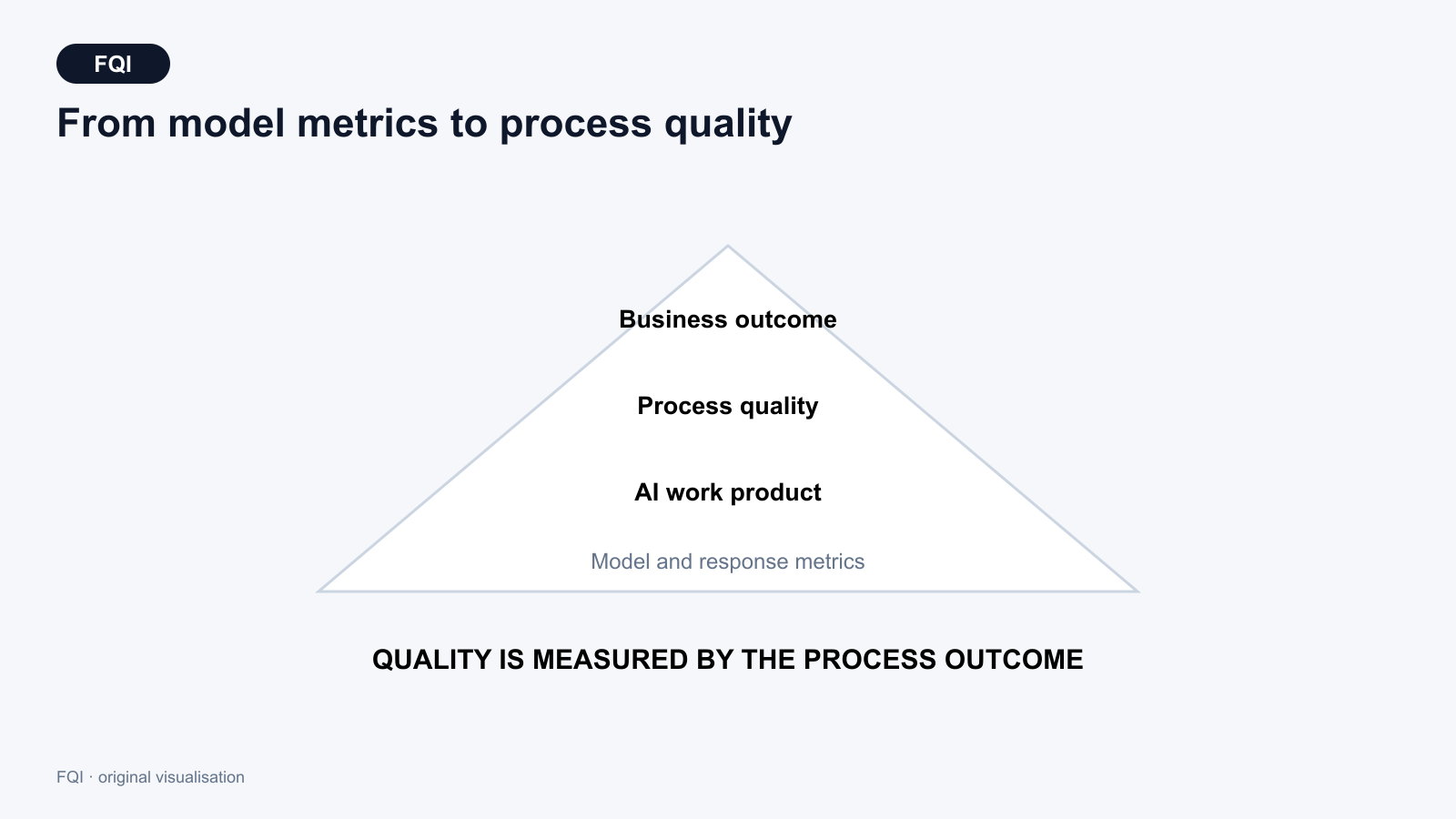
A recent OpenAI analysis describes a shift from information search towards active task completion. In professional contexts, ChatGPT is reportedly used more than twice as often for creating or completing tasks as it is outside work. This changes the measurement logic for quality management: the linguistic response is not the product. The product is the outcome of the downstream business process, including errors, rework and release risk.
FQI takeaway
- Usage is not a quality metric: Large numbers of generated texts or automated steps say nothing about process capability or failure costs.
- End-to-end outcomes must be measured: Relevant metrics include defect escape, rework, lead time, escalation and effectiveness.
- artificial intelligence (AI) needs a process owner: Model selection cannot replace a Control Plan, release rule or Corrective and Preventive Action (CAPA) feedback loop.
The principle at a glance
OpenAI published the analysis “From asking to doing” on 6 August 2026. The data comes from individually managed Free, Go, Plus and Pro accounts, not organisation-managed Enterprise environments. Categorising messages by type of use follows the provider’s own methodology. The source is therefore relevant to usage trends, but commercially interested and not independent evidence of the quality, productivity or economic value of the resulting work products.
Terms explained
- AI: Artificial intelligence; systems that derive patterns from data or support tasks automatically.
- CAPA: Corrective and Preventive Action; a structured process for correcting and preventing problems.
- CTQ: Critical to Quality; a characteristic that is decisive for customer requirements or process quality.
- 8D: Eight Disciplines problem-solving method; D1 through D8 structure the team, problem, cause, actions and closure.
- COPQ: Cost of poor quality; costs caused by defects, scrap, rework, complaints and their handling.
- prompt: A task instruction or input for an AI system; it describes the task, rules, context and expected result.
- output token: A technical unit used to process text; a token usually represents a word or word part, not necessarily a complete word.
Deep dive
While AI mainly answers questions, quality is often judged by response characteristics: factual accuracy, relevance, clarity and source support. Once a system creates documents, performs analysis, changes code or triggers process steps, the unit of quality assessment shifts. The output is no longer just text. It becomes an intermediate product in a business process and may initiate real decisions.
The OpenAI analysis reports that professional use is more often oriented towards “doing”, such as writing, coding or analysing. This does not show that these tasks are completed correctly or more productively. It does show why organisations need broader metrics. A high number of generated reports can even be negative when reviewers spend more time making corrections or errors are discovered later in the process.
A suitable measurement system should distinguish several levels. Input metrics describe data quality, source availability and task complexity. Process metrics measure lead time, clarification requests, termination rate, human review time and resource use. Output metrics assess completeness, compliance and error classes in the AI result. Outcome metrics show whether the overall process genuinely improves through less rework, lower failure cost, faster decisions or stronger detection. Risk metrics are also needed, including escape rate, improper releases, privacy events and untraceable changes.
This separation is essential in Six Sigma. The CTQ (critical-to-quality requirement) must relate to the process or customer outcome. Local time savings while drafting a document are not demonstrated process value if review time rises or additional faults appear. The target Y belongs at process or customer level. AI usage, prompt count and token consumption are mainly X factors or activity measures. They may explain causes, but should not be confused with achieving the objective.
One use case is an AI assistant that drafts 8D reports. Measurement could cover the time saved until a version is approved. It should also include technical rejections, mixed problem and cause statements, missing evidence and later customer complaints. The assistant is not successful because it quickly generates text for discipline 4 (D4), but because the approved root-cause analysis becomes more reliable and the overall process more efficient.
A second use case is automated inspection-depth analysis from technical documents. A simple hit rate is insufficient. The decisive outcomes are missed critical characteristics, unnecessary inspection requirements, processing time, human correction effort and the consequences of incorrect classification. For rare, highly critical failures, aggregate accuracy may conceal the actual risk.
Every AI-assisted process also needs a process owner. This role defines purpose, boundaries, acceptance criteria and reaction plans. The model team operates the technology, while the professional function owns the work product. A Control Plan defines which characteristics are checked automatically, when a person decides and which deviations trigger CAPA. AI is thereby controlled as a process component rather than an isolated tool.
A reliable before-and-after comparison also needs a baseline: current processing times, error types, rework rate and review effort without AI. Only comparison across similar case types shows whether automation creates value or merely moves work to a later process stage.
Limitations and risks
First, the underlying analysis comes from the provider itself. Its methodology, classification and selection of trends require critical interpretation.
Second, the dataset covers individual accounts. Organisational use with managed roles, workflows and governance may differ substantially.
Third, usage frequency describes neither quality nor productivity. The FQI transfer to quality metrics is a methodological inference, not a result of the OpenAI analysis.
Fourth, an extensive measurement architecture may outweigh the benefit of small assistance applications. Review depth and the number of metrics should scale with risk.
Fifth, metrics can create harmful incentives. Optimising only for short lead time may increase defect escape. Measurement systems therefore need a balanced set covering quality, time, cost and risk.
FQI conclusion
When AI creates work products, its quality must be measured in the real process. Prompt quality and model scores are prerequisites, not business metrics. What matters is whether the end-to-end process becomes more stable, faster and more economical without moving errors or risks elsewhere. Quality management already has the appropriate instruments: CTQs, process metrics, Control Plans, COPQ, effectiveness reviews and clear process ownership.
Sources & transparency
- OpenAI: From asking to doing: How the world is putting ChatGPT to work, 6 August 2026.
- Source status: provider analysis based on individually managed ChatGPT accounts; not an independent productivity or quality study.
- FQI transfer: The multi-level metrics model and links to Six Sigma, COPQ and Control Plans are professional inferences by FQI.
- “More than twice as often” refers to the provider’s classification of professional and non-professional use.
- This article was researched and written with AI support. Sources and professional transfers were pre-reviewed with AI. Human professional and source approval was documented on 10 August 2026, and the article is approved for publication.
- Approval status: First-use explanations and the glossary were reviewed by a human and approved for publication on 17 August 2026. Approved by: Johann Fischer.