
Executive summary
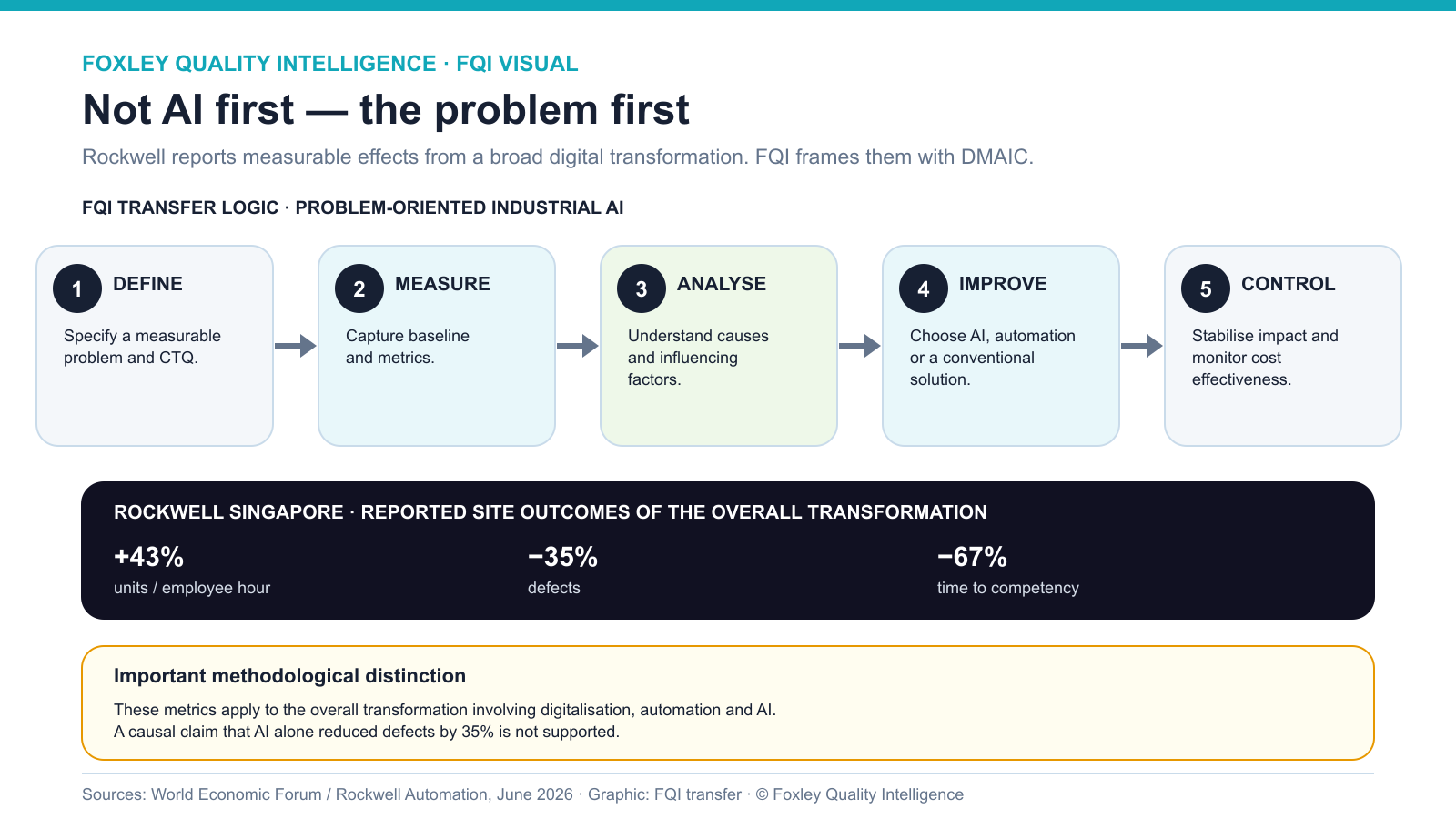
Rockwell’s Singapore plant manufactures more than 1,000 SKUs and handles over 20,000 changeovers per year. According to the World Economic Forum, the site deployed more than 50 digital and AI-enabled solutions. Across this overall transformation, units per person-hour increased by 43%, defects fell by 35%, and time to employee competency decreased by 67%. The key point for FQI is that these figures demonstrate the success of a transformation programme, not the isolated effect of any single AI application.
FQI takeaway
- High mix, low volume is not a disqualifier: High product variety and frequent changeovers increase the need for data-driven support, flexible automation and consistent process knowledge.
- Measurable impact matters more than a technology demo: The published effects concern productivity, quality and qualification—operational outcomes rather than technical performance metrics alone.
- Start with the problem, then select the technology: From an FQI perspective, the case fits a DMAIC logic. This is a professional interpretation, not a claim that Rockwell conducted the programme under Six Sigma.
The principle at a glance
According to the WEF, the plant operated in a demanding high-mix, low-volume environment with challenges involving flexibility, consistent quality and reliance on employees’ tacit knowledge. The site responded with more than 50 digital and AI-enabled solutions, including flexible automation, AI-enabled quality control and intelligent maintenance.
The relevant relationship is therefore not “AI → 35% fewer defects”, but operational problem → coordinated digital transformation → measurable overall effect. This distinction is central when evaluating industrial AI projects.
Terms explained
- AI: Artificial intelligence; systems that derive patterns from data or support tasks automatically.
- first-pass yield: The share of units that pass the process the first time without rework.
- KPI: Key performance indicator; a metric used to assess a process or outcome.
- LLM: Large language model; a model for processing and generating text.
- DMAIC: Define, Measure, Analyse, Improve and Control; a structured Six Sigma improvement cycle.
Deep dive
Why the starting point matters
More than 1,000 different SKUs and over 20,000 annual changeovers place heavy demands on setup, material flow, inspection processes, work instructions and qualification. In such environments, product variety increases both technical complexity and the need for information. The WEF explicitly identifies flexibility, quality consistency and dependence on experiential knowledge as challenges at the site.
Rockwell therefore did not rely on a single algorithm. The site implemented more than 50 digital and AI-enabled solutions. The company’s official announcement mentions intelligent automation, AI-enabled quality control and predictive maintenance, among other applications. Results are reported at site level: +43% units per person-hour, −35% defects and −67% time to competency.
FQI transfer: DMAIC as a framework for AI projects
The following is FQI’s interpretation. The case can be read through a classic improvement framework: Define clarifies the specific process problem, Measure establishes a reliable baseline, Analyse identifies relevant influencing factors, Improve selects the technically and economically appropriate solution, and Control verifies that the improved state remains stable over time.
This sequence prevents a common failure in technology-led initiatives: a company acquires a new LLM, vision platform or analytics tool and only then starts looking for a problem. Quality management should reverse that direction. The starting point might be defect rate, first-pass yield, inspection effort, troubleshooting time, downtime or qualification duration. Only the root-cause analysis can determine whether AI is the right lever at all.
AI thus becomes a possible improvement measure rather than the project objective. An unremarkable solution with lasting, measurable impact may be more valuable than a technically impressive demonstrator that does not materially influence quality, cost or delivery performance.
Limitations and risks
First, the reported improvements cannot be attributed causally to individual AI applications. The WEF and Rockwell describe an overall transformation comprising digitalisation, automation and AI. Second, the percentages are specific to this site and do not establish a general expectation for other plants or processes. Third, the detailed information comes from the WEF and Rockwell themselves and does not replace an independent causal analysis of the improvements. Fourth, a strong focus on KPIs can create harmful incentives when metrics are optimised without process context. Any transfer therefore requires a baseline, a qualified measurement system, process stability and an economic assessment.
FQI conclusion
The Rockwell case does not prove that AI automatically improves quality. It shows how digital technologies can generate industrial value when they are linked to clear process problems and measurable outcomes. The consequence for quality management is remarkably conventional: understand the problem → measure → analyse causes → select suitable technology → sustain the effect. Six Sigma may therefore provide a particularly useful framework for industrial AI projects—even when the best solution does not ultimately involve AI.
Sources & transparency
- World Economic Forum: Rockwell Automation – Singapore – Productivity, Global Lighthouse Network, published 22 June 2026.
- Rockwell Automation: Rockwell Automation Site Named a World Economic Forum Global Lighthouse, published 23 June 2026.
- The DMAIC interpretation, the distinction between technology-led and problem-led approaches, and the resulting recommendations are FQI assessments. This article was created with AI support, professionally reviewed and explicitly approved for publication on 10 August 2026.
- Approval status: First-use explanations and the glossary were reviewed by a human and approved for publication on 17 August 2026. Approved by: Johann Fischer.