
Executive summary
A peer-reviewed study connects three worlds that are often managed separately: DMAIC for structured process improvement, CRISP-DM for data-centred analysis, and AI agents for decision-making, knowledge reasoning and orchestration. Its mapping of 96 publications also identifies a governance gap: none of the data science frameworks examined fully reflects the ISO 9000 principles. The proposed APOF brings these perspectives together under business governance. It is, however, a research framework rather than industrially validated proof of effectiveness.
FQI takeaway
- There is no need to choose between DMAIC and CRISP-DM: DMAIC connects the problem, process impact and control; CRISP-DM structures data understanding, modelling and evaluation.
- AI agents replace neither method nor accountability: Their potential value lies in coordinating analytical tasks, reasoning over distributed knowledge and preparing decisions for qualified review.
- Governance must be part of the architecture: Customer value, roles, approvals, data quality and auditable decision trails belong above the agent system, not in a policy added afterwards.
The principle at a glance
DMAIC starts with the business or quality problem. Define clarifies the objective, customer and CTQs; Measure establishes a reliable baseline; Analyze investigates causes; Improve changes the process; and Control sustains the result. Its logic is process-centred and designed for lasting control.
CRISP-DM structures the path from business understanding through data understanding, preparation and modelling to evaluation and deployment. Its logic is more iterative and data-centred. This is precisely why CRISP-DM complements DMAIC, while not automatically covering DMAIC’s quality and governance responsibilities.
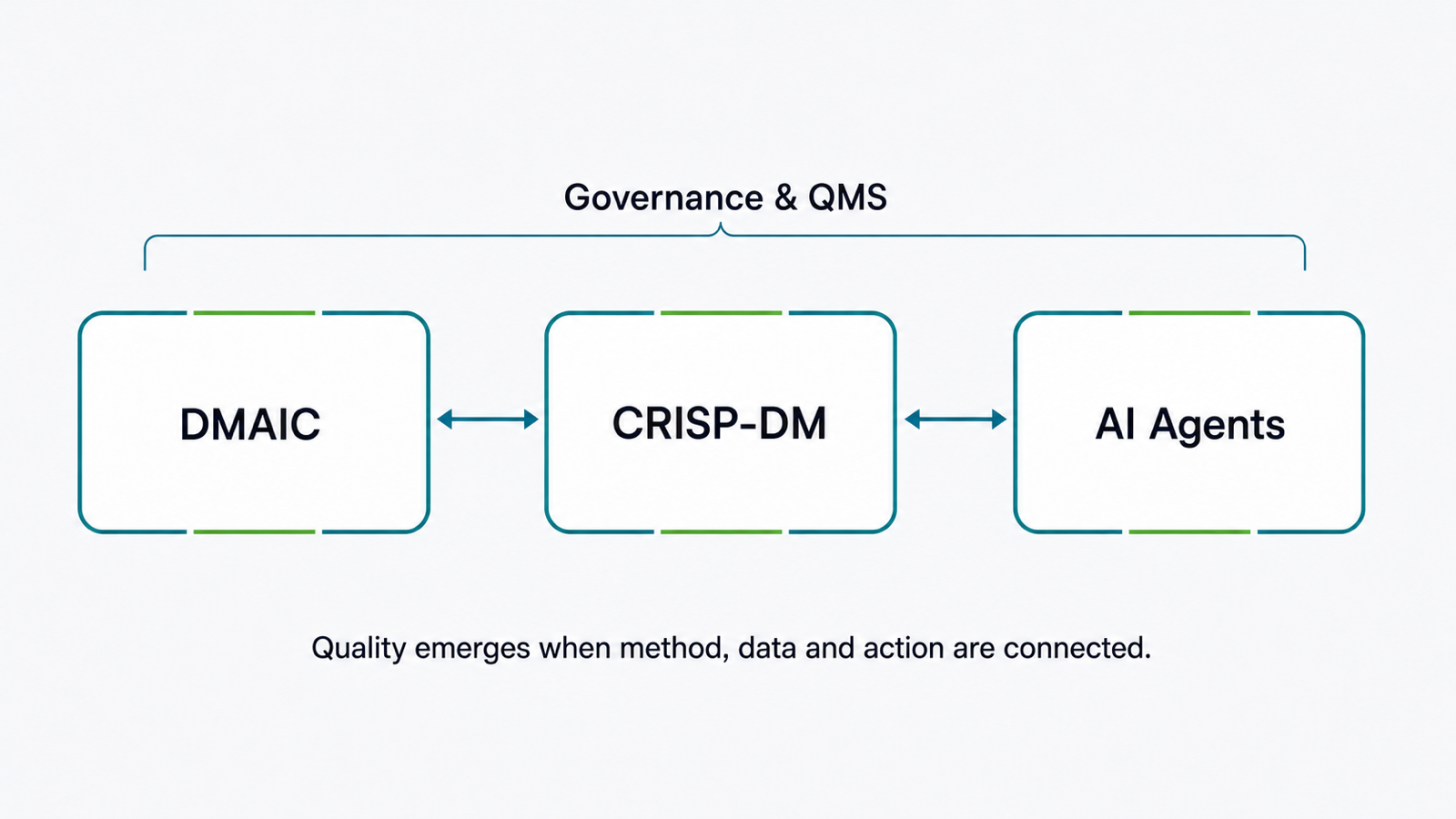
AI agents form a third layer. They can plan tasks, invoke tools, combine information from different systems and coordinate intermediate results. The study groups these contributions into three roles: decision-making, knowledge reasoning and orchestration. The common bracket remains the QMS, with human accountability.
Terms explained
- AI: Artificial intelligence; systems that derive patterns from data or support tasks automatically.
- QMS: Quality management system; the controlled organisation of responsibilities, processes and evidence.
- DMAIC: Define, Measure, Analyse, Improve and Control; a structured Six Sigma improvement cycle.
- CRISP-DM: Cross-Industry Standard Process for Data Mining; a process model for data analysis and model development.
- APOF: Agentic Process Optimization Framework; a research framework connecting governance, AI agents, data and tools.
- reasoning: The processing steps an AI system uses to connect information and reach an answer or decision.
Deep dive
What the study actually examines
Bahr and colleagues conduct a systematic mapping study of 96 publications on data-driven process optimisation in manufacturing. They examine how common data science frameworks align with ISO 9000 principles, the relationship between CRISP-DM and DMAIC, reported effects of data-driven methods, and the functions performed by AI agents.
The result is not an argument for replacing established quality methods with a new AI framework. On the contrary, the authors describe DMAIC and CRISP-DM as structurally distinct but complementary. CRISP-DM is more exploratory and model-centred. DMAIC embeds data collection, process performance, improvement and long-term control in a defined problem-solving process.
APOF as a connecting architecture
The findings lead to the Agentic Process Optimization Framework, comprising four components: business governance, an AI agent system, a data system and a tool system. The governance layer is intended to preserve objectives, customer requirements, quality requirements and auditability. The agent system coordinates analysis and knowledge work, while the data and tool systems provide controlled information and execution resources.
For quality practice, this suggests a plausible target architecture. An improvement project remains tied to CTQs, process performance and control through DMAIC. CRISP-DM structures the data science work. Agents connect information, analyses and tools, document intermediate states, and escalate decisions that require human approval.
Across the reviewed literature, the study reports cycle-time reductions of up to 5.5%, makespan reductions of 8–11%, predictive accuracies above 90% for quality tasks, and fault-detection improvements of up to 30% over the respective baselines. These are peak results from different applications, not a performance commitment for APOF.
Limitations and risks
APOF is derived from a literature mapping; the study does not validate the complete framework as an end-to-end system in a real factory. The reported performance figures are also not directly transferable because the datasets, tasks and baselines differ. Recurring barriers include data quality, process complexity and organisational constraints. AI agents do not remove these prerequisites. Without reliable data, defined roles, restricted access, approval gates and expert review, orchestration may simply distribute errors across more systems at greater speed.
FQI conclusion
The study’s strongest message is not that agents will take over process optimisation. It is that data science needs the methodological and organisational frame of quality management, while quality management can deliberately integrate data-centred and agentic capabilities. DMAIC, CRISP-DM and AI agents are therefore not competing product labels but distinct building blocks of a controlled system. For organisations, the sensible path starts with governance, CTQs and accountability; models, agents and automation come afterwards.
Sources & transparency
- Bahr, Lukas; Poßner, Lucas; Wewerka, Judith; Bittencourt, José; Gröger, Sophie; Daub, Rüdiger: Aligning quality management and data science with AI agents for process optimization in manufacturing: A survey, Journal of Industrial Information Integration, volume 52, article 101129, 2026, DOI: 10.1016/j.jii.2026.101129.
- Institutional publication record from the Technical University of Munich with abstract, metadata and peer-review status.
- The architectural transfer to quality practice and the assessment of deployment boundaries are FQI interpretations. This article and its original visualisation were created with AI support, professionally reviewed and explicitly approved for publication on 10 August 2026.
- Approval status: First-use explanations and the glossary were reviewed by a human and approved for publication on 17 August 2026. Approved by: Johann Fischer.