
Executive summary
Fraunhofer presents the Wise-Cut and PredictiveBoX projects as approaches for predicting tool wear and workpiece quality from vibration signals and AI. The intended benefits include forecasting remaining tool life and avoiding visible effects such as chatter marks. The project description is a credible applied research signal, but it does not publish a complete validation dataset or transferable performance metrics. For quality management, the key distinction is between predicting machine condition and predicting the risk to a critical-to-quality characteristic.
FQI takeaway
- Tool condition is not yet product quality: a wear estimate becomes quality-relevant only when its effect on dimensions, surface, burrs or capability is demonstrated.
- The sensor chain needs its own assurance: position, sampling rate, drift and reproducibility determine whether a model sees wear or an installation artefact.
- The reaction must be risk-based: tool change, continued operation and increased inspection require validated thresholds and an economic trade-off.
The principle at a glance
Predictive maintenance asks when a tool or asset is likely to require intervention. Predictive quality asks whether the predicted state creates an unacceptable risk for the product. The two questions may correlate, but they are not identical. A tool can show wear while still producing conforming parts, or produce a critical surface defect because of chatter, runout or material interaction before a generic wear threshold is reached.
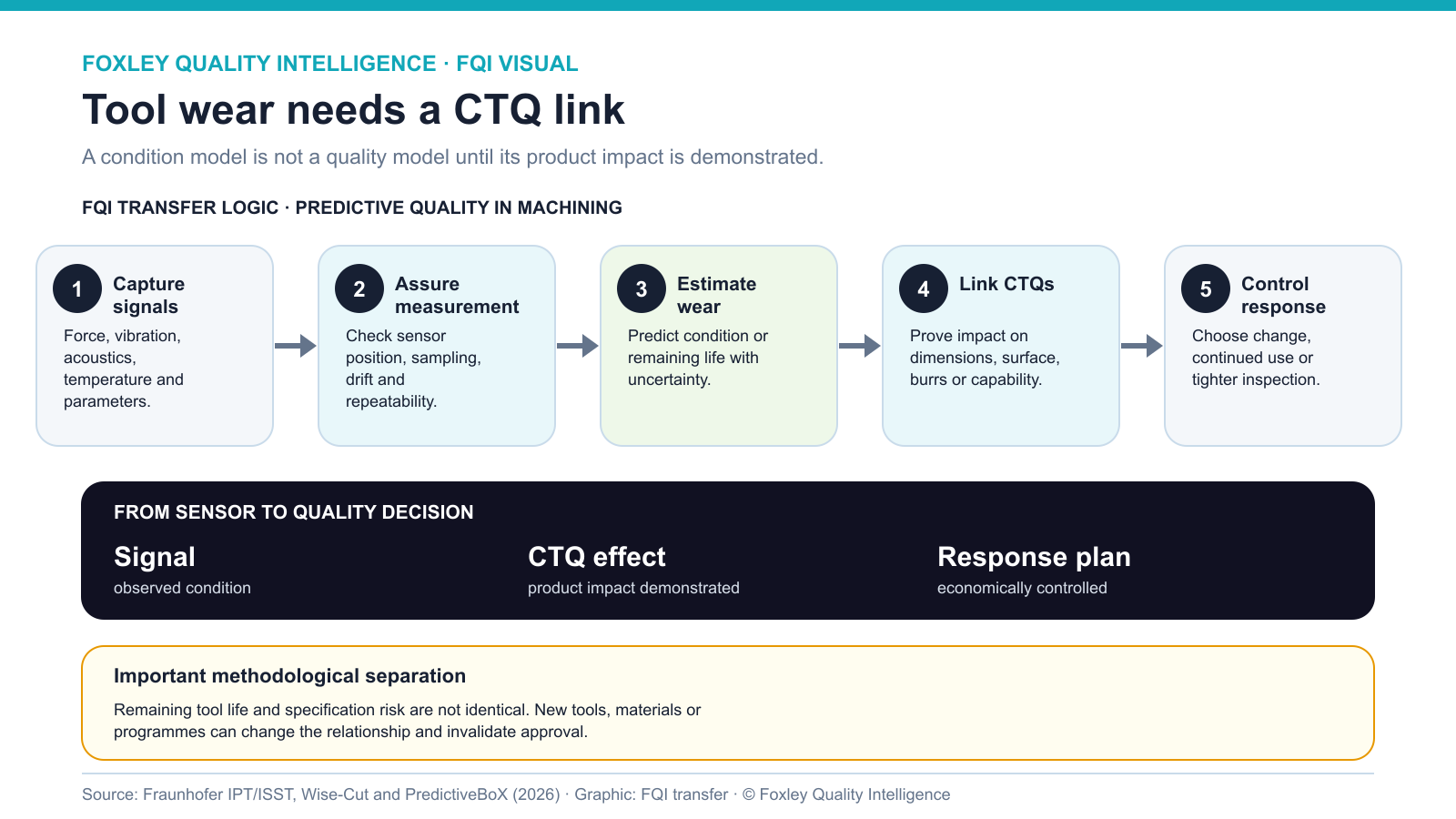
A controlled chain therefore runs from sensor signal to measurement assurance, from signal to wear estimate, from wear estimate to a CTQ effect, and finally from risk to a defined response. Every link needs evidence.
Terms explained
- AI: Artificial intelligence; systems that derive patterns from data or support tasks automatically.
- shadow mode: A test phase in which a system runs alongside operations but does not trigger automatic decisions.
- MSA: Measurement System Analysis; checking whether a measurement system is fit for its intended decision.
- CTQ: Critical to Quality; a characteristic that is decisive for customer requirements or process quality.
- COPQ: Cost of poor quality; costs caused by defects, scrap, rework, complaints and their handling.
Deep dive
Machining generates rich signals from force, vibration, acoustic emission, spindle power, temperature and process parameters. Machine-learning models can combine these signals and estimate wear state or remaining useful life. Yet the model may also learn machine type, programme, material batch or sensor mounting. Measurement System Analysis should therefore address the complete acquisition chain, including repeatability after sensor replacement and robustness to legitimate process changes.
The CTQ link is the core of predictive quality. The validation dataset must connect each signal window and predicted wear state to measured product results such as diameter, roughness, burr height or process capability. A model that predicts a wear label with high accuracy but cannot identify when the product approaches a specification risk remains a maintenance model.
Thresholds should reflect both risk and economics. An early tool change reduces defect probability but consumes remaining tool life. A late change may create scrap, rework or customer risk. A useful decision rule combines uncertainty in the prediction, severity of the affected CTQ, inspection coverage, tool cost and Cost of Poor Quality. Near an uncertain boundary, increased inspection may be more appropriate than an automatic stop.
Introduction should begin in shadow mode across multiple tools, materials and programmes. Predictions are logged without changing production, then compared with actual wear and CTQ measurements. Only after stability is demonstrated should alerts influence the Control Plan. Changes in tool supplier, coating, material or NC programme need a defined revalidation trigger.
Limitations and risks
The Fraunhofer page describes ongoing projects and demonstrators, not a completed peer-reviewed effectiveness study. It does not provide enough metrics to judge false alarms, missed quality risks or transfer between machines. Sensor drift, changed mounting and new process combinations can invalidate the learned relationship. A remaining-life estimate may also create false confidence if the CTQ mechanism was never measured directly.
FQI conclusion
AI-based tool-wear prediction becomes predictive quality only when a validated chain links the signal to the product characteristic and a controlled reaction. The decisive evidence is not that the algorithm recognises wear, but that it improves conformity, capability or COPQ without introducing unacceptable false interventions.
Sources & transparency
- Fraunhofer IMS: Embedded AI for smart sensors and machines – Wise-Cut, 2026.
- Evidence status: applied research project and demonstrator description; no complete public industrial validation metrics. The CTQ chain, MSA requirements and release logic are FQI interpretations.
- This article and its original visualisation were created with AI support, professionally reviewed and explicitly approved for publication on 10 August 2026.
- Approval status: First-use explanations and the glossary were reviewed by a human and approved for publication on 17 August 2026. Approved by: Johann Fischer.