
Executive summary
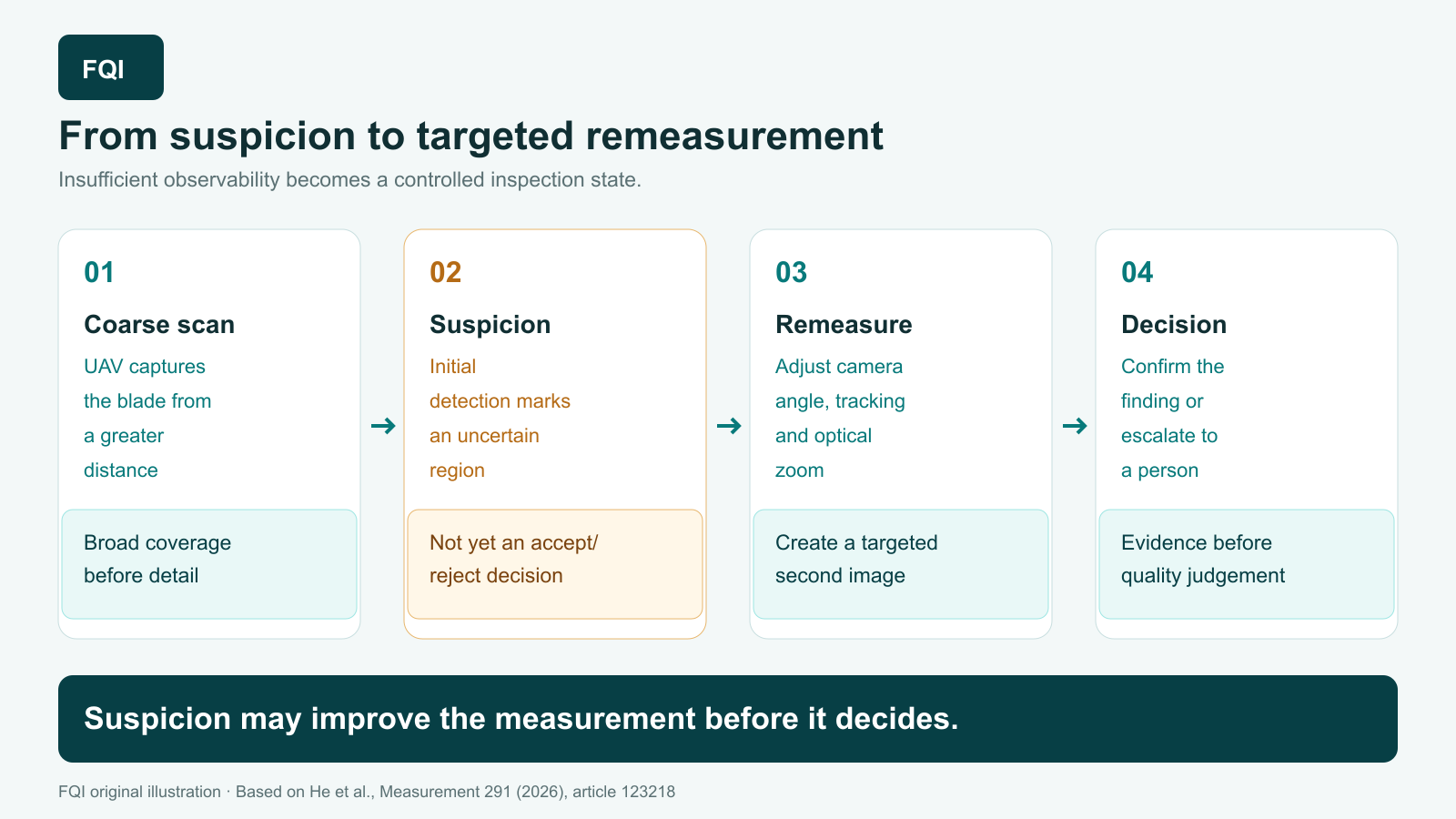
Many visual inspection systems treat image capture as a fixed preliminary step: the camera collects data and the model decides afterwards. A wind-turbine-blade study closes that gap. An initial defect suspicion controls camera angle, tracking and optical zoom so that the system deliberately produces a better second image. The key FQI transfer is straightforward: when observability is inadequate, an inspection process needs a defined remeasurement state rather than an immediate judgement.
FQI takeaway
- Image quality belongs to the inspection decision: A powerful model cannot reconstruct information lost through distance, viewing angle or blur.
- Uncertainty needs an active response: A suspicion should be able to trigger a targeted second measurement instead of ending immediately as an accept, reject or false-alarm decision.
- Validate the complete loop: Camera, preliminary check, motion control, zoom, second image and final classification form one measurement system.
The principle at a glance
The study replaces passive image collection with a closed-loop coarse-to-fine inspection. An unmanned aerial vehicle (UAV) first scans a broad area of the blade. When the on-board model detects a suspicious region, the camera mount, target tracking and optical zoom are adjusted. Only then is the finer image created for final detection.
Terms explained
- UAV: Unmanned aerial vehicle; here it carries the camera, computing hardware and control system.
- Active perception: A measurement strategy in which an initial result deliberately changes the next observation.
- Gimbal: A movable camera mount that stabilises and redirects the viewing angle.
- MSA: Measurement System Analysis; evidence that a measurement chain is suitable for its intended decision.
- AI: Artificial intelligence; systems that derive patterns from data or automate tasks.
Deep dive
Small cracks, erosion spots or coating defects may occupy only a few pixels in a wide-angle image. The detection model is then not the only constraint. Distance, viewing angle, movement, lighting and focal length determine whether the defect is observable at all. The authors therefore connect coarse detection and image acquisition in a feedback loop: locate a suspicious region, steer the camera, apply optical zoom and inspect again.
The accessible publisher preview describes tests using artificially shortened blade specimens and decommissioned blades in a storage yard. The camera operated from approximately five to ten metres. The system used a DJI Matrice 300 RTK platform, a Zenmuse H20T camera and on-board computing hardware. The article reports improved detection measures and more detected defects than passive image capture.
However, different publicly visible sections give inconsistent percentages for the reported improvement. Without the complete result presentation, it is unclear whether they refer to different baselines, datasets or analysis stages. This Research Brief therefore does not use those percentages as effectiveness evidence. The documented architecture and the limited test setting remain the defensible findings.
In a Control Plan, the documented production inspection and response plan, the first model pass should therefore be treated as a measurement decision rather than a release. Defined rules specify when a second image is required, which camera positions are permitted and when insufficient observability must be escalated to a person. MSA should repeat tests across distances, angles, lighting, surfaces and motion. Detection, false alarms, unusable images and extra cycle time need separate measures.
Only then can a team test whether active remeasurement improves the decision. A higher defect count is insufficient: it may represent additional true findings, repeated counting or more false alarms. The evidence chain therefore needs referenced defect lists and an unbroken link between the suspicion, the second image and the confirmed finding.
Limitations and risks
The experiments do not replace validation on operating blades in a wind farm. Decommissioned components, shortened specimens and image-based simulations only partly represent turbulence, access constraints, real surface ageing and safety distances. The accessible preview also provides no complete confusion matrix across operating conditions. Active steering can introduce new failure modes: an incorrect initial suspicion directs resources to the wrong place, while a missed region receives no second chance. Flight control and optical zoom therefore belong in inspection-equipment monitoring.
FQI conclusion
The strongest idea is not a new detector but a different inspection process. A preliminary result may improve the measurement before a quality decision is made. The question shifts from “How accurate is the model?” to “Can the process recognise missing evidence and remeasure deliberately?”. A defensible deployment needs referenced defects, validated re-imaging rules, explicit escalation and measures for the complete loop.
Sources & transparency
- He et al.: On-board adaptive defect detection for wind turbine blade via UAV, Measurement, volume 291, article 123218, DOI 10.1016/j.measurement.2026.123218.
- On 20 September 2026, the original publisher page provided the abstract and selected method and result sections; the complete article text was not freely available.
Editorial note: The architecture, test setting and equipment come from the source. Applying them to MSA, Control Plans, remeasurement rules and referenced finding chains is FQI interpretation. Inconsistent publicly visible improvement percentages were not consolidated into an effectiveness claim. This text was prepared with artificial intelligence (AI) support and remains a draft until explicit approval.