
Executive summary
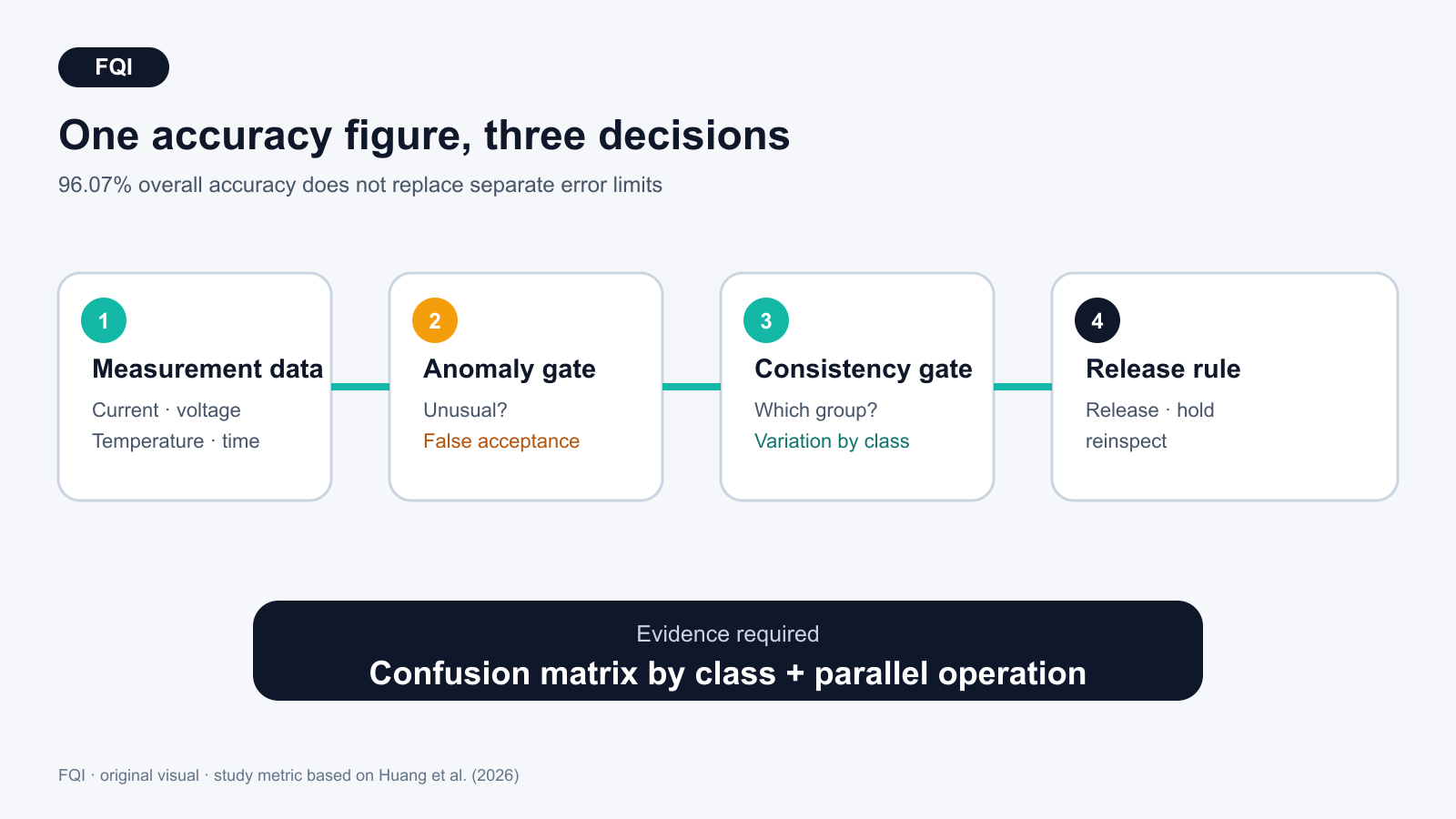
A recent study combines two inspection tasks in battery-cell production. The model identifies unusual cells while assigning normal cells to groups with similar behaviour. On production data, the approach reaches 96.07% overall accuracy. That result is technically interesting, but it is not sufficient for release. An anomaly and poor consistency have different consequences. Error costs, boundary cases and performance for each decision therefore need separate evidence.
FQI takeaway
- One model does not replace separate quality objectives: Defect detection and grouping require their own acceptance criteria.
- Overall accuracy can conceal critical errors: Incorrectly released cells and unnecessarily rejected cells must be evaluated separately.
- Time savings become a benefit only after validation: A shorter inspection flow must not merely move uncertainty into the algorithm.
The principle at a glance
Charge and discharge behaviour is recorded as time-series data for battery cells. The study transforms those data into a two-dimensional representation using a Hankel matrix. A neural network called HMM-Net then searches for patterns across several time scales. Its output distinguishes anomalous cells and groups of normal cells with similar behaviour. The aim is to combine two inspection stages that are normally performed one after another.
Terms explained
- Hankel matrix: A time series arranged into overlapping segments so that temporal patterns can be analysed as a surface.
- Anomaly detection: Finding observations that differ substantially from expected behaviour.
- Consistency screening: Assessing whether cells within an intended group behave sufficiently alike.
- MSA: Measurement System Analysis; checking whether measurement and evaluation reliably support the intended decision.
- AI: Artificial intelligence; systems that infer patterns from data or automate tasks.
Deep dive
The authors motivate the combined approach by the long resting times and complex workflows associated with separate anomaly detection and consistency screening. HMM-Net processes charge and discharge data from a real production environment. Multiple convolution kernels capture patterns with different durations. In the combined classification task, the paper reports 96.07% overall accuracy and better performance than the comparison models.
For quality management, combining tasks is more than a model optimisation. The first decision is whether a cell is unusual and potentially unsuitable for release. The second is which group a normal cell should join so that a later battery pack behaves uniformly. An incorrect answer has different consequences in each case. A missed anomaly may affect reliability and safety. Incorrect grouping may intensify ageing or performance variation within the pack. A false alarm, by contrast, causes scrap, additional inspection or delivery delay.
A release dossier should therefore contain a confusion matrix for every class. How many anomalous cells were missed? How many normal cells were blocked? How stable is the grouping? Results are also needed for different lines, material lots, cell formats, temperatures and ageing states. Overall accuracy weights these situations by their frequency in the test data, not by their risk.
The input data are part of the measurement system as well. Current, voltage, temperature, time base and rest conditions must be traceable and sufficiently stable. Missing data or a sensor change can alter the pattern even when the cell has not changed. The MSA must therefore cover the measurement chain and algorithm together. For boundary cases, the Control Plan—the documented production inspection and response plan—should require a repeat measurement, an alternative test or human escalation.
Practical value appears only in controlled parallel operation. The new method should initially run beside the existing screening process. Differences are investigated at individual-cell level and linked to later behaviour. An inspection step can only be removed or shortened after error limits, drift monitoring and the response plan have been demonstrated.
Limitations and risks
The accessible original page reports 96.07% overall accuracy, but its abstract does not provide a complete breakdown by error class and production variant. The efficiency claim is therefore not proof of a safely shortened release process. Results from one production dataset may depend on cell chemistry, equipment condition and class distribution. Joint optimisation can also hide conflicting objectives: a model may improve the common consistency class while becoming worse at rare critical anomalies. Transferability remains open without an independent test set and drift monitoring.
FQI conclusion
The study offers an interesting way to consider inspection time and data use together. For FQI, the key is not to confuse technical integration with a combined release logic. Anomaly detection, consistency grouping and economic cycle time require separate metrics and limits. A defensible rollout begins with parallel operation and ends only when the measurement chain, model, boundary cases and response plan are controlled together.
Sources & transparency
- Huang et al.: A one-step approach for cell anomaly detection and consistency screening in lithium-ion battery production based on data-driven modeling, Computers in Industry, volume 181, article 104521, DOI 10.1016/j.compind.2026.104521.
- Evidence status: The journal article uses real production data; the accessible original page contains its abstract, model description and central result. The issue is listed for December 2026.
- FQI transfer: Separate error metrics, MSA, parallel operation and risk-based release are an editorial interpretation by FQI.
- This article was researched and prepared with artificial intelligence (AI) support. Sources, figures, translation and FQI analysis were reviewed and approved for publication by Johann Fischer on 21 August 2026.