
Executive summary
Term note: AI – Artificial intelligence; systems that derive patterns from data or support tasks automatically. · MSA – Measurement System Analysis; checking whether a measurement system is fit for its intended decision.
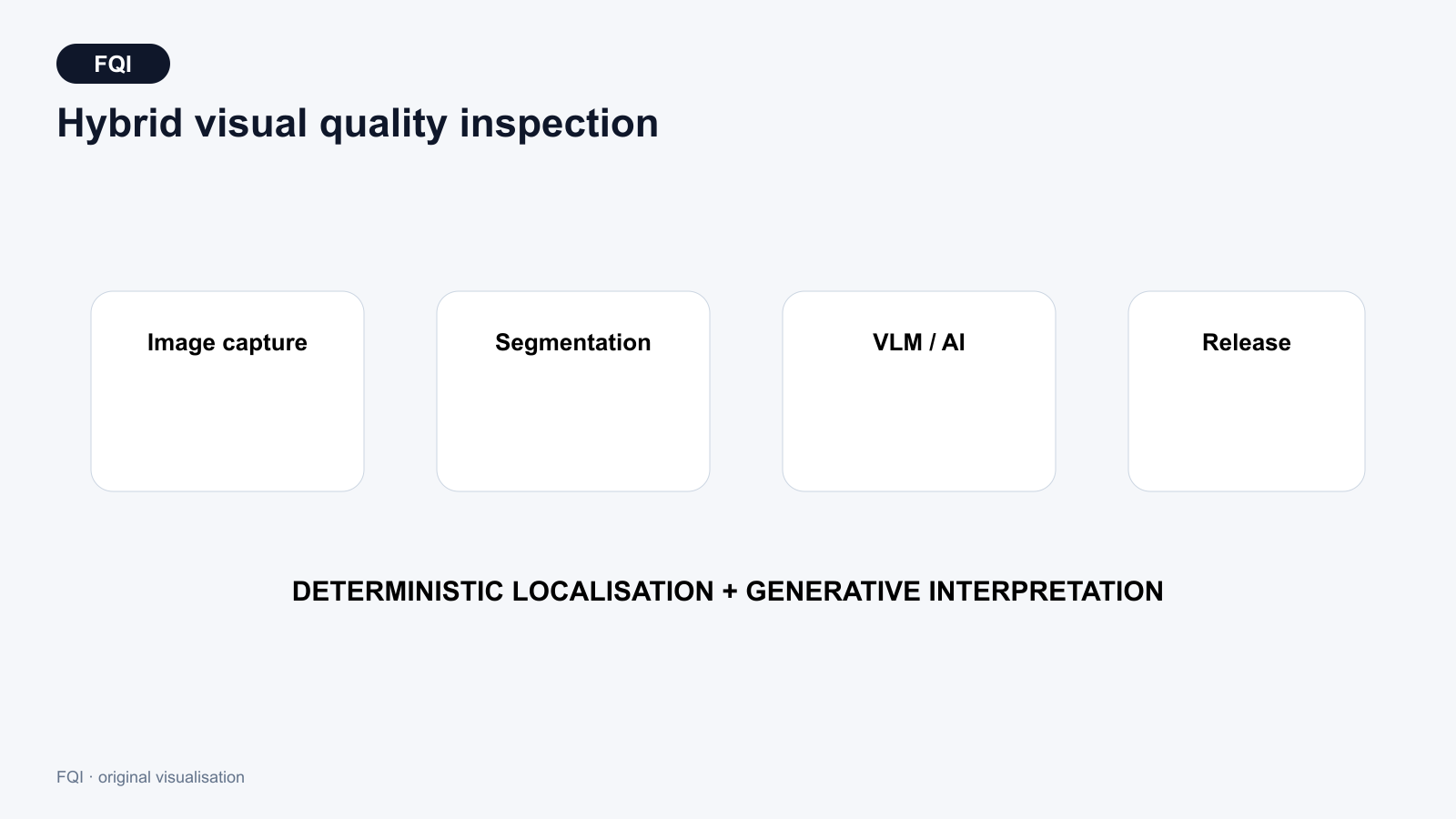
A recent study of automated vehicle-damage assessment illustrates a typical weakness of multimodal AI: a VLM (vision-language model) achieved strong semantic classification but localised small defects unreliably. Upstream segmentation substantially reduced the reported hallucination rate. The implication for quality inspection is that specialised measurement methods should localise defects, while generative models are better suited to context, interpretation and reporting.
FQI takeaway
- Semantic plausibility is not spatial measurement accuracy: A convincing report may rely on incorrectly localised image features.
- Hybrid architectures are more robust: Specialised detection or segmentation provides evidence for the generative model to interpret.
- Residual error remains critical for release: Even a substantially improved system needs MSA, boundary-sample testing and human escalation.
The principle at a glance
The preprint “Grounding Agentic VLMs with Dedicated Segmentation for Fine-Grained Vehicle Damage Assessment” was published on 3 August 2026. The authors studied small scratches and fine cracks that occupy only a few pixels and can easily be confused with reflections or surface texture. Qwen-VL, a vision-language model, achieved 87.3% semantic classification accuracy but showed weaknesses in spatial attribution. The proposed hybrid architecture was evaluated using 100 human-verified reports. The results have not yet been peer reviewed.
Deep dive
Multimodal vision-language models can describe images, explain relationships and write reports. This can create the impression that they are also precise visual measurement systems. The study shows why that equivalence is problematic. The model often named damage categories correctly, but hallucinated damage in reflective areas, missed elongated scratches and produced inconsistent localisation results.
The authors therefore separate two functions. A specialised segmentation model performs spatial detection. The vision-language model then uses that segmentation as the basis for semantic assessment and reporting. In a controlled evaluation of 100 reports, the stated hallucination rate fell from 92% with a text-based approach and 78% with a purely image-based approach to 31% when grounded in segmentation. The improvement is considerable, yet a 31% hallucination rate remains far too high for many release decisions.
The separation of functions is decisive for quality management. Visual inspection involves at least three different tasks: measuring or locating a feature, classifying the feature and deciding what it means. Conventional computer vision or a specialised segmentation model may be easier to control for the first task. A generative model can then consider context such as component location, defect description or inspection instruction. The final accept-or-hold decision should remain tied to defined criteria and escalation rules.
From an MSA (measurement system analysis) perspective, image capture and algorithm must be assessed together. Influence factors include lighting, camera angle, resolution, focus, surface condition, component variant, contrast, defect size and operator influence. Repeatability means that the same part is assessed consistently under identical conditions. Reproducibility concerns different systems, shifts or capture conditions. For attribute inspection, agreement with qualified reference judgements, false acceptance and false rejection are central. High overall accuracy can conceal rare but critical defects.
The study also provides a methodological warning: a widely used loss function for imbalanced classes caused small-damage detection to collapse in the tested configuration. Established machine-learning methods do not necessarily fit the physical defect pattern. Selecting the model architecture, loss function and training data is part of inspection-equipment development and must be verified against boundary samples.
One industrial application would be the inspection of fine conductor-track, solder or housing defects. A specialised vision system marks potential defect regions. The multimodal model then assigns the component, defect class and inspection criterion and produces a traceable report. Another application is incoming inspection for components with many variants. A generative model can link documents, drawings and image findings, but should not be allowed to claim a defect at an unmarked image location.
A suitable Control Plan would therefore contain several layers: qualified image capture, detection thresholds, plausibility checks, release rules, an uncertainty region and a reaction plan. Cases outside the validated range are not decided automatically but escalated to a person. AI becomes one module in an inspection chain rather than the sole inspector.
Limitations and risks
First, this is a preprint with a limited evaluation of 100 reports in one application area. The reported values cannot be transferred to industrial inspection processes without independent validation.
Second, the definition of hallucination depends on the segmentation masks and experimental setup used. Different error definitions may produce different results.
Third, a hybrid architecture introduces additional interfaces and failure sources. Incorrect segmentations may be processed convincingly by the language model. Grounding the output in verifiable image evidence reduces one risk but does not eliminate it.
Fourth, multiple models increase latency, computational cost, maintenance effort and configuration risk. Economic viability and inspection needs must be weighed against failure costs.
FQI conclusion
Generative AI can usefully enhance visual quality inspection, but it should not be confused with a calibrated measurement system. Robust solutions separate detection, interpretation and decision-making and validate every stage, including the interfaces. The most important lesson from the study is not a particular model score, but the architectural choice: physical evidence first, generative interpretation second, and release only within defined limits.
Sources & transparency
- Hogale, Pai and Ravi: Grounding Agentic VLMs with Dedicated Segmentation for Fine-Grained Vehicle Damage Assessment, arXiv:2608.02470, 3 August 2026.
- Evidence status: current preprint without completed peer review; controlled evaluation in vehicle-damage detection.
- FQI transfer: The application to MSA, attribute inspection, Control Plans and industrial visual inspection is a professional inference by FQI.
- The reported hallucination rates are specific to the experiment and definition; they are not general performance claims for vision-language models.
- This article was researched and written with AI support. Sources and professional transfers were pre-reviewed with AI. Human professional and source approval was documented on 10 August 2026, and the article is approved for publication.
- Approval status: First-use explanations and the glossary were reviewed by a human and approved for publication on 17 August 2026. Approved by: Johann Fischer.