
Executive summary
Term note: AI – Artificial intelligence; systems that derive patterns from data or support tasks automatically. · AUROC – Area under the receiver operating characteristic curve; a threshold-independent measure of classifier discrimination.
TinyGLASS is a 2026 preprint describing self-supervised visual anomaly detection on a Sony IMX500 intelligent vision sensor. The authors report an AUROC of 94.2% on MVTec AD, approximately 20 frames per second and an 8 MB model footprint. This combination is technically attractive for low-latency inspection close to the process. Yet the benchmark result does not demonstrate release capability for a specific production line, and the announced source code is only planned after paper acceptance.
FQI takeaway
- Good-part training can reduce the defect-data problem: the model learns normal appearance without requiring a complete catalogue of defect classes.
- Anomaly is not the same as nonconformity: an unusual appearance may be acceptable, while a critical defect may remain visually subtle.
- Edge deployment changes the control plan: hardware limits, model version, drift and escalation of uncertain cases become quality characteristics.
The principle at a glance
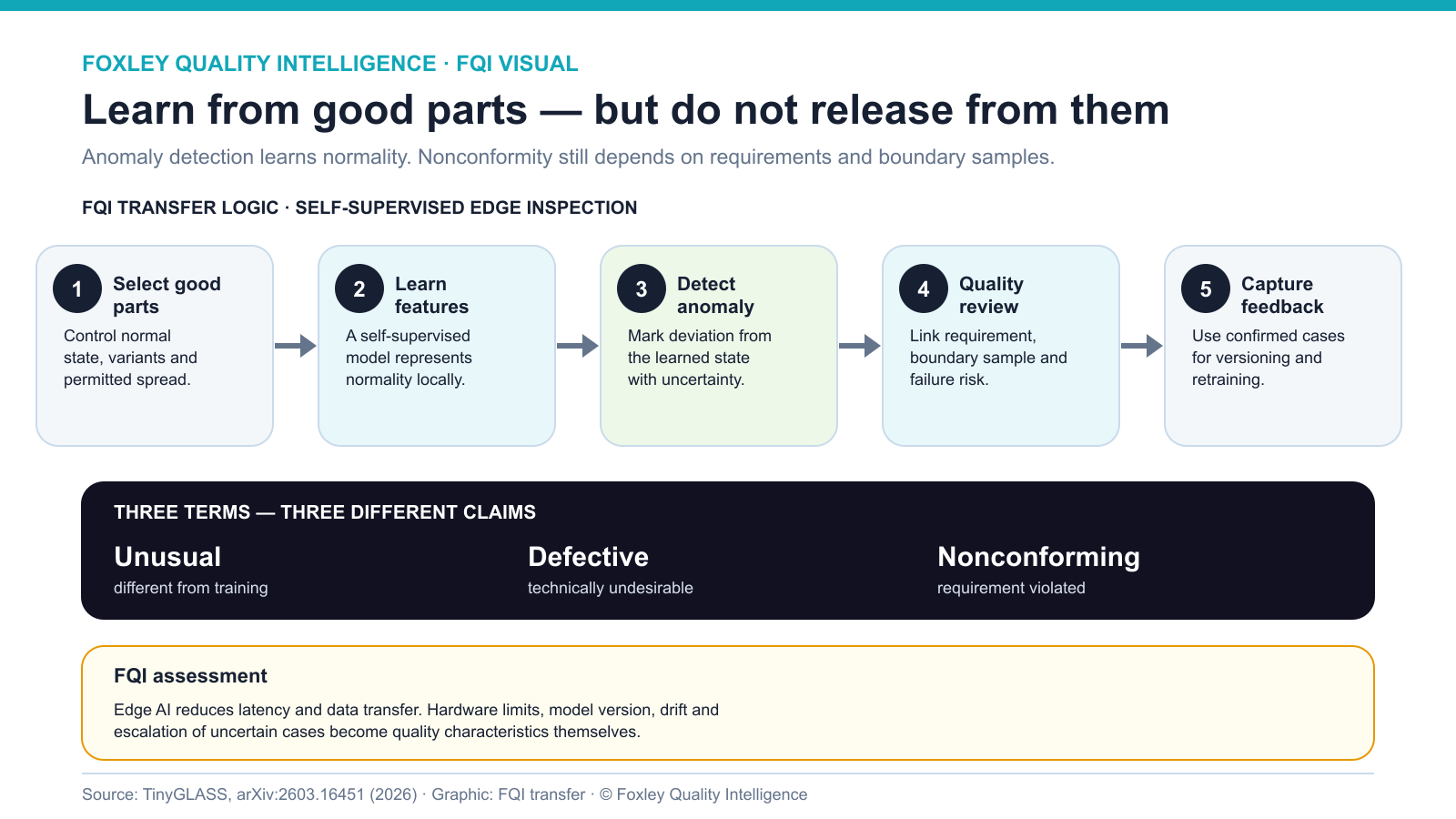
Self-supervised anomaly detection learns a representation of normality from nominal samples. During inspection, a new image is compared with that learned space and receives an anomaly score or localisation map. This is useful in high-mix, low-volume production because defects are scarce and product variants change frequently.
The quality logic still requires three separate claims. “Unusual” means different from the training distribution. “Defective” means technically undesirable. “Nonconforming” means a documented requirement has been violated. Only the last claim can directly support a conformity decision, and it requires a link to specifications, risk and boundary samples.
Deep dive
Edge AI offers practical advantages: images can be processed locally, latency and network load fall, and sensitive image data need not leave the machine. The IMX500 combines sensing and inference, making compact inspection stations possible. TinyGLASS targets this constrained environment with a small self-supervised model rather than a large cloud pipeline.
However, training on good parts creates its own validation burden. The good-part set must represent authorised materials, surface variation, lighting, camera position, acceptable cosmetic variation and relevant process states. If it is too narrow, normal variation triggers false alarms. If it includes undetected defects, the model may learn them as normal.
Validation should therefore include confirmed defects, deliberately selected boundary samples, known acceptable variants and challenge conditions such as illumination drift or contamination. Metrics should cover missed defects, false rejects, localisation quality, latency and stability across product changes—not AUROC alone. The response plan also matters: a high-confidence anomaly may trigger containment, while an uncertain case should be routed to human review rather than automatically rejected.
On-device deployment needs version control for model, firmware and preprocessing. A hardware replacement, changed exposure setting or compressed input can shift the feature distribution even when the product has not changed. Monitoring must detect drift, and the feedback loop should preserve expert-confirmed cases for controlled retraining and revalidation.
Limitations and risks
MVTec AD is a benchmark, not proof for a particular industrial process. AUROC can obscure the costs of false rejects and missed critical defects at the chosen operating threshold. The preprint has not completed peer review, and source-code availability is conditional. Finally, normality-based systems are vulnerable to dataset contamination and may detect visually salient but harmless variation more readily than subtle safety-critical defects.
FQI conclusion
Edge anomaly detection can make visual inspection faster and less dependent on large defect datasets. It does not remove the need for requirements, representative good-part selection, boundary samples and an explicit decision rule. A quality-capable system treats the anomaly score as evidence for review—not as an automatic definition of nonconformity.
Sources & transparency
- TinyGLASS: A Tiny Self-Supervised On-Sensor Anomaly Detection System, arXiv:2603.16451, March 2026.
- Evidence status: preprint and benchmark evaluation on MVTec AD; no general production-release evidence. The distinction between anomaly, defect and nonconformity is an FQI interpretation.
- This article and its original visualisation were created with AI support, professionally reviewed and explicitly approved for publication on 10 August 2026.
- Approval status: First-use explanations and the glossary were reviewed by a human and approved for publication on 17 August 2026. Approved by: Johann Fischer.