
Executive summary
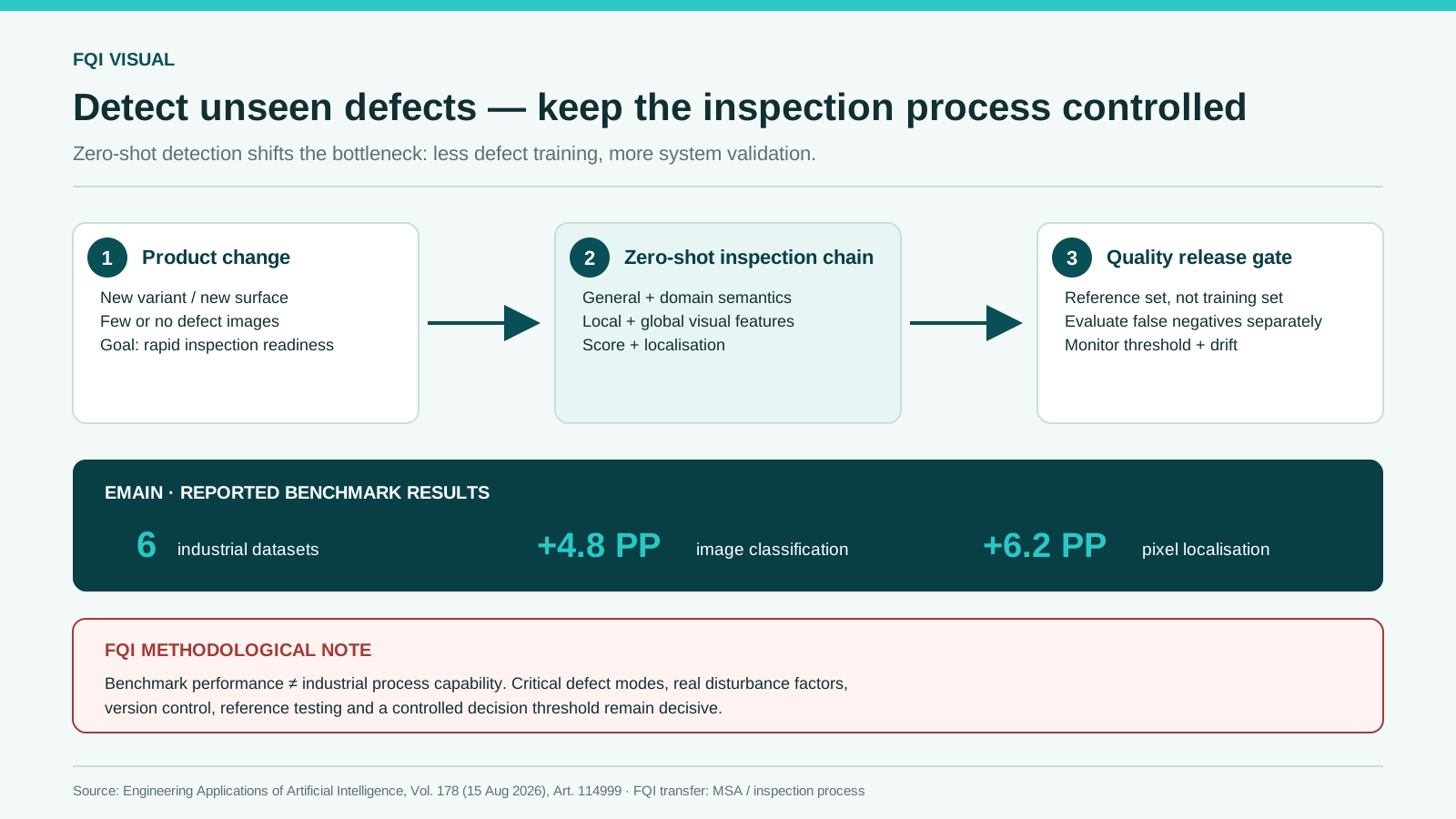
The EMAIN study published on 15 August 2026 addresses a core problem in industrial visual inspection: after product changes and for rare defect modes, suitable defect examples for retraining are often unavailable. The zero-shot approach combines domain-specific prompting, local and global image features and spatial interaction. Across six datasets, the authors report gains of up to 4.8 percentage points at image level and 6.2 percentage points at pixel level. For FQI, however, the benchmark result is secondary to a more important question: how can such a system be qualified and controlled as an industrial inspection process?
FQI takeaway
- Zero-shot reduces training effort, not validation effort: fewer target-specific defect images may simplify introduction, but fitness for the intended inspection purpose still has to be demonstrated.
- Measurement System Analysis (MSA) must cover the digital measurement chain: camera, illumination, preprocessing, model, prompt logic, threshold and decision rule form one controlled inspection configuration.
- False negatives are the central quality risk: a strong average benchmark score says little about whether critical defect classes are reliably detected under actual production conditions.
The principle at a glance
Zero-shot anomaly detection aims to identify anomalies in a target domain without prior training on defect examples from the specific target class. EMAIN combines general and domain-oriented text representations with local and global visual processing. The authors report improvements over comparison methods on six industrial datasets.
The potential industrial benefit is clear: variant changes, new products and rare defects may require less effort to collect and annotate defect examples. That does not mean the method can be deployed without reference data or release testing. Training and validation are different tasks.
Terms explained
- AI: Artificial intelligence; systems that derive patterns from data or support tasks automatically.
- MSA: Measurement System Analysis; checking whether a measurement system is fit for its intended decision.
- EMAIN: A research method for detecting unseen visual anomalies without target-class defect examples.
- prompt: A task instruction or input for an AI system; it describes the task, rules, context and expected result.
Deep dive
Conventional supervised vision systems are particularly effective when relevant defect states are known, sufficiently frequent and consistently labelled. In quality management, this prerequisite is often problematic. Severe defects should be rare, new variants create additional feature combinations, and high-mix/low-volume processes may provide only limited data for each variant. Zero-shot approaches therefore shift the bottleneck away from building large defect datasets and towards qualifying a more general detection logic.
EMAIN is an interesting research example. According to the paper, the method combines defect-semantic-aware prompt adaptation with text-encoder adaptation, parallel local convolutional blocks, spatial interaction and local-global feature fusion. Evaluation covers both image-level classification and pixel-level localisation. Across six benchmarks, the reported maximum gains reach 4.8 and 6.2 percentage points respectively. This demonstrates progress in the benchmark setting, but it does not demonstrate process capability on a specific production line.
From an FQI perspective, the main change concerns MSA — measurement system analysis. In AI-supported inspection, the measurement system consists of more than camera and optics. Additional influence factors include illumination, focus, field of view, preprocessing, model version, prompt or text representation, thresholds, hardware, runtime libraries and decision logic. A change to any of these elements can shift detection behaviour. Configuration management therefore becomes part of measurement-system control.
A product-specific reference set is still useful for release. It does not have to be used as training data. Instead, it provides independent evidence that relevant good and defective states are separated reliably. Suitable validation can include repeated runs, deliberate disturbance factors such as illumination or position changes, separate evaluation of critical defect modes and a documented decision threshold. For categorical outputs, sensitivity, specificity, false-negative rate and confusion matrices are usually more informative than one aggregate accuracy figure.
In the Control phase of a Six-Sigma-oriented deployment, drift becomes another concern. Camera contamination, changed surface properties, new supplier lots or software updates can alter the input distribution. A production zero-shot process therefore needs monitoring, version traceability, escalation rules and requalification. The advantage is to bring new inspection tasks into a controlled state faster.
Limitations and risks
The reported results come from benchmarks and must not be interpreted as evidence of industrial process capability. Datasets only partially represent real variation in cycle time, contamination, reflections, ageing equipment and product mix. Average metrics may also conceal critical individual defect modes. Quality decisions therefore require risk-weighted interpretation: missing a cosmetic defect and missing a safety-critical defect are not equivalent. Finally, dependency on model and software versions remains. Zero-shot does not mean maintenance-free.
FQI conclusion
Zero-shot inspection is particularly relevant to flexible manufacturing because it may reduce the need for product-specific defect examples. For quality management, however, the effort shifts from dataset creation to systematic validation of the entire digital measurement chain. The correct test is not whether a model leads six benchmarks, but whether critical defects are reliably detected under defined process conditions, whether changes are controlled and whether degradation becomes visible in time. MSA, independent reference testing and Control logic therefore remain central.
Sources & transparency
- Zhu et al.: Zero-shot industrial defect detection in flexible manufacturing via general-expert prompt fusion and spatial interaction, Engineering Applications of Artificial Intelligence, Volume 178, Part 1, 15 August 2026, article 114999.
- The figures for six datasets and gains of up to 4.8 percentage points at image level and 6.2 percentage points at pixel level are taken from the published article highlights.
- The transfer to MSA, reference sets, false-negative risk, configuration management and Control is an FQI assessment, not a claim by the authors regarding a specific industrial release methodology.
- This article was researched and drafted with AI support. Sources, figures and professional transfers were reviewed; explicit human approval for publication was documented on 15 August 2026.
- Approval status: First-use explanations and the glossary were reviewed by a human and approved for publication on 17 August 2026. Approved by: Johann Fischer.