
Executive summary
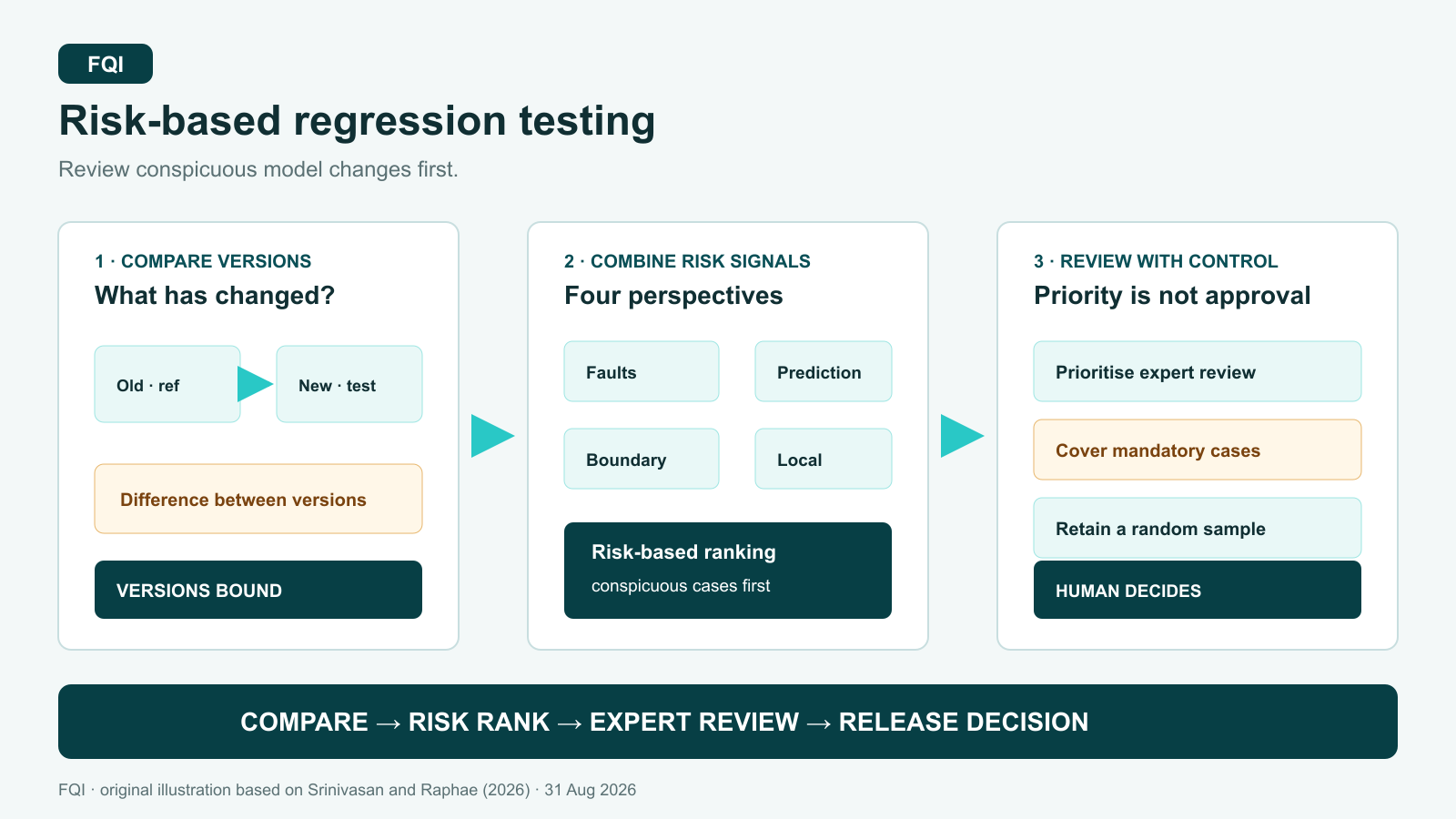
After a model update, teams often have more test cases than experts can economically verify. RiskBlend ranks cases by how strongly model behaviour, the decision boundary and the local data neighbourhood have changed between two versions. Across four public tabular datasets, it consistently found regression faults earlier than four comparison methods. For FQI, this is not an approval engine. It is a risk-based sampling plan that focuses expensive expert review on conspicuous changes while coverage, acceptance criteria and approval responsibility remain separate controls.
FQI takeaway
- Assess versions together: a confidence score from the new model does not reveal what changed during the update.
- Sequence expert review by risk: cases with strong boundary or behavioural shifts are checked first against reliable references.
- Never confuse prioritisation with approval: a high rank replaces neither minimum coverage nor an independent acceptance decision.
The principle at a glance
In this study, a regression fault occurs when the old model classifies a case correctly and the updated model gets it wrong. RiskBlend combines four signals: proximity to known regression faults, prediction shift, decision-boundary shift and change in the local neighbourhood. Weights are learned on a separate labelled validation set. The final ranking is then produced without access to the labels of the cases awaiting review.
The National Institute of Standards and Technology (NIST), the US standards institute, calls for documented testing, evaluation, verification and validation of artificial intelligence (AI), including measurable criteria and conditions similar to deployment. Risk-based ranking can make that process more efficient; it cannot reduce its requirements.
Terms explained
- Regression test: a check that a change has not degraded previously correct behaviour.
- Decision boundary: the mathematical boundary where a classifier changes from one class to another.
- APFD: average percentage of faults detected; a measure of how early known faults appear in an ordered test sequence.
- TEVV: test, evaluation, verification and validation; structured evidence for requirements and intended use.
- AI: artificial intelligence; systems that infer patterns from data or automate parts of a task.
- NIST: National Institute of Standards and Technology, the US standards institute.
Deep dive
The authors study four datasets from financial, social and healthcare contexts, five classifier families and four types of model update. These include feature addition, mildly shifted additional training data, stronger combined changes and preprocessing-only changes. Every combination is repeated with 15 random seeds. This yields 1,200 experimental configurations and 80 dataset–classifier–scenario cells.
Performance is measured with average percentage of faults detected (APFD). RiskBlend has the highest mean in all 80 cells. Its lead over the strongest comparison method ranges from 0.003 to 0.317 APFD; the abstract summarises the maximum as 0.32. Gains are especially large for decision trees and k-nearest-neighbour models. An ablation, which removes one signal at a time, shows that decision-boundary shift contributes most. The neighbourhood signal adds little in these experiments.
An FQI pilot starts by defining the test objective. The team records critical fault types, permitted model and data versions, reference labels, minimum coverage and available expert capacity. Old and new versions then process the same unseen candidate set. A simple baseline, such as reviewing the largest prediction changes first, remains in the comparison. RiskBlend or a simplified multi-signal approach should be adopted only if held-out updates show that it consistently reveals more relevant regression faults within the same budget.
The test plan records the ranking signals, weight version, validation data, review quota and response rule. Safety-critical or customer-specific cases can be mandatory regardless of score. Random samples from lower-ranked cases reveal blind spots in the ranking. Feature changes, preprocessing changes, a new classifier or a shifted population trigger renewed validation of the prioritiser itself.
Limitations and risks
The work is a preprint and covers tabular binary classification only. Images, text, multiclass tasks and continuous targets are not evaluated. Three of the four update scenarios use synthetically perturbed data; real production changes may behave differently. Learned weights require a representative labelled validation set and become less reliable when it contains very few regression faults. APFD evaluates the order of known faults, not their severity, cost or safety impact. High values can also be influenced by fault density. Operational use therefore needs severity weighting, mandatory cases and an independent effectiveness assessment.
FQI conclusion
Limited review capacity does not justify blind sampling. RiskBlend shows that directly comparing two model versions can provide more useful information than examining only the uncertainty of the new one. Quality teams can turn this into a controlled workflow: expose changes, review conspicuous cases first, retain mandatory coverage and monitor the ranking with random samples. Test-case prioritisation then becomes a documented review tool, not a substitute for reference data, risk assessment or human approval.
Sources & transparency
- Srinivasan and Raphae: RiskBlend – A Multi-Signal Framework for Test Input Prioritization in Machine Learning Regression Testing, arXiv:2608.27704v1, submitted 27 August 2026.
- National Institute of Standards and Technology (NIST): AI RMF Core – Measure. The transfer to risk-based test planning, mandatory cases and approval rules is FQI editorial interpretation.
- Evidence status: evaluated preprint without a production field study. This draft was prepared with AI support; human subject-matter and source approval are still pending.