
Executive summary
NIST’s 2026 roadmap describes AI opportunities in manufacturing, sensing, robotics, digital twins, supply chains and maintenance. It also identifies central barriers: complex industrial data, heterogeneous control and sensor systems, and requirements for trustworthy, explainable and reliable operation. The implication for quality management is that a successful AI pilot is not yet a controlled production solution. The validated infrastructure surrounding the model is what makes the difference.
FQI takeaway
- Data and measurement quality come before model optimisation: Without controlled sensors, semantics and data provenance, AI performance remains unstable.
- Integration is a quality characteristic: Interfaces, timing, system states and feedback effects must be validated end to end.
- Scaling needs a maturity path: Proof of concept, pilot, release and continuous operation require different evidence and accountabilities.
The principle at a glance
NIST published its “2026 Roadmap on Artificial Intelligence and Machine Learning for Smart Manufacturing” on 3 July 2026. The roadmap addresses foundations, current applications and emerging research directions. Topics include industrial data analytics, sensing, autonomous systems, additive manufacturing, digital twins, robotics, supply chains, physics-informed AI, explainable AI, RAMS (reliability, availability, maintainability and safety), data-oriented metrology and foundation models. A roadmap describes development fields and barriers; it does not demonstrate that every technology named is already production-ready.
Terms explained
- AI: Artificial intelligence; systems that derive patterns from data or support tasks automatically.
- MES: Manufacturing execution system; software for controlling and recording production operations.
- NIST: The US National Institute of Standards and Technology.
- CTQ: Critical to Quality; a characteristic that is decisive for customer requirements or process quality.
- CAQ: Computer-aided quality; software support for inspection planning, quality data and analysis.
- PDM: Product data management; managing product files, versions and related information.
- ERP: Enterprise resource planning; a system for planning and managing core business resources and orders.
- RAMS: Reliability, availability, maintainability and safety of a technical system.
- TEVV: Test, Evaluation, Verification and Validation; systematic evidence that requirements and intended use are satisfied.
- COPQ: Cost of poor quality; costs caused by defects, scrap, rework, complaints and their handling.
Deep dive
Many AI projects begin with an isolated dataset and a narrowly defined target. That can be sufficient for a proof of concept. Production changes the situation: data arrives continuously, machine states vary, new product variants appear, sensors age, interfaces change and decisions feed back into the process. Model performance remains important, but it is only one part of overall capability.
The NIST roadmap identifies these structural barriers. Industrial datasets are not merely large; they are heterogeneous, time-dependent and often incomplete. Sensor and control systems come from different generations. Critical applications require trustworthy, explainable and safe operation. From a quality-management perspective, these are requirements for production and measurement infrastructure, not just an algorithm.
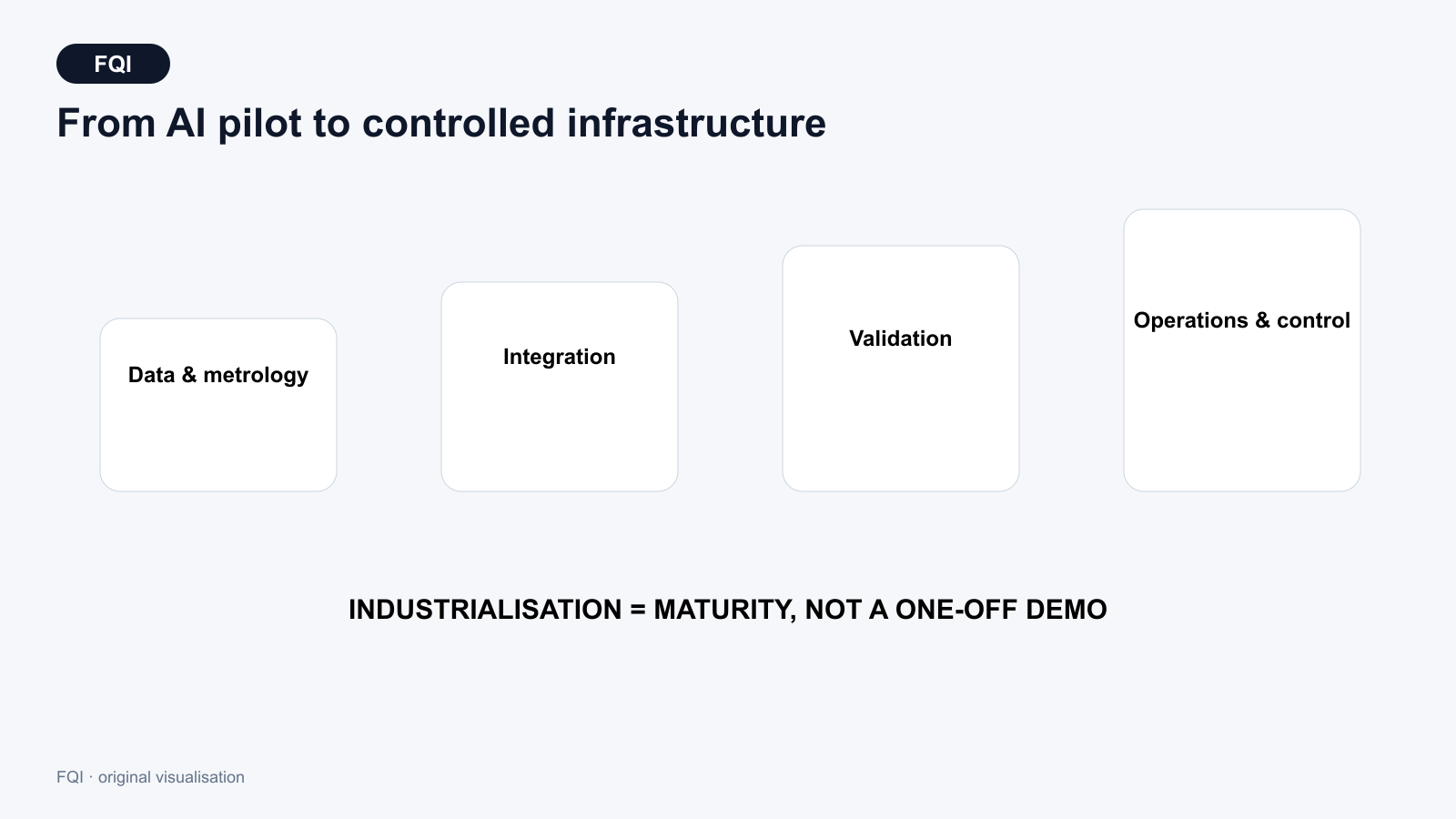
A robust maturity path can be divided into six levels. First, define the use case: process objective, CTQ (critical-to-quality requirement), customer, risk and economic benefit. Second, qualify the data and metrology basis: measurement chain, timestamps, resolution, data provenance, reference values and known bias. Third comes integration into machines, MES, CAQ, PDM or ERP, with clear interfaces and failure reactions. Fourth, develop the AI system, including the model, retrieval, rules and user interface. Fifth, conduct a risk-based TEVV and release phase—test, evaluation, verification and validation. Sixth, control continuous operation through drift monitoring, change control, incident and event processes, and periodic revalidation.
This resembles industrialisation. A laboratory result is not released directly into series production. The same principle must apply to AI. A highly accurate model can fail in the field when sensor values are assigned to the wrong time, variant identifiers are missing or maintenance states were absent from training. Conversely, a moderate model can create substantial process value through clear operating limits, plausibility rules and escalation.
The RAMS perspective extends conventional model metrics. Assessment should include availability of the data pipeline, restart after failure, behaviour when sensors are missing, model maintainability and a safe response to implausible results. An AI system that works only under ideal conditions lacks adequate industrial robustness.
One use case is predictive quality in electronics manufacturing. Process, machine and inspection data are used to predict defect probabilities. Value arises only when timing is correct, characteristics are unambiguous, material or programme changes are recorded, and a reaction plan exists. A second use case is a digital twin for process optimisation. Its valid operating range and the circumstances in which physical measurements take priority must be validated.
Scaling should proceed economically in stages. A proof of concept asks whether a technical signal exists. A pilot tests process benefit under real boundary conditions. Release evaluates risks and controls. Only continuous operation provides evidence about stability, maintenance effort and the actual effect on COPQ, the cost of poor quality. Skipping these distinctions creates technical debt and a shadow infrastructure that is difficult to audit.
Limitations and risks
First, the NIST publication is a broad roadmap. It prioritises research and development fields but is not a complete implementation standard for individual organisations.
Second, extensive infrastructure and governance requirements may make small projects uneconomic. The depth of control should scale with criticality, automation and the consequence of failure.
Third, explainability is not the same as correctness. A plausible explanation can rationalise an incorrect model result after the event. Explanation methods require their own validation.
Fourth, proprietary data models, platforms and interfaces can create long-term vendor lock-in. Maintainability and data portability therefore belong in the procurement decision.
Fifth, a technically strong pilot can fail because no one owns the process. Infrastructure cannot replace roles, competence and operational acceptance.
FQI conclusion
Industrial AI becomes scalable not through the best model, but through a controlled overall architecture. Data quality, metrology, interfaces, TEVV, RAMS, change control and process ownership determine the transition from demonstrator to production system. Quality management should therefore shape the architecture from the start—not be invited only when a pilot needs to be “validated” after the fact.
Sources & transparency
- Vogl, Cornelius and Jia: 2026 Roadmap on Artificial Intelligence and Machine Learning for Smart Manufacturing, NIST, published 3 July 2026.
- Full publication with digital object identifier: 10.1088/3049-4761/ae5967.
- Evidence status: research-oriented roadmap and review; not a binding implementation or certification standard.
- FQI transfer: The six-stage maturity path and the links to CTQ, TEVV, RAMS and COPQ are professional inferences by FQI.
- This article was researched and written with AI support. Sources and professional transfers were pre-reviewed with AI. Human professional and source approval was documented on 10 August 2026, and the article is approved for publication.
- Approval status: First-use explanations and the glossary were reviewed by a human and approved for publication on 17 August 2026. Approved by: Johann Fischer.