
Executive summary
Term note: AI – Artificial intelligence; systems that derive patterns from data or support tasks automatically. · FMEA – Failure Mode and Effects Analysis; a method for proactively assessing risks.
At production ramp-up, the data needed for reliable AI inspection is usually missing: representative defect images. A 2026 preprint proposes learning defect appearance from only three to five annotated examples and transferring it to new surfaces with a diffusion model. On the private industrial dataset used by the authors, mean average precision increased from 78.8% to 83.3% in the few-shot setting and from 65.0% to 85.1% for zero-shot domain transfer. The result is promising, but it is neither peer-reviewed nor independently reproducible with the published material.
FQI takeaway
- Synthetic data can accelerate inspection ramp-up: it can temporarily bridge the period between production launch and the arrival of sufficient real defect cases.
- Generated does not mean representative: morphology, frequency, position, illumination and process causality must be checked against real operating conditions.
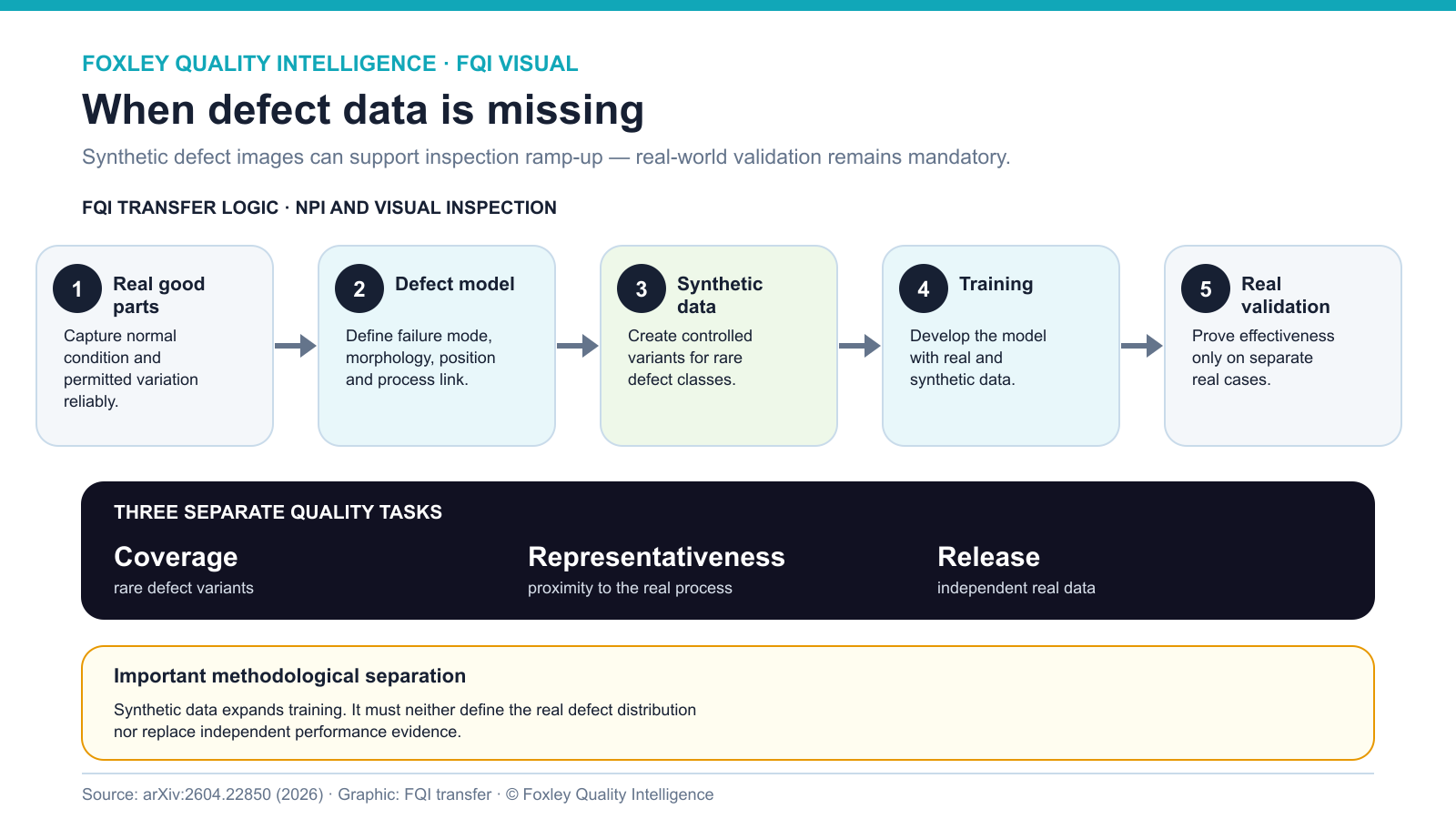
- Release evidence must remain separate: generated images may support training, but they must not constitute the independent proof of inspection effectiveness.
The principle at a glance
Visual inspection models need examples covering relevant variation in defect size, position, material, illumination, camera angle and process state. During new product introduction, critical defects are rare, surfaces may still change and intentionally producing defective parts may be expensive or unsafe. The proposed method separates defect appearance from its original background, learns a compact representation from a few similar examples and inserts the defect into a defined area of a good target surface. Post-processing aligns colour, illumination and local gradients so the result looks embedded rather than pasted on.
For quality management, the attractive idea is not simply “more images”. Prioritised failure modes from FMEA can be translated into early training cases with defined severity, location and boundary variants. This creates a link between risk analysis and inspection planning before series production has produced a sufficient defect history.
Deep dive
The decisive design question is the validation architecture. Training data, tuning data and independent test data must be separated. If a detector is trained with synthetic images and then evaluated mainly on images from the same generator, the test may primarily measure compatibility between generator and detector. Credible release evidence needs real parts, deliberately produced reference defects where feasible, boundary samples and later series defects.
A suitable Control Plan should therefore record the share of synthetic data per defect class, the generator version, expert approval of defect morphology, comparisons between synthetic and real feature distributions, and separate performance metrics for real and artificial test sets. A gap between these groups is evidence of a simulation-to-reality problem, not a reason to average the numbers.
The business case is strongest where real defect parts are rare, costly or hazardous. Yet volume alone has no value if generated images amplify the wrong visual cues or understate real process variation. A practical pilot can compare three development sets: real images only, real plus synthetic images, and real images with conventional augmentation. All variants should be evaluated on the same held-back real parts. Detection performance, false-alarm rate, robustness to illumination and performance on boundary samples should all be included.
Limitations and risks
The evidence comes from a preprint and a private industrial dataset. Optical plausibility does not demonstrate that a defect could physically arise in the process. Generator artefacts may become shortcuts that the inspection model learns instead of the defect. Synthetic variants also extend known failure classes; they do not guarantee detection of entirely new mechanisms. Finally, the reported performance values describe one experimental setting and are not a general performance promise.
FQI conclusion
Synthetic defect data is not a substitute for real inspection evidence, but it can be a powerful ramp-up tool. Used well, it reduces the time to a useful inspection model and translates FMEA priorities into concrete training cases. It becomes quality-capable only through provenance, version control, independent real-world testing and continuous feedback from series defects.
Sources & transparency
- Jindal et al.: Accelerating New Product Introduction for Visual Quality Inspection via Few-Shot Diffusion-Based Defect Synthesis, arXiv:2604.22850, April 2026.
- Evidence status: preprint without completed peer review; results are based on a private industrial dataset. The link to FMEA, Control Plans and release evidence is an FQI interpretation.
- This article and its original visualisation were created with AI support, professionally reviewed and explicitly approved for publication on 10 August 2026.
- Approval status: First-use explanations and the glossary were reviewed by a human and approved for publication on 17 August 2026. Approved by: Johann Fischer.