
Executive summary
The HopRefusalBench benchmark examines 889 multi-step questions that cannot be answered correctly with the available information. Even the best system tested stopped correctly and for the right reason in only 42.9% of cases. This is a central finding for quality management: an AI system needs criteria not only for correct results, but also for controlled stopping, uncertainty reporting, escalation and a safe fallback process.
FQI takeaway
- Reasoned abstention is a quality characteristic: A justified non-decision may be safer than a plausible but unsupported answer.
- Stopping criteria belong in the Control Plan: Missing evidence, contradictory sources and exceeded search budgets must trigger defined responses.
- Error metrics must be extended: Alongside wrong answers, organisations should measure late stopping, unnecessary refusal and wasted resources.
The principle at a glance
HopRefusalBench was published as an arXiv preprint on 2 August 2026. It combines three causes of unanswerability—an unknown answer, a false premise and insufficiently specified context—with different positions of the defect in a multi-step search chain. Ten proprietary and open models were examined in search-augmented operation. The best system achieved a TCHR (Target-Aware Correct Halting Rate) of 42.9%. The study has not yet been peer reviewed.
Terms explained
- AI: Artificial intelligence; systems that derive patterns from data or support tasks automatically.
- FMEA: Failure Mode and Effects Analysis; a method for proactively assessing risks.
- 8D: Eight Disciplines problem-solving method; D1 through D8 structure the team, problem, cause, actions and closure.
Deep dive
Conventional AI benchmarks mainly evaluate whether a correct answer was produced. In quality-relevant processes, this view is incomplete. A system can also fail by answering an unsolvable task, accepting a false premise or continuing to search until its resource budget is exhausted. The problem is not only hallucination, but a lack of control over when decision-making must stop.
HopRefusalBench makes these differences visible. The authors distinguish targeted refusal, apparent refusal without the correct reason, hallucinated completion and exhaustion of the search budget. A large proportion of explicit refusals stated the correct reason. According to the authors, the bottleneck was more often the decision to refrain from answering at all. The system could partly recognise the deficiency but continued processing nevertheless.
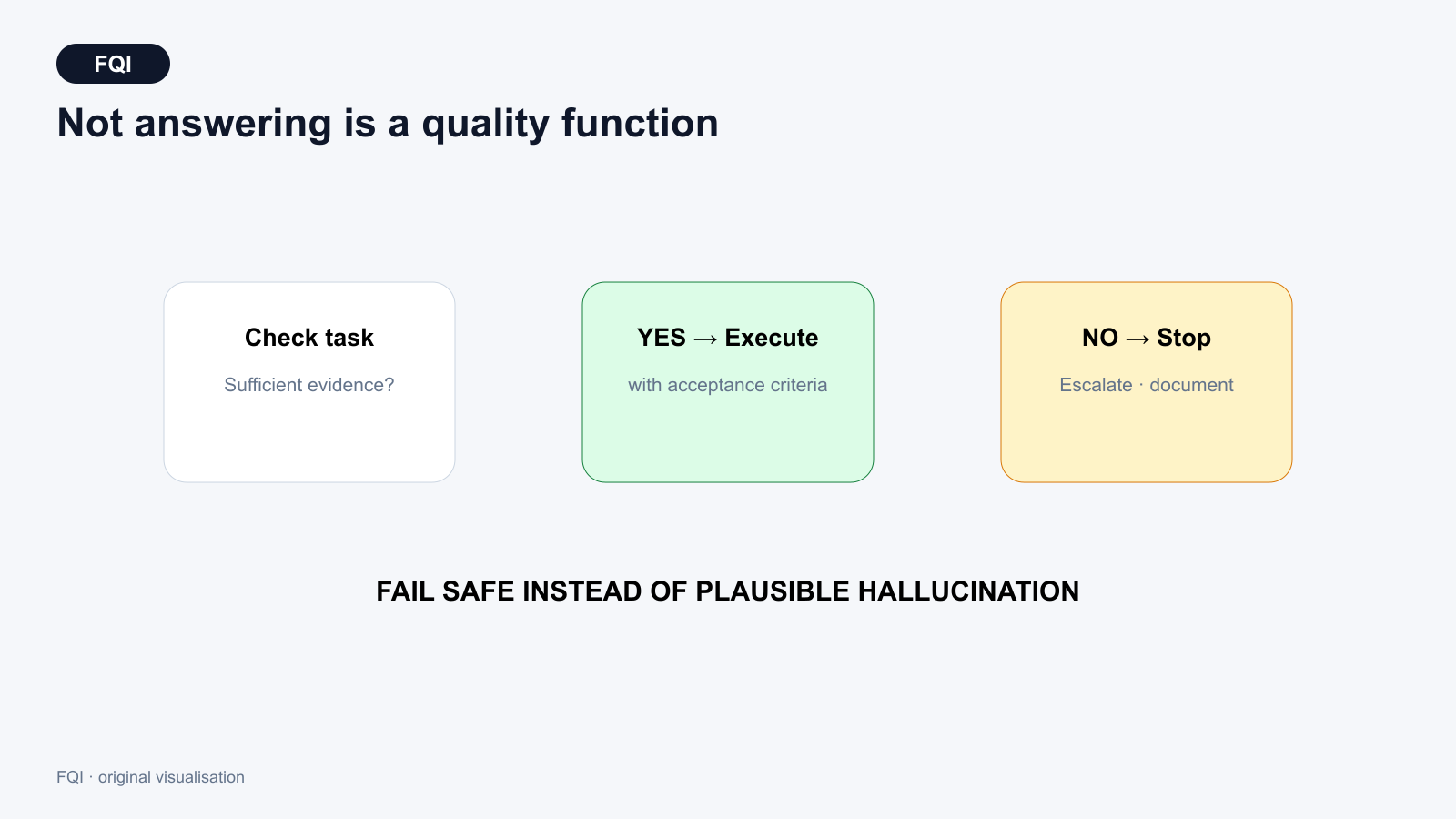
In quality management, a correct non-decision corresponds to a fail-safe state. A machine that stops when a protective signal is missing fulfils a safety function. An inspection process that places an incomplete lot on hold initially produces no output, but prevents a defect escape. AI systems need the same logic to be specified explicitly. “I do not have sufficient reliable evidence” is then not a usability defect, but an intended process outcome.
A Control Plan for an AI agent should therefore define input conditions and reaction plans. Critical characteristics might include the number of independent sources, source age, degree of contradiction, coverage of required fields, extraction confidence and remaining search budget. When limits are violated, the agent must not continue composing freely. Possible responses include asking a clarifying question, handing over to a person, setting a hold status, providing a limited partial answer or stopping with a reason.
Metrics must represent this logic. In addition to the correct-answer rate, at least five outcomes are useful: correct answer, correct refusal, unnecessary refusal, wrong answer despite missing evidence and termination after exceeding resources. The timing and cost of stopping also matter. A system that stops correctly only after one hundred search steps should be evaluated differently from one that identifies the missing prerequisite early.
One use case is AI-assisted 8D analysis. If inspection values are missing or the cause is unsupported, the agent should not formulate a root cause. It should identify the evidence gap and propose the next verification step. For discipline 4 (D4), this is significantly safer than a linguistically convincing assumption. A second use case is automated supplier or standards research. If a current primary source is unavailable or document versions conflict, the system should block the decision rather than derive an apparently definitive statement from older secondary sources.
The transfer to FMEA is direct. Failure modes include “agent answers an unsolvable question”, “agent stops despite sufficient evidence”, “agent fails to recognise a false premise” and “agent consumes resources without gaining information”. Prevention and detection controls must then be validated through targeted negative testing. Unanswerability becomes a regular part of inspection planning.
Limitations and risks
First, the benchmark represents multi-step knowledge search. Other applications such as visual inspection, forecasting or process control need their own stopping criteria and cannot be evaluated with the same metrics.
Second, a high refusal rate is not automatically safe. Excessive caution can block processes, increase lead times and encourage users to create informal workarounds.
Third, language-model confidence scores are not automatically calibrated. A numerical threshold alone is not reliable evidence of answerability.
Fourth, the human escalation route can itself become a bottleneck. The fallback process must be designed for sufficient capacity, response time and competence.
FQI conclusion
Reliable AI must know not only how to process a task, but also when it must stop. Controlled termination is the digital equivalent of a hold, stopping the line and entering a fail-safe state. Quality management should treat abstention, clarification and escalation as specified outputs with dedicated test cases, metrics and reaction plans. Only then does a general AI answering function become a controlled decision process.
Sources & transparency
- Xie et al.: HopRefusalBench: Diagnosing Refusal Failures in Search-Augmented Agents for Multi-Hop Reasoning, arXiv:2608.01358, 2 August 2026.
- Evidence status: current preprint without completed peer review; the study examined multi-step, search-augmented knowledge tasks.
- FQI transfer: Treating the topic through fail-safe, Control Plan and FMEA concepts is a professional inference by FQI.
- The 42.9% metric is benchmark- and configuration-specific; it is not a general failure rate for production AI systems.
- This article was researched and written with AI support. Sources and professional transfers were pre-reviewed with AI. Human professional and source approval was documented on 10 August 2026, and the article is approved for publication.
- Approval status: First-use explanations and the glossary were reviewed by a human and approved for publication on 17 August 2026. Approved by: Johann Fischer.