
Executive summary
AssertMate is a current research approach for automatically generating software test assertions. The system separates the question of what should be observed from the prediction of the expected result and combines several AI perspectives. The transfer to quality management is fundamental: test volume alone does not demonstrate effectiveness. A test detects faults only when the characteristic, reference and acceptance criterion are technically correct.
FQI takeaway
- Code coverage is not evidence of effectiveness: An executed test without a suitable test oracle may leave real faults undetected.
- The inspection characteristic and target value must be developed separately: “What should be measured?” and “Which result is correct?” are different quality questions.
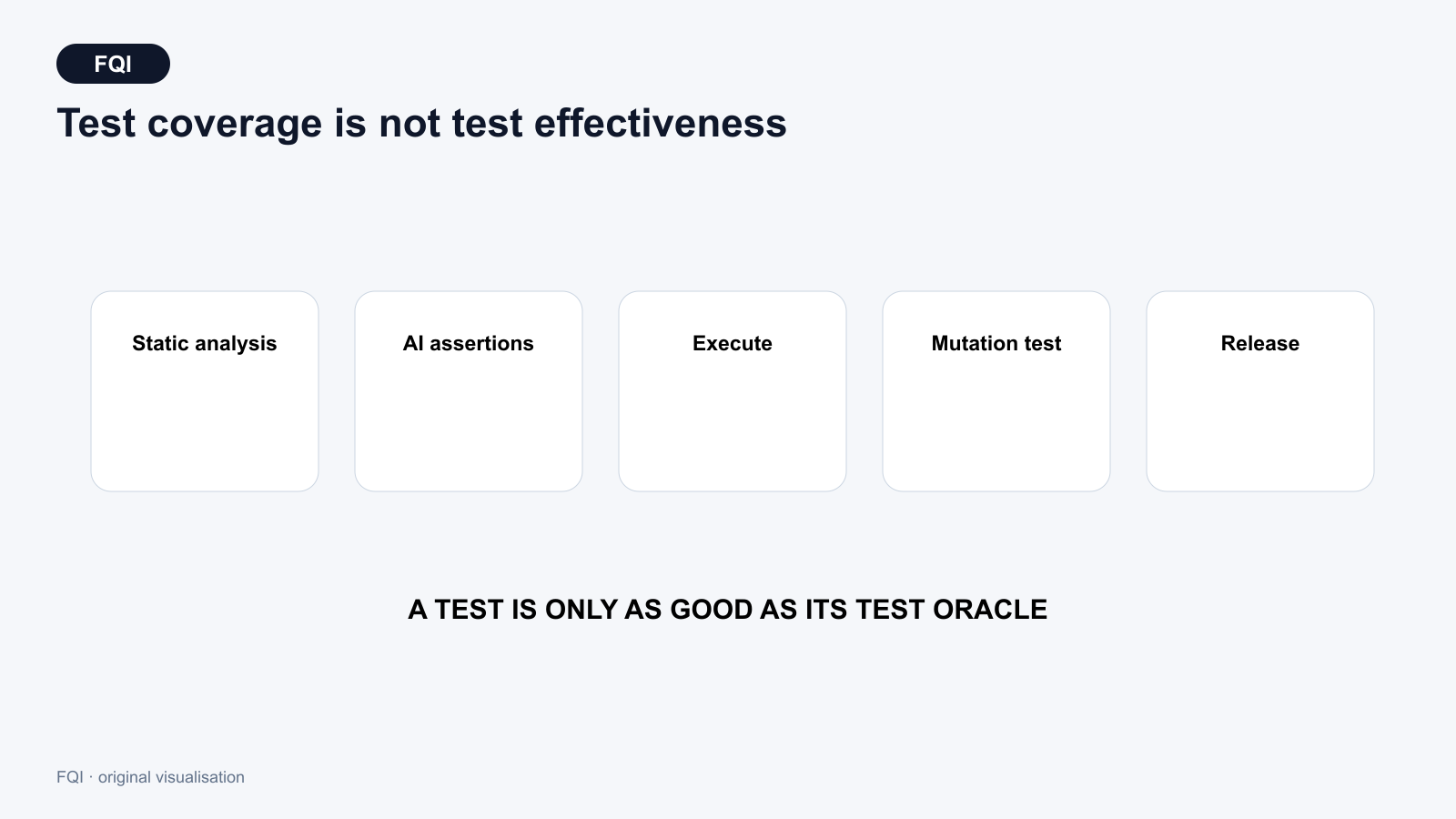
- AI needs deterministic cross-checks: Static analysis, execution and mutation testing provide stronger evidence than self-assessment by language models alone.
The principle at a glance
The preprint “Agent-Based Test Assertion Generation via Diverse Perspective Aggregation” was published on 6 August 2026. AssertMate combines three components: static and type-based construction of the observed actual value, multiple AI strategies for determining the expected value, and an large language model (LLM)-based selection agent. On the Defects4J benchmark, the authors evaluated compilability, pass rate and fault-detection rate, among other measures. The work has not yet been peer reviewed and focuses on Java software tests.
Terms explained
- AI: Artificial intelligence; systems that derive patterns from data or support tasks automatically.
- FMEA: Failure Mode and Effects Analysis; a method for proactively assessing risks.
- LLM: Large language model; a model for processing and generating text.
- reasoning: The processing steps an AI system uses to connect information and reach an answer or decision.
- output token: A technical unit used to process text; a token usually represents a word or word part, not necessarily a complete word.
Deep dive
A unit test is more than code that executes a function. It needs a test oracle: a statement defining which result is expected and when the test passes. Without a reliable assertion, a test may execute large portions of the code and still detect no fault. This distinction is equally important in general quality management. A physical inspection plan is ineffective if characteristics are measured but limits, references or reaction rules are unsuitable.
AssertMate structures the task into three stages. Static analysis and type-dependent rules first determine which actual value can reasonably be observed. Several agents then generate candidates for the expected value from different perspectives, including code generation, retrieval-augmented generation and multi-step reasoning. Another agent selects an assertion. This architecture narrows the language model’s task: it does not have to invent the characteristic, measurement access and expected behaviour simultaneously.
In the Defects4J experiment, AssertMate achieved a compilation success rate of 76.78%, a pass rate of 60.09% and a fault-detection rate of 46.25%, according to the authors. They report statistically significant improvements over the comparison approaches and supplemented the evaluation with mutation testing. AssertMate also required substantially more tokens. The figures indicate potential, but also show that a significant share of generated assertions still fails to compile, fails to pass or does not detect faults.
The transfer to inspection planning begins by separating the inspection object, characteristic and acceptance criterion. An AI system may generate numerous inspection steps from a specification. That alone does not increase inspection effectiveness. Each step must address a relevant failure mode, use a suitable measuring or inspection device and apply a technically correct target criterion. FMEA can establish the connection to risk; test or inspection planning translates that risk into evidence.
Mutation testing transfers as well. In software, controlled faults are introduced into code to determine whether tests detect them. The equivalent in technical inspection includes boundary samples, deliberately introduced defects and challenge parts. An inspection system should not merely accept known good parts correctly; it must reliably detect defined defects. The focus shifts from the size of the inspection plan to its detection effectiveness.
One software use case is integrating AI into a CI/CD pipeline. The system proposes assertions; static analysis and the compiler check their form; mutation testing evaluates fault detection; and critical changes require human approval. A broader quality-management use case is an assistant for inspection instructions. It identifies potential characteristics from drawings and specifications, formulates target criteria and links them to FMEA effects. The proposals are checked against qualified references; AI does not decide release on its own.
The approach also illustrates a useful architectural principle: use generative AI where several plausible hypotheses or formulations are needed. Use deterministic methods to check syntax, types, executability and measurable impact. This combination is stronger than a purely generative system evaluating its own work.
Limitations and risks
First, the study is a preprint based on an established but limited Java benchmark. Results do not automatically transfer to other languages, architectures or industrial software.
Second, the selection agent is itself an LLM. Candidate generation and assessment may therefore contain correlated errors. Independent expert or execution-based verification remains necessary.
Third, compilation and pass rates are well below 100%. The approach is an assistance system, not an autonomous release authority.
Fourth, resource consumption is higher than for simpler methods. Economic viability depends on failure costs, criticality and the degree of automation.
Fifth, mutation testing covers only the injected fault classes. Unmodelled requirements and systemic interactions remain undetected.
FQI conclusion
AssertMate offers a quality lesson that extends beyond software: a test is only as good as its test oracle. More test cases, greater code coverage or additional agents cannot replace technically correct characteristics and target criteria. A useful architecture combines AI-generated candidates, deterministic checks, deliberate fault injection and risk-based human release. AI thereby becomes a tool for inspection planning—not a replacement for objective evidence.
Sources & transparency
- Wang et al.: Agent-Based Test Assertion Generation via Diverse Perspective Aggregation, arXiv:2608.05822, 6 August 2026.
- Evidence status: current preprint without completed peer review; evaluated on Defects4J with a focus on Java unit tests.
- FQI transfer: Applying the findings to general inspection planning, FMEA, boundary samples and challenge parts is a professional inference by FQI.
- The reported metrics are benchmark- and implementation-specific and are not a general performance guarantee for AI-assisted test systems.
- This article was researched and written with AI support. Sources and professional transfers were pre-reviewed with AI. Human professional and source approval was documented on 10 August 2026, and the article is approved for publication.
- Approval status: First-use explanations and the glossary were reviewed by a human and approved for publication on 17 August 2026. Approved by: Johann Fischer.