
Executive summary
Finding the original lot number in a long record is one task. Identifying the lot in a test station after two transfers is another. StateBench studies this distinction using controlled sequences and varies the kind of state update a language model must follow. An acceptance test for a document assistant can compare the tasks at the same text length to identify where retrieval gives way to an error in updating related values.
FQI takeaway
- Vary document length and type of update independently.
- Calculate the expected state after every event outside the model.
- Give a successful search test credit only for the use it actually covers.
The principle at a glance
The simplest task assigns a value that never changes. The next allows a later entry to overwrite an earlier one. Another operation updates the current value, for instance by adding to a counter. A fourth allows one object to take the current value of another. It matters exactly when the transfer occurred. Applying a subsequent change at the source retroactively to the copied value would give the wrong answer.
Deep dive
StateBench derives related variants from one sequence. It holds the number of variables, possible values and positions of assignments comparable. This lets researchers examine when a successful search turns into an incorrect calculation. They observe differences between model architectures and between task formats. Training specifically on these tasks also changes the interpretation of the result. A model trained for the experiment has undergone a different test from an existing assistant used as supplied.
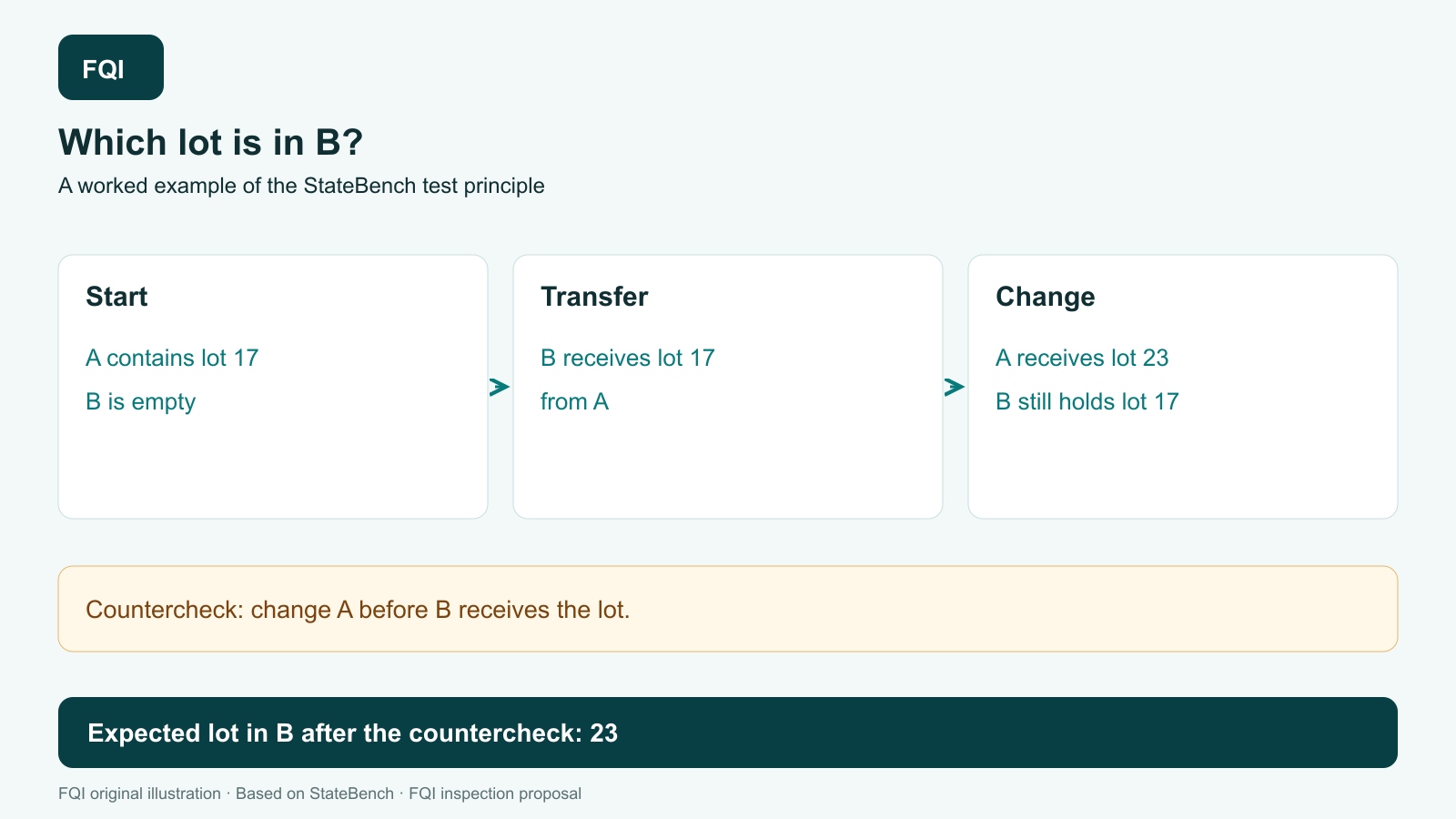
A simplified FQI example uses two containers. A starts with lot 17. B takes the lot number from A. A then changes to lot 23. What lot is in B? An inspector records both states after each event and obtains 17 for B. An easier control document states the number assigned to B explicitly at the same place. The two documents can have the same length and the same number of distracting entries.
For a paired test, reverse only the order of the transfer and the change to A. The correct answer for B now changes, although the document contains the same numbers and container names. An unchanged answer suggests a shortcut worth investigating. This pair can reveal more about the failure than another randomly selected page. Asking the question both immediately after the decisive event and again at the end helps distinguish executing an update from retaining its result through later entries.
Limitations and risks
The study uses formally defined operations. Real logs can contain late entries, reversals and ambiguous timestamps. If the order is unresolved, there may be no unique expected answer. Flag those cases for clarification. A synthetic test does not assess the interpretation of local rules or the reliability of a connected database.
FQI conclusion
Tie acceptance to the operation needed in practice. A search test may suffice to display an explicitly recorded value. An inventory query after several transfers requires a verified way to apply the events in order. If the assistant fails when copying values between objects, a deterministic component could compute the state and leave the language model to explain it and point to the relevant entries.
Sources & transparency
The StateBench team describes its own methods and model comparisons. Operational examples and proposed checks are FQI interpretations. Sources reviewed on 4 November 2026. Artificial intelligence assisted preparation. Johann Fischer explicitly approved this article package for publication on 2026-11-04.