
Executive summary
An artificial intelligence (AI) agent can acknowledge a limit in words without enforcing it technically. FARSIGHT examines published trading-agent designs and available implementations. FQI focuses on the distinction between a recommendation inside the model and a restriction enforced independently. A stop should remain effective when the model makes a mistake, responds late or adopts the same unreliable source as other agents. The study supplies inspection questions, not an assessment of financial products or evidence of industrial operating safety.
FQI takeaway
- Test stop and quantity limits on the actual execution path.
- Compare documented safeguards with the released software revision.
- Demonstrate stopping when the model response is missing or incorrect.
The principle at a glance
A language model can receive textual rules and consider them in its answer. An external restriction instead controls the action independently of that judgment. For an agent modifying work orders, it might enforce a maximum change count or block execution without permission.
The AI connection is delegation of decisions to language models. The quality problem arises when a promised limit exists only as advice inside the same unreliable decision chain.
Deep dive
FARSIGHT assesses 15 academic designs and audits seven released codebases. The authors distinguish described controls from implementation evidence. The releases do not contain complete live trading execution paths, which explicitly limits the findings. Additional market experiments are simulations. FQI therefore transfers the control principle, not a numerical damage estimate.
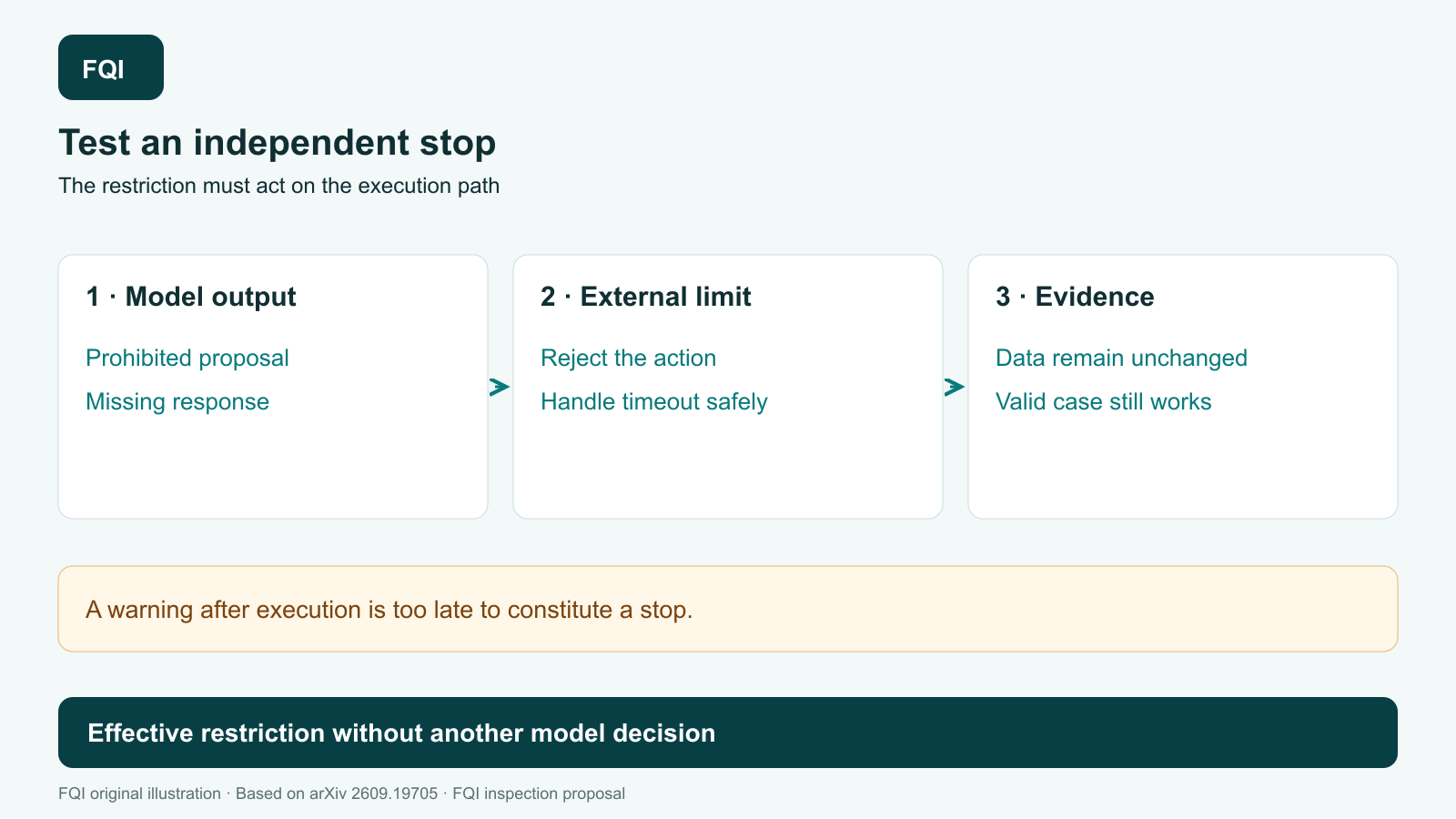
FQI proposes testing the stop path with a deliberately unreliable model answer. In a simplified example, an agent reschedules inspection orders. The team specifies a permitted change count. The agent then proposes a larger count. A technical control must detect the excess before changes occur. A warning in the final report would be too late.
Repeat the experiment with no response and with an invalid response format. Define the expected behavior beforehand. In particular, a timeout must not accidentally become permission. A successful stop should be accompanied by evidence that the affected data remained unchanged.
Next test an allowed operation. The safeguard must distinguish why this case is permitted. Blanket blocking is easy to achieve but does not constitute a useful process control. Technical responsibility includes both preventing damaging actions and enabling legitimate work.
Connect each safeguard claim to its concrete execution path. Include alternative interfaces through which the same modification is possible. A restriction in the user interface is insufficient if another tool call bypasses it. Tool changes require renewed examination. The approved configuration record should identify tested paths and those outside the experiment.
Preserve the stop reason, rejected operation and state comparison as one evidence record. A reviewer can then distinguish a warning that merely appeared in a model response from a control that prevented the operation. This record is also useful when investigating why an otherwise valid operation was blocked.
Limitations and risks
The study examines academic designs and available research code. Missing documentation does not automatically prove that an operator lacks all controls. Conversely, a function named in a paper is not implementation evidence. Simulated populations do not directly characterize actual markets or industrial equipment. FQI transfers only the architecture question to controlled work processes. This article provides no trading recommendation.
FQI conclusion
A stop is established by its effect on the relevant action. FQI recommends an experiment outside the model’s decision: an impermissible operation, a missing response and a permitted control case. Bind results to the actual tool path. A general safety promise then becomes a testable property of a defined configuration, with limits that remain visible when the system changes.
Sources & transparency
Methods, evaluation and limitations reviewed on 3 November 2026. Scientific preprint; no independent reproduction by FQI. Operational examples and inspection proposals are FQI interpretations, not additional experiments in the study. Artificial intelligence assisted preparation. Johann Fischer explicitly approved this article package for publication on 2026-11-04.