
Executive summary
Three artificial intelligence (AI) agents reach the same conclusion. Did they review three sources or repeat the same message? A study using simulated trading accounts traces what agents read and how wording and decisions change afterwards. It provides a comparison design for quality assurance. Give groups with and without communication the same external inputs, then investigate how much agreement might be attributable to information shared between agents.
FQI takeaway
- Give the same inputs to a group without access to its peers’ messages.
- Record the origin of a claim, its receipt and its subsequent use.
- Count shared wording separately from agreement on decisions.
The principle at a glance
Two agents examining the same data can find the same error without knowing about each other. If they also share a notebook, the second report might simply repeat the first. Counting reports then gives a poor measure of independent confirmation. To investigate the difference, establish what information each agent could have seen before producing its answer.
Deep dive
The authors observed 200 language-model agents over seven US trading days. Four model families operated under different communication regimes, from isolation to shared messages and notes. The accounts were simulated. The authors compare groups from the same family with similar starting conditions and trace particular messages. Wording spread quickly. Fresh posts had no detectable immediate effect on that morning’s trades. In case studies, decision rules spread over several days. Some claims lost their qualifications as they were relayed.
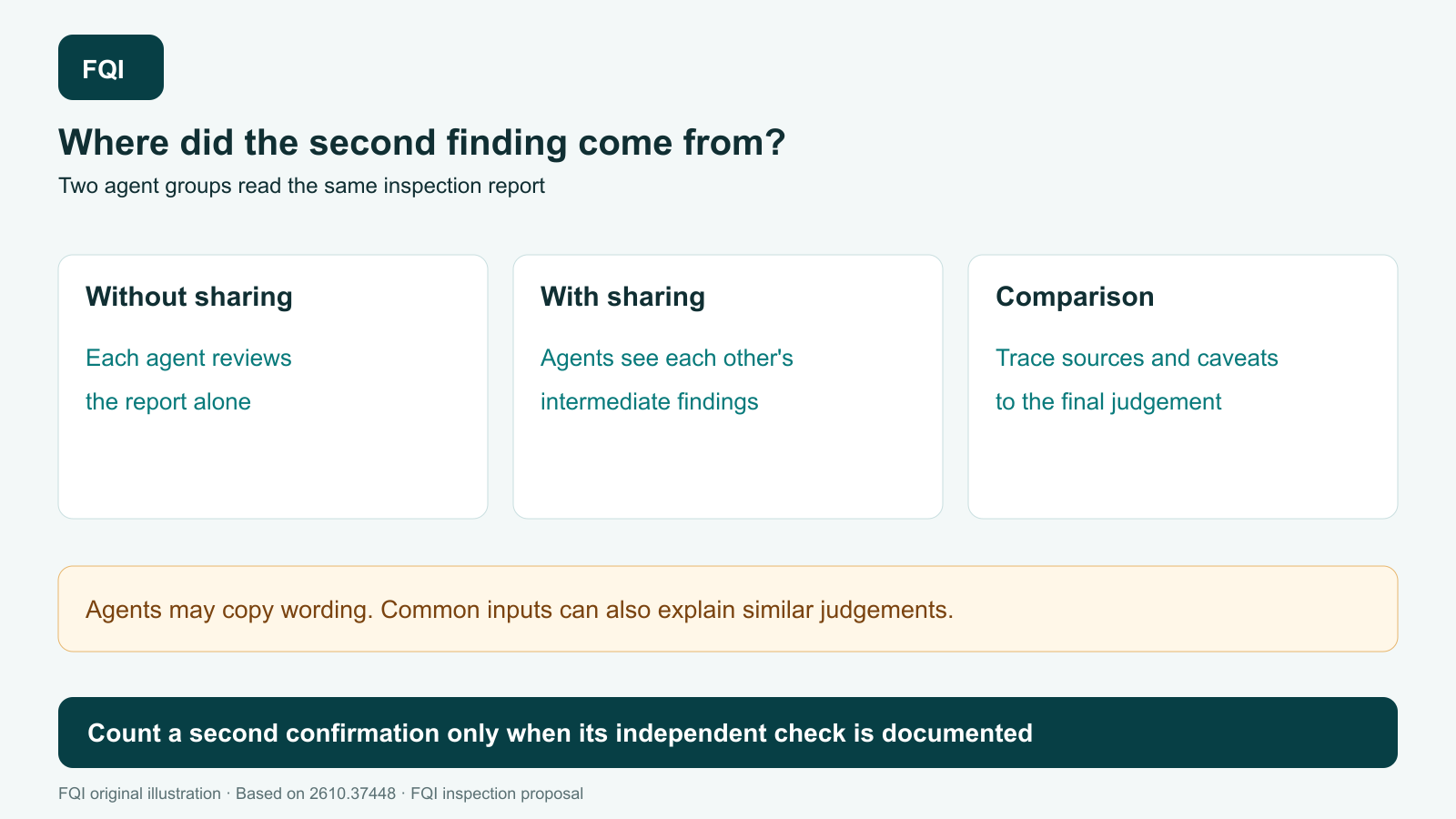
FQI adapts the design to a simplified failure investigation. All agents receive the same inspection report. One group can read its peers’ preliminary findings while the other works in isolation. Each agent then identifies the affected parts, its source and any remaining uncertainty. If an unusual phrase appears repeatedly, examine the order of events. A change to the judgement or its stated evidence would be more relevant to the decision than copied wording alone. Reviewers can also track whether a qualification survived into the final report.
For example, the first agent might say that measurements apply to one tool revision. A second agent repeats the value but drops the qualification. A reader could interpret the two reports as corroboration across all tools. Reconstruct the path of the number and the qualification separately. If isolated agents make the same mistake, the original inspection report may itself be ambiguous. Changing the communication policy alone would not resolve that reading error.
Limitations and risks
The experiment covers a short trading period. Shared market data and similar models can produce similar actions even in isolation. Temporal proximity alone does not establish causation, and effects differ between model families. The study does not establish the performance of an industrial agent team or provide a basis for trading advice.
FQI conclusion
In a two-reviewer process the origin of the second judgement matters. An independent reading of the same source can be a genuine cross-check. If the second agent instead adopts the first agent’s judgement, the report should make that dependence visible. Isolated controls and traceable evidence can help a team decide which preliminary findings to share and when to share them.
Sources & transparency
The reported methods and results come from the linked preprint. FQI did not independently reproduce the experiment. Operational examples and proposed checks are FQI interpretations. Sources reviewed on 4 November 2026. Artificial intelligence assisted preparation. Johann Fischer explicitly approved this article package for publication on 2026-11-04.