
Executive summary
The reliability of an image model’s probabilities can depend on the number of labelled examples available for adaptation. PRISM investigates this using small patches of digitised tissue. With full supervision the study finds an association between discrimination and subsequent calibration. With very few labels, that relationship no longer reliably supports a ranking. A model comparison should therefore include the labelling budget actually available at the intended site.
FQI takeaway
- Compare models using the intended proportion of labelled examples.
- Report discrimination and calibration before and after adjustment.
- Test both directions of transfer between sites separately.
The principle at a glance
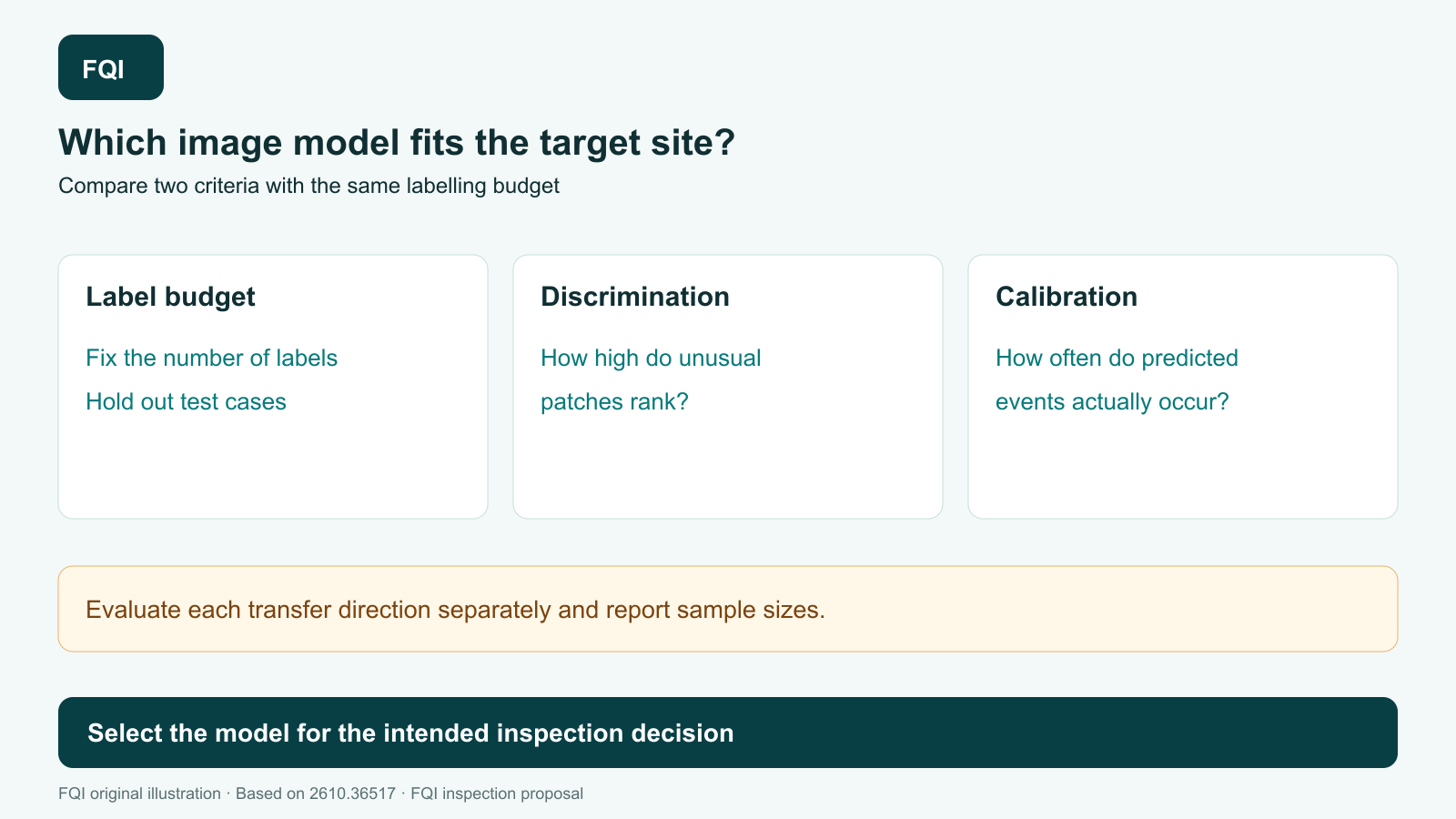
Discrimination concerns whether positive cases generally rank above negative ones. Calibration concerns what a probability means in practice. A system may order cases well while consistently assigning values that are too high or too low. When a threshold triggers further inspection, both properties matter. The order alone does not tell a team which numerical threshold is appropriate.
Deep dive
PRISM compares eight pretrained models on six datasets. The image representations stay fixed, and a simple classifier learns from different fractions of the available labels. This controls some sources of variation while describing only one way to adapt a model. The study also examines transfer between five hospitals under the same label definition. Rescaling the probabilities after training helps to different degrees across the test settings.
A similar decision arises when a second factory can label only a small number of inspection images. For a local study, FQI would identify the source site, target site and direction of transfer. Compare all models at the same predefined label budget and reserve a separate sample for testing. Report how well the model ranks defects and how often a finding is confirmed within each range of predicted probabilities. Retain case counts for small groups.
Suppose one model ranks unusual patches slightly better at the target site, while the probabilities of a second match the observed frequencies more closely. The first property may matter most when a person reviews a prioritised list. Calibration carries more weight when a numerical probability triggers another inspection. Specify the operational task before ranking the models. A composite index can screen combinations, but the final decision still needs the component results. Document which site supplied calibration data and which references remained untouched until testing.
Limitations and risks
The manufacturing example is an FQI application. The study examines tissue patches using a particular learning protocol. A patch is not a whole slide, and these results do not establish clinical readiness. Site differences can combine several influences. The regularisation used to fit the classifier can also affect the ranking. An apparent transition in these data is not a universal threshold.
FQI conclusion
Before purchasing more annotations, identify the part of the decision for which evidence is missing. If discrimination improves at the source while probabilities at the target remain unreliable, an additional comparison at the target may be more informative. A report organised this way helps allocate labelling effort to the conditions that will determine whether the proposed inspection actually works.
Sources & transparency
The reported methods and results come from the linked preprint. FQI did not independently reproduce the experiment. Operational examples and proposed checks are FQI interpretations. Sources reviewed on 4 November 2026. Artificial intelligence assisted preparation. Johann Fischer explicitly approved this article package for publication on 2026-11-04.