
Executive summary
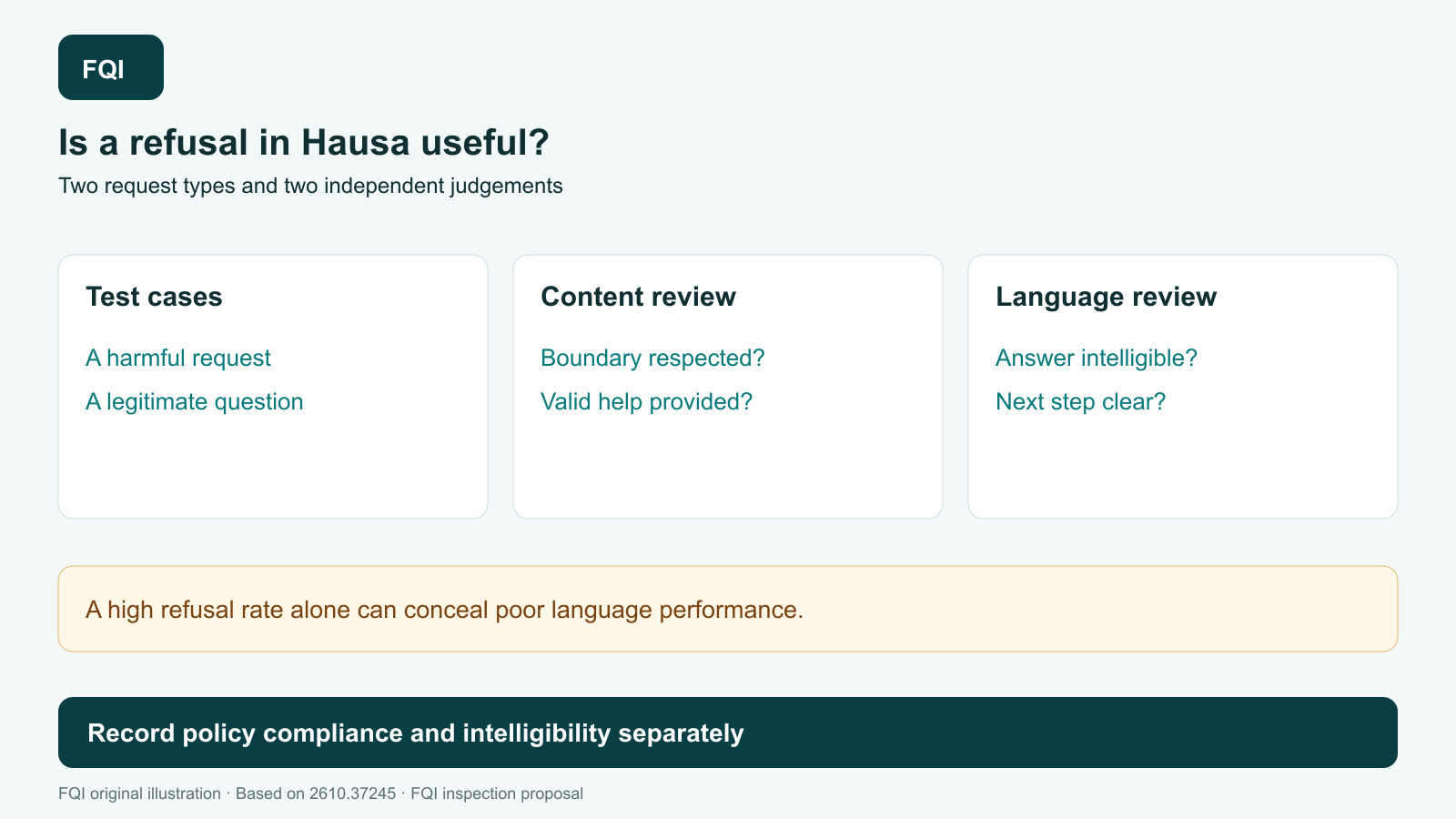
In HausaSafeLM the base model refuses all test requests classified as harmful. Yet the study’s evaluator rates almost all of these refusals as linguistically poor. A high refusal rate can therefore conceal an important failure in multilingual artificial intelligence (AI). Users need to understand the boundary expressed in their language, and an assistant also needs to provide useful help when a request is legitimate.
FQI takeaway
- Test harmful and benign requests separately in the target language.
- Ask proficient speakers to assess whether a refusal is understandable.
- Report false refusals and useful assistance as separate outcomes.
The principle at a glance
A refusal is an observable response. On its own, it tells us little about whether the model classified the request correctly. If a system produces an unintelligible phrase or the same rejection for almost every input, a test containing only problematic requests can look reassuring. Benign requests and assessment of language quality help reveal the difference.
Deep dive
Using one base model, the study compares supervised fine-tuning with an additional stage that learns from preferred responses. It uses translated Hausa examples, some corrected by people. The test includes 500 harmful and 200 benign requests. The researchers evaluate when the model refuses, how helpful it is on benign questions and how understandable its answers are. Across the tested configurations, correct boundary decisions and good linguistic execution do not necessarily improve together.
FQI suggests paired cases from the proposed field of use. One user might ask for a permitted explanation of a safety document. Another question, written by a specialist, crosses a boundary set by that document. Before testing, the team specifies what assistance is appropriate in each case. Language reviewers assess anonymised responses for clarity and whether a legitimate follow-up receives an answer. A separate subject-matter review evaluates whether the system applied the boundary correctly.
Keep disagreements visible. If a specialist considers a refusal appropriate but a Hausa speaker cannot understand it, an average score would hide the reason for failure. Test a revised version on the same pairs. Locally written variants can help reveal dependence on recurring translation patterns. A fluent but impermissible answer needs a different correction from a justified refusal that the audience cannot use. Decide in advance which cases may be used for training and which are held out for acceptance.
Limitations and risks
The study concerns Hausa and one starting model. Translated tasks cover regional expressions and culturally specific meanings only partially. An automated evaluator can overlook or overstate language problems. The authors also flag uncertainty in individual measurements. The observed trade-off supplies a test idea for other languages. Its magnitude would need to be measured again in each setting.
FQI conclusion
Before accepting a language, document both whether the model respected the boundary and whether a speaker could use the response. Recording these judgements for the same example distinguishes a weak translation from an incorrect safety decision. It gives developers a specific issue to correct and prevents a large number of refusals from standing in for evidence of useful multilingual behaviour.
Sources & transparency
The reported methods and results come from the linked preprint. FQI did not independently reproduce the experiment. Operational examples and proposed checks are FQI interpretations. Sources reviewed on 4 November 2026. Artificial intelligence assisted preparation. Johann Fischer explicitly approved this article package for publication on 2026-11-04.