
Executive summary
A model correctly reproduced every test label in a study of a rotary valve in a dairy pilot plant. The labels came from a threshold applied to a vibration measurement that was also available to the model. The result demonstrates how faithfully a device can implement an alarm rule. A maintenance decision about physical wear requires a further link between the alarm and the condition of the equipment.
FQI takeaway
- Trace every condition label back to the measurement, engineering rule or inspection that produced it.
- Report agreement with the rule separately from detection of independently confirmed faults.
- Check different valves, operating conditions and on-device resource requirements before changing a maintenance interval.
The principle at a glance
Condition monitoring looks for a change in the way a machine operates. Prognosis asks a different question about a future failure or remaining service life. The authors collected vibrations from a working rotary valve and processed the measurements on a computer inside the plant. An interpretable learning model allowed them to examine which signals drove its decisions. This provides a way to check what the detector learned. Establishing how much the rotor had worn would require an independent observation.
Deep dive
The researchers recorded vibrations at one valve position on three occasions. They measured the old unit before its scheduled replacement, the newly commissioned replacement and the same replacement after three months. The service stages reflect time in operation. They were assigned without physically measuring wear. Production conditions could therefore also account for differences between recordings.
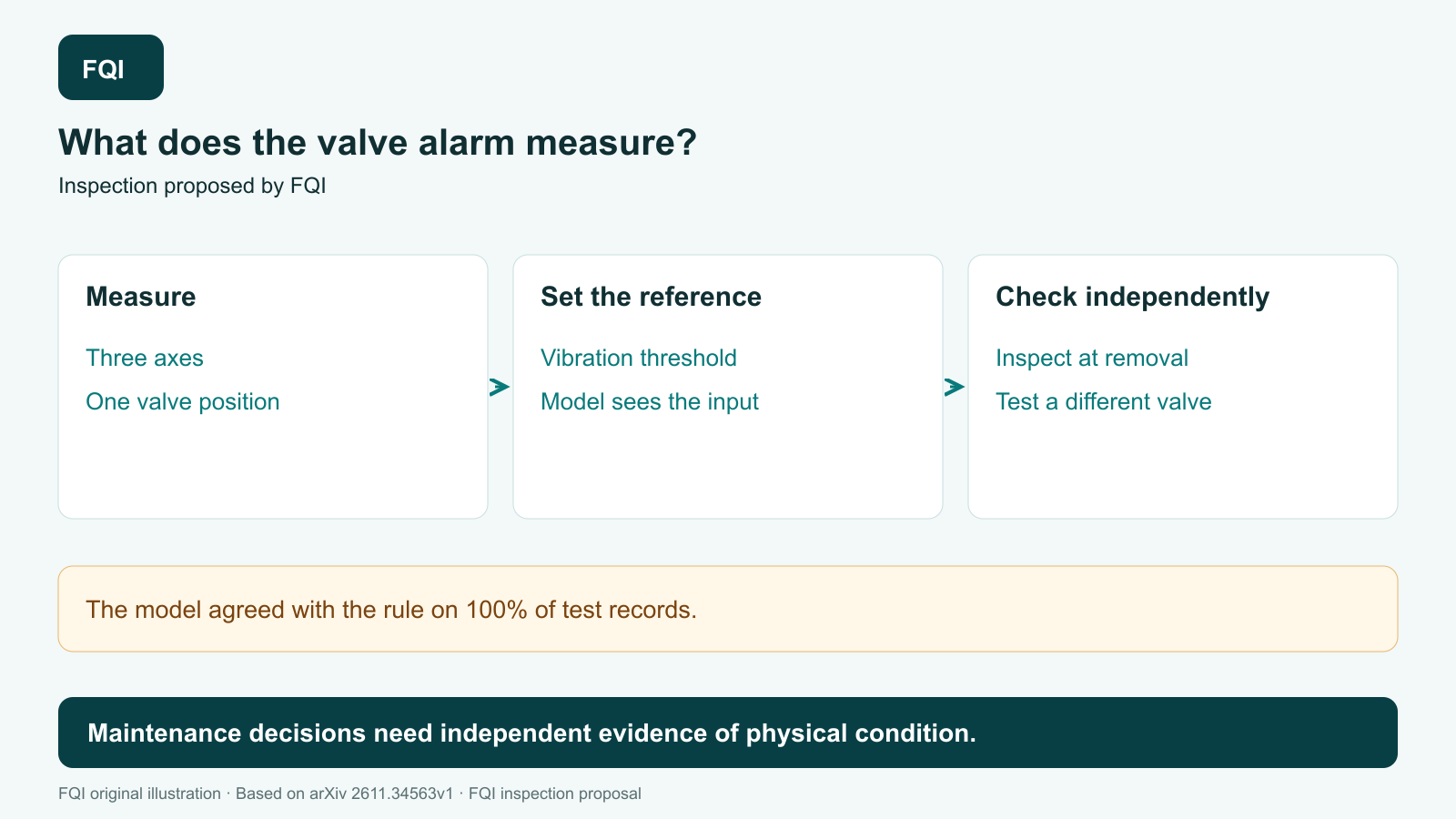
The machine-learning dataset contained 1,287 records from the old and newly commissioned units. The team combined the effective vibration measurements on three axes into one magnitude. A value of 0.5 or less was labelled anomalous because it departed from the vibration signature of the running rotor. The combined magnitude was also an input feature. An Explainable Boosting Machine, which represents predictions through interpretable feature contributions, agreed with the rule on 100% of test records. A linear support vector machine agreed on 99.61%.
The explanations recovered the threshold and showed which axis dominated at this mounting position. The findings can guide a test of whether fewer features would suffice. The authors acknowledge that a simple decision tree could reproduce the threshold. They also report resource advantages for the interpretable model on the tested device. A successful implementation and an independently validated wear detector are distinct engineering deliverables.
FQI proposes a two-stage acceptance exercise. First, run known measurements through the entire device and check the expected flag, processing time and behaviour at the threshold. Then test the claimed physical meaning of the flag. For example, retain inspection findings from removed valves, link those findings to preceding measurements, and review both flagged and unflagged cases. Equipment reserved for this second test should remain outside model development. A maintenance team could then assess the consequences of an unnecessary alarm and of a missed fault using evidence from its own operating range.
Limitations and risks
The experiment covers one position at a pilot plant. A random split of individual records does not test transfer to another installation. Operating conditions and sensor position could change the distribution. The data are subject to confidentiality restrictions. Resource figures came from single runs, without independent hardware power measurements or continuous per-window latency tests. The proposed feature reductions and remaining service life still need validation.
FQI conclusion
The most informative part of this case is the origin of the reference. Agreement with a monitoring rule can justify a narrowly defined device function. Extending a replacement interval requires evidence that connects the measurements to physical condition and to the consequences of continued operation. A review should put those two claims alongside their respective tests, so maintenance staff can see which decision the evidence supports.
Sources & transparency
On Utilization of Edge-AI for condition monitoring towards predictive maintenance: A use case in dairy processing using explainable AI · arXiv v1
Author preprint v1. FQI checked the cited sections of the original study. Workplace examples and inspection proposals are FQI interpretations. The experiments were not independently replicated.
Codex drafted the texts and checked them against the original study. Johann Fischer authorized publication on that basis on 27 November 2026.