
Executive summary
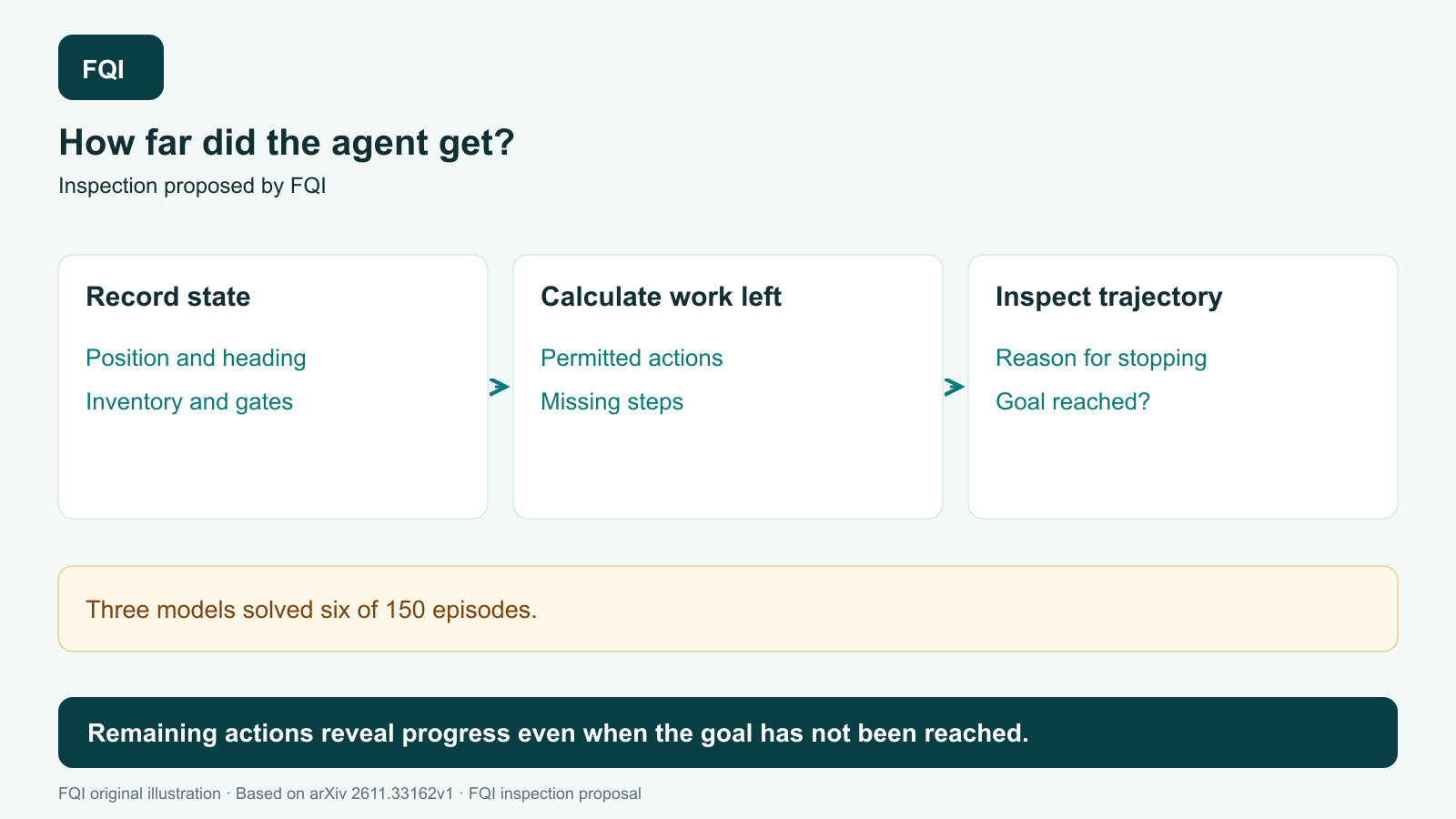
An agent can stand next to a goal and still have most of the work ahead of it. In MultiNet v2.0-Gridworld, researchers ask three vision-language models to act in a maze. By changing the mechanisms inside it and calculating the actions still required, they can distinguish progress from proximity. Six successes in 150 episodes describe a deliberately demanding visual protocol. For quality teams, the relevant question is which prerequisite an agent has actually met.
FQI takeaway
- Measure progress in actions and prerequisites.
- Test familiar controls separately from unfamiliar ones.
- Report the observation mode and stopping rule alongside success.
The principle at a glance
A key changes what an agent can do next. Picking it up can be productive even if this takes the agent farther from the exit. Walking toward a closed door can have the opposite effect. A search algorithm calculates the shortest executable route from the current state, including heading, inventory and the state of each mechanism. This supplies an independent reference even for an unfinished run.
Deep dive
The researchers selected 50 mazes from a validated pool of 214. Doors require keys, switches operate gates, and some layouts require these actions in a particular order. The action choices, renderer and scoring procedure remain fixed as mechanisms change. This makes it possible to investigate a particular difficulty without replacing the entire task.
Each model attempted each maze. An episode ended at the goal, at a step limit based on the shortest solution, or after 30 consecutive steps without a change in position, inventory or mechanism state. The last rule ended 139 episodes. No model solved 45 of the 50 mazes. All solved instances required at most 45 optimal actions and contained neither a switch and gate nor a distractor.
For a simplified workplace example, consider a calibration release form. An agent can fill in every visible box while the required calibration reference is still missing. A useful progress measure would count the reference as an outstanding prerequisite. A check based only on the number of filled boxes could mask this omission. Testers could run the same case with the rule stated explicitly and with the rule discoverable through feedback. The resulting trace gives them a basis for deciding which part of the interface to improve.
Limitations and risks
The researchers deliberately used the weakest observation setting from their preliminary comparisons. The agent had to detect changes between images and could see only a short history. The performance ordering also changed with the choice of progress or completion as the outcome. One unfamiliar mechanism cannot establish why every unfamiliar control fails. There was no human baseline, and the agents were not told their remaining step budgets.
FQI conclusion
Define a reference for the unfinished work before interpreting a low completion rate. The reference should reward actions that satisfy real prerequisites, including necessary detours. A test team can then inspect the first unresolved requirement and vary the information available at that point. Applying this method to an actual workflow requires a separate check that the reference includes all of its operational requirements.
Sources & transparency
Attributing Agentic Failure in Reasoning Vision-Language Models with Interactive 2D Environments · arXiv v1
Author preprint v1. FQI checked the cited sections of the original study. Workplace examples and inspection proposals are FQI interpretations. The experiments were not independently replicated.
Codex drafted the texts and checked them against the original study. Johann Fischer authorized publication on that basis on 28 November 2026.