
Executive summary
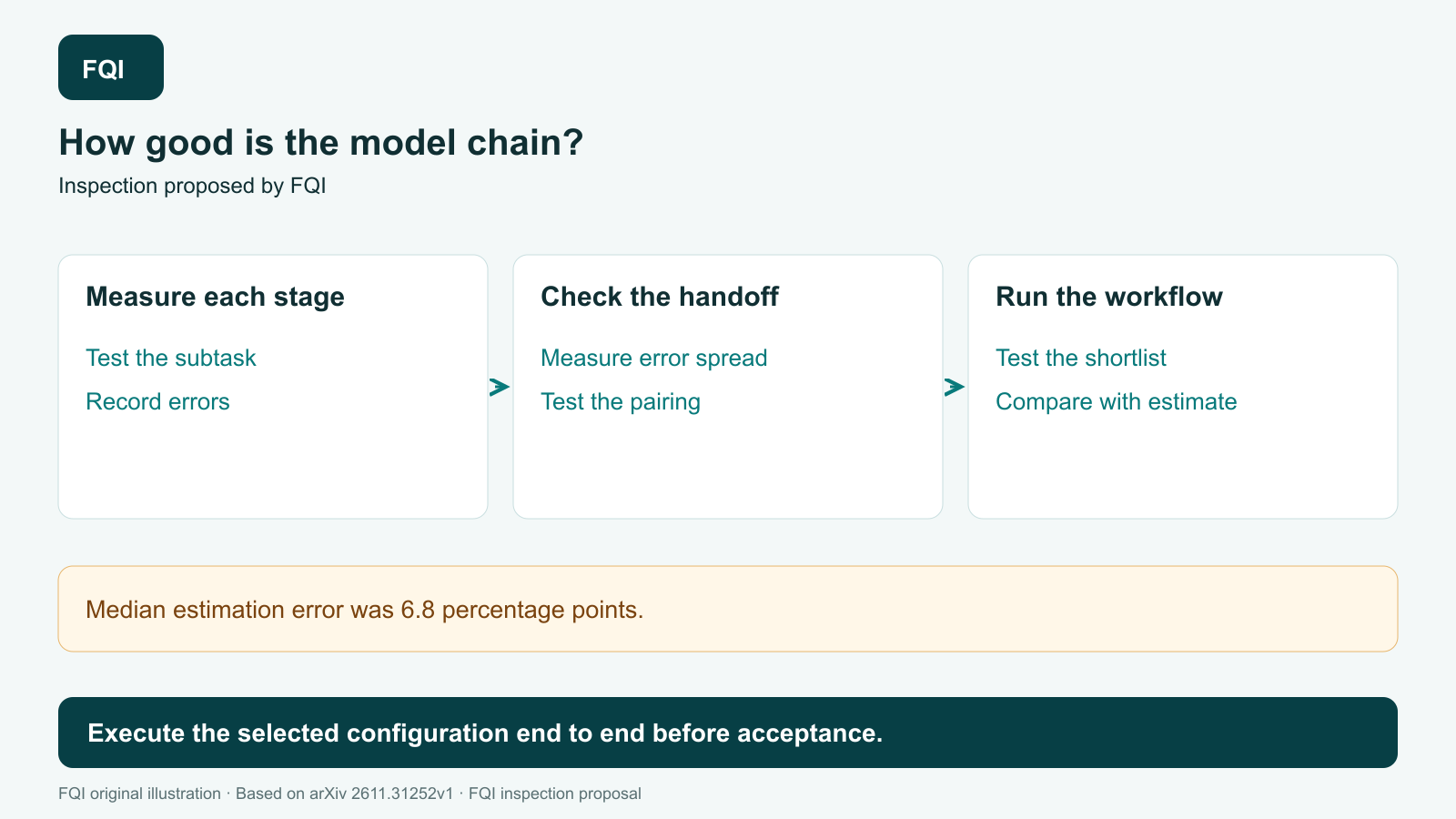
An artificial intelligence (AI) workflow can fail even when each model performs well on its own test. One stage can pass the next a plausible but incomplete result. DAGGER estimates the quality of model combinations by considering both individual tasks and dependencies between adjacent stages. Across the tested question-answering workflows the authors report a median estimation error of 6.8 percentage points. Teams can use such estimates to choose configurations for end-to-end testing.
FQI takeaway
- Measure how downstream performance changes with the input it receives.
- Use estimates to select combinations for full trials.
- Record the evaluator, the task population and the estimation error.
The principle at a glance
Consider a system that finds a passage, relates it to other evidence, then writes an answer. There may be several possible models at each stage. Trying every combination costs time and computing resources. DAGGER represents the workflow as a directed graph without cycles. It estimates performance for individual stages and for the handoffs between them. A matrix completion method infers missing entries from patterns in measurements already available.
Deep dive
The authors test sequential, branching and more general workflows on three datasets requiring several steps to answer a question. They use Qwen, Mistral and Llama models for the stages and a separate language model to evaluate the answers. Agreement with that evaluator provides the reference for these comparisons.
Table 1 illustrates the difference structure can make. For a sequential workflow, the estimate was 64.94% against a measured 64.50%. A branching case had an absolute error of 4.95 percentage points. Neither example sets a bound for an individual configuration. Across the evaluation the authors report 10.2 times lower profiling cost than their BenchPress comparison. The cost result concerns collecting information about candidate configurations.
A simplified quality example would combine a document search, a proposed cause of a complaint and a written report. An articulate report can conceal the loss of a crucial record earlier in the chain. A reviewer can keep the downstream question fixed and supply complete, incomplete and conflicting records. Comparing the final answer with an independent case file tests whether the model combination preserves the evidence that matters.
Limitations and risks
The estimator assumes local pairwise dependencies capture enough of the workflow. A shared failure across distant stages can challenge that assumption. The experiments cover multi-hop question answering and three candidate models. A language-model evaluator can also share errors with the systems under test. A median error describes the middle observation and gives no upper bound on a critical error in a specific case.
FQI conclusion
Keep the predicted result and the observed end-to-end result in separate fields. If two candidates are closer than the errors seen in comparable estimates, a small numerical difference offers little basis for selection. Run both against the same relevant cases, and include cases in which an upstream model supplies a convincing but defective input. This connects profiling savings to a checkable operational choice.
Sources & transparency
DAGGER: Deployment-Free Quality Estimation for Generative AI Workflows · arXiv v1
Author preprint v1. FQI checked the cited sections of the original study. Workplace examples and inspection proposals are FQI interpretations. The experiments were not independently replicated.
Codex drafted the texts and checked them against the original study. Johann Fischer authorized publication on that basis on 28 November 2026.