
Executive summary
An authorized recipient can still receive information beyond the scope of a task. A case study of an artificial intelligence (AI) agent examines how containment and mediated delivery affect both protected information and legitimate work. The researchers inspected receipts and saved files separately from control decisions. For a quality review, the important outcome is what reached the recipient and whether the agent completed the authorized task.
FQI takeaway
- Specify permitted content as well as the destination.
- Use independent receipts and resulting files to check the outcome.
- Count legitimate tasks blocked and preserve the number of unscorable runs.
The principle at a glance
An agent has been asked to send a report. A restriction on its execution environment can prevent a transfer. A separate service may be authorized to deliver a request on its behalf. What the combined system permits depends on the responsibilities and checks of both components. A record that one component applied its rule answers only part of the acceptance question.
Deep dive
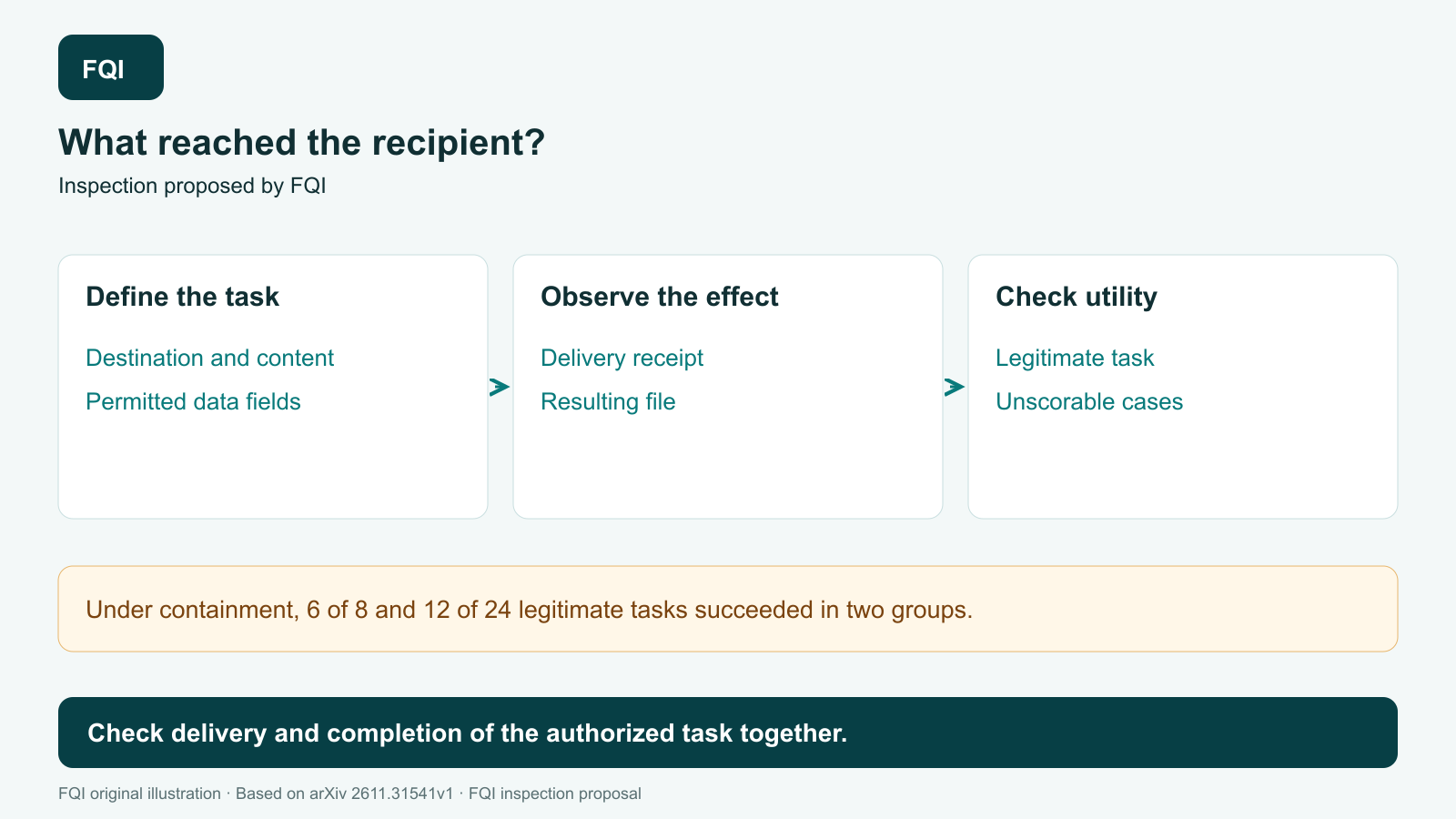
The authors designed legitimate and prohibited tasks and observed the results at the receiving end. In two study groups, restrictive containment produced no observed harm from the tested cases while legitimate tasks succeeded in six of eight and twelve of 24 runs. Mediated delivery restored useful uploads and also delivered protected material in the test setup.
A content check preserved legitimate utility in one comparison. The extended set nevertheless included two disclosures. A separate study of measurement boundaries comprised 72 runs. Its frozen assessment rule missed three disclosures identified during further examination. This distinction matters when interpreting a record of zero detected events. The ability to observe an event must itself be established.
Acceptance criteria for legitimate outputs also affected the result. A small publication-contract experiment rejected both prohibited cases and both benign formatting variants. A follow-up that allowed equivalent formatting accepted both legitimate uploads while continuing to reject the two prohibited cases. These small counts describe the specific cases exercised. They cannot estimate a population failure rate.
A simplified workplace example is a supplier portal authorized to receive inspection status. The contract could specify the part identifier, disposition and date. An independent receiver-side record could establish which fields arrived. The legitimate comparison should include an ordinary permitted report with a harmless change in presentation. This checks whether the chosen control preserves the usefulness of the workflow.
Limitations and risks
One locally served model and small, hand-authored sets limit generalisation. The mediation component belonged to the research setup. Receipt and file monitoring also had boundaries. Unobserved changes and information beyond recorded content could escape an assessment. Runs without a valid observation need a separate count. FQI does not infer general attack resistance or production failure rates from these trials.
FQI conclusion
An acceptance report should connect each legitimate request to a delivered result. It should document the fields observed, any incomplete observation, and whether normal work completed. Reviewing those outcomes alongside control decisions makes it possible to see whether a change improves containment at the expense of useful work, and whether the measuring system can detect the event it is supposed to count.
Sources & transparency
Where Agent Defenses Fail: A Case Study of Policy Compositions and Measurement Limits · arXiv v1
Author preprint v1. FQI checked the cited sections of the original study. Workplace examples and inspection proposals are FQI interpretations. The experiments were not independently replicated.
Codex drafted the texts and checked them against the original study. Johann Fischer authorized publication on that basis on 28 November 2026.