
Executive summary
Repeated artificial intelligence (AI) predictions can agree on the same wrong image. HSTTA studies this problem when matching electrical brain recordings to images for a person whose correct pairings are unavailable during adaptation. It uses agreement across sessions to select how specific a prediction can be. Comparing that proxy with known answers during evaluation shows why a consistency target does not guarantee the same accuracy for every person.
FQI takeaway
- Check agreement against independent reference answers.
- Report when the system returns a group of images rather than one image.
- Inspect shared errors and per-person results alongside the average.
The principle at a glance
The model searches a fixed collection of images. Similar images are grouped at different levels of a hierarchy. An uncertain prediction can refer to a larger group. A group can contain the correct item while still leaving a user with several alternatives. Both correctness and the size of the group matter to the use of such a result.
Deep dive
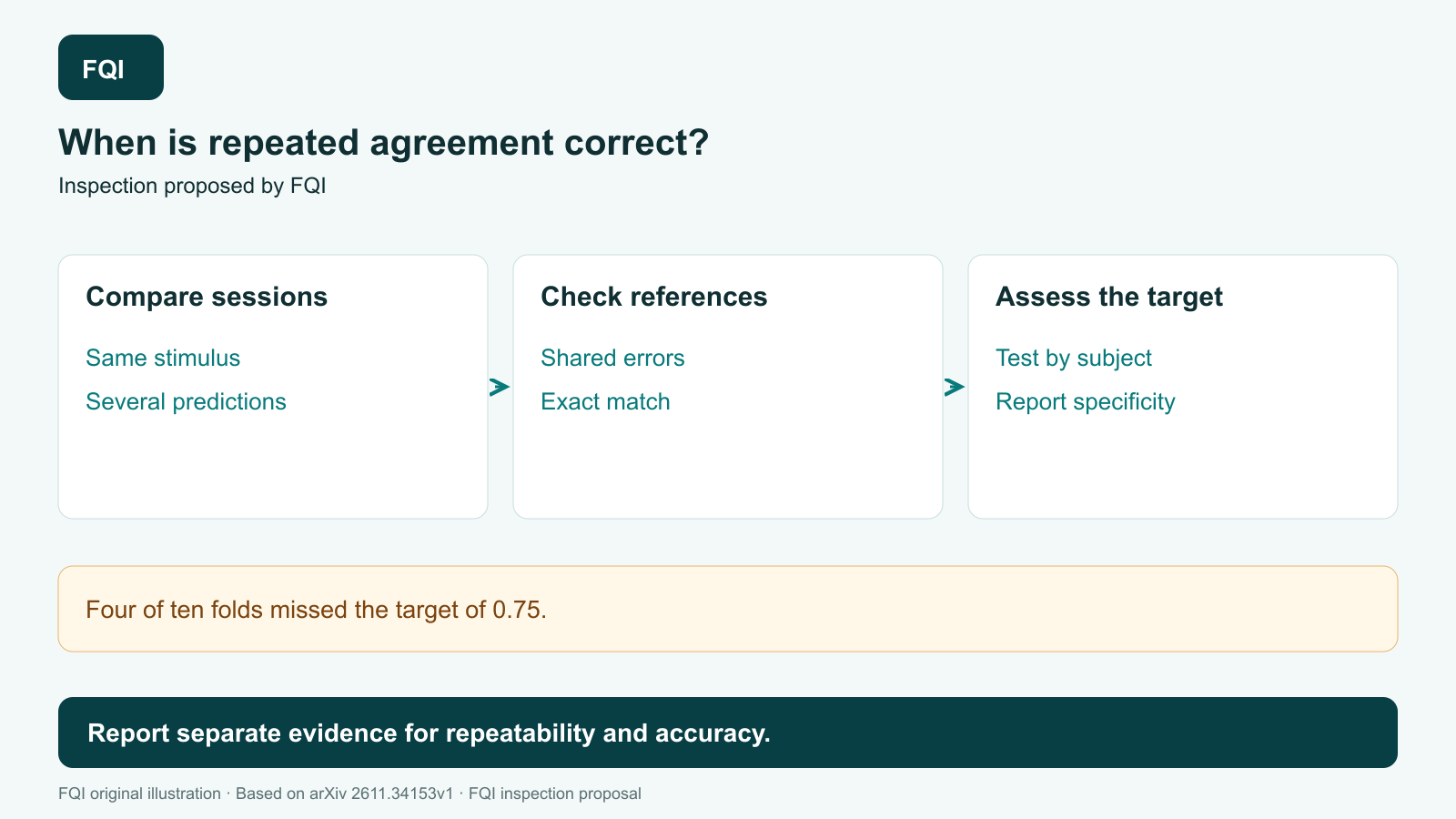
The researchers compare recordings made when the same stimulus is shown in different sessions. They examine whether the top prediction in one session belongs to the group proposed for another. This gives a consistency score without using target labels to adapt the model. A reverse matching check can also cause the method to move to a coarser group when support for a specific prediction is weak.
The evaluation holds out people and includes two datasets. One protocol uses 200 candidate images. Another divides the gallery in two, adapts on one half, then freezes the model before testing on the other. This helps distinguish matching familiar candidates from transfer to unseen concepts.
On THINGS-EEG2 the main model’s first-choice accuracy increased from 25.65% when frozen to 59.22% with adaptation under one ranking metric. Results varied with the original model, dataset and ranking rule. On the second dataset, the advantage over a learning-based comparator was not statistically established in the standard comparison. Some simpler methods performed better in the disjoint gallery setting.
The supplementary calibration analysis is especially relevant to an acceptance decision. At a target of 0.75, four of ten folds reached only 0.720 to 0.745. Conditional on an incorrect first choice in one session, the chance of selecting that same wrong image in the other was 0.159, compared with a chance reference of 0.005. Correlated errors can raise agreement without raising accuracy.
Limitations and risks
The task involved brain recordings and image retrieval. A factory camera application would need its own evidence. Reliable pairing of repeated observations, suitable image groups and a sufficiently capable initial model are prerequisites. A coarse answer is easier to count as correct. The lower specificity needs to remain visible wherever results are reported.
FQI conclusion
For a simplified inspection example, several images of a component may all conceal the same feature. Agreement across those images provides little evidence about the concealed area. A new viewing angle or a separate measurement can contribute different information. Quality teams should establish which errors their repeated observations can share, then check their acceptance thresholds against independent references in each intended target group.
Sources & transparency
HSTTA: Hierarchical Selective Test-Time Adaptation for Label-Free Cross-Subject EEG-to-Image Retrieval · arXiv v1
Author preprint v1. FQI checked the cited sections of the original study. Workplace examples and inspection proposals are FQI interpretations. The experiments were not independently replicated.
Codex drafted the texts and checked them against the original study. Johann Fischer authorized publication on that basis on 28 November 2026.