
Executive summary
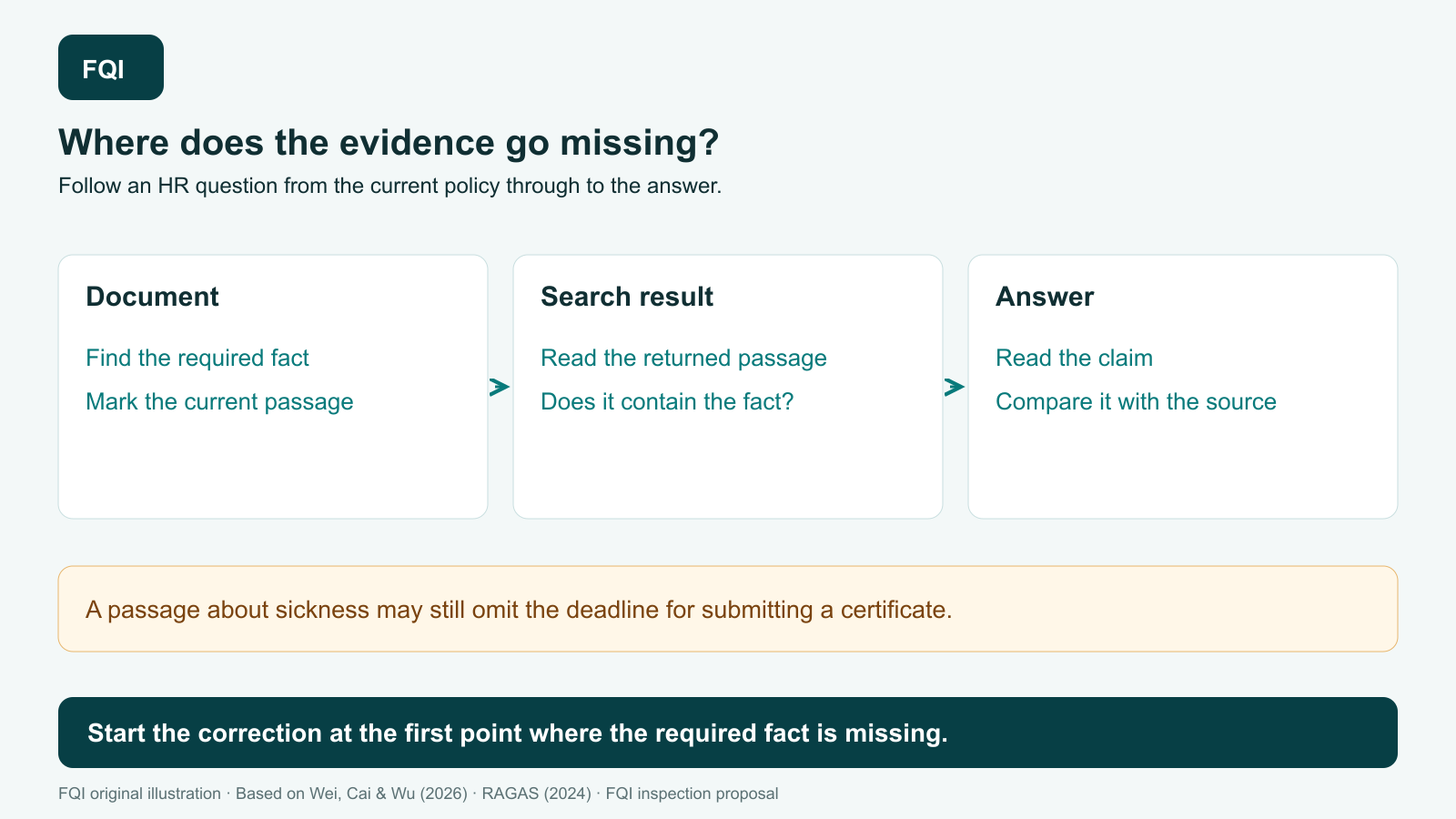
A human resources assistant retrieved passages on the right topic for each of three test questions. For a question about a sick-leave certificate, the material it found still left the question unanswered. A check that counted relevant passages would have passed the case. The experiment by Amazon Web Services shows how a quality team can trace such a failure. List the facts needed for the answer, then check whether the current policy contains them, whether the search returned them and whether the assistant used them correctly.
FQI takeaway
- Before the test, ask the policy owner which facts a complete answer requires.
- For each missing fact, check the current document. Its location determines who can act next. The policy owner can fill a gap in the collection. The search team can investigate why an existing passage was missed.
- After a change, compare results for each of the original questions. An improvement for one user can coincide with a worse answer for another.
The principle at a glance
A language model can draw on passages retrieved from a document collection when writing an answer. An assessor can inspect both the passages and the answer. Even for the first step, the verdict depends on what counts as a hit. A document about leave may be useful background for a question about sickness. Whether it states the deadline for providing a certificate is a separate, verifiable matter. A reviewer should be able to point to the sentence that states the deadline.
The independent RAGAS study also evaluates the information inside retrieved passages. Its context relevance measure assesses what share of the sentences a question actually requires. The researchers compared the automated assessment with human judgments. Selecting the relevant sentences proved especially difficult. Keeping the passage alongside the score gives a subject expert something concrete to examine when a release decision is disputed.
Deep dive
In the AWS example, passage-level precision reached 1.00 on all three questions. For the sick-leave question, fact-level precision was 0.09. Retrieval coverage, which measures whether the retrieved material answers each part of the question, was 0.00. The authors then checked the collection itself. The leave policy mentioned sickness briefly, but the collection lacked a dedicated sick-leave policy. Reviewing those documents gave the team a reason to investigate the available policy information before changing the assistant again.
In a comparison run, the team changed only the instructions given to the model. It asked the assistant to stick closely to the retrieved material, ignore irrelevant details and keep its answer focused. The score for how well the material supported the answer to the performance-review question rose from 0.83 to 0.87. For the sick-leave question it fell from 0.39 to 0.31. The same change had different effects on the two cases.
For operational testing, FQI proposes adding a location field beside every required fact in the test record. Record the supporting passage in the current approved document, then compare it with what the search supplied. An empty field sends the case to the policy owner for clarification. If the passage exists but the search repeatedly misses it, the search team has a reproducible failure. When the passage is present in the retrieved material, reviewers can examine how the model used it.
Limitations and risks
AWS reports three questions from its own reference application. That small exercise establishes neither an error rate for HR departments nor a product performance advantage. Scores can vary between runs. Even a statement taken from a real document can be assigned to the wrong person. A general preference listed on a form, for instance, provides no evidence that a particular employee chose it. An answer about a person needs evidence for that link as well.
FQI conclusion
Find the first point where a required fact goes missing. Keeping the document, retrieved passage and answer together helps the team assign the correction, then rerun the same case to see whether the change reached the user.
Sources & transparency
The measured example comes from section 2 and tables 2 and 3 of the AWS authors’ report. RAGAS provides independent methodological support for evaluating context relevance. Assigning a corrective action to the team responsible for the first missing fact is FQI’s proposed application. Wei, Cai and Wu · AWS experiment · Es and colleagues · RAGAS
Codex assisted with drafting and checked the claims against the cited original sources. Johann Fischer authorized publication on 2026-11-13.