
Executive summary
Which inputs should be tested first when a language model can produce more answers than experts can inspect? Foreword estimates failure risk from internal model states before an answer is generated. The research uses both passing and failing reference inputs. For quality assurance, another distinction matters: a case resembling known failures is different from a case with no comparable references. FQI derives a proposed inspection process that assesses reference coverage, test order and actual outcomes separately. The study does not establish an automatic release decision.
FQI takeaway
- Learn from both outcomes: A collection of successful examples alone provides an incomplete account of known failure patterns.
- Check coverage before ranking: A case outside the reference base needs additional inspection even when its estimated failure risk looks low.
- Keep testing the answers: Ranking allocates inspection effort; it does not replace execution or expert assessment of the target system.
The principle at a glance
A large language model (LLM) processes an input internally before producing its response. Foreword uses information from this initial processing step. It therefore needs access to internal model states, which an ordinary interface to a closed service does not provide.
The framework combines two possible representations with two estimators. Inputs are represented either by internal states directly or through a Jacobian lens: a mathematical mapping that makes those states more readable as scores over vocabulary fragments. A simple statistical classifier learns to separate passing from failing cases. Alternatively, two statistical mixture distributions model the groups separately. This pair also provides a measure of how well a new input is supported by the reference base at all.
The distinction needs no model equations: “resembles known failures” and “resembles no known case” are different warnings. The first helps determine test order. The second questions whether the risk estimate can be relied upon for this input.
Deep dive
Kim, Feldt and Yoo study ten tasks with three open-weight language models. Tasks include text classification, correction and programming problems. Each reference input receives ten generated answers, assessed against task-specific criteria. Only a strict majority of correct answers counts as a pass. The reference set grows progressively to 500 labelled inputs. Subsequent ranking of new cases does not require generating their answers first.
On average, the four Foreword configurations distinguish passing from failing cases better than Clotho, which models only passing references. The statistical classifier provides the more consistent gains in early failure discovery. By contrast, the more readable Jacobian representation is not universally the best ranking signal. Its additional value mainly concerns investigating recurring failure patterns. This matters when choosing an implementation: finding failures earlier does not automatically require the more expensive representation.
To test reference coverage, the study inserts inputs from other tasks into the target task’s input template. The joint density of both reference groups identifies these unfamiliar inputs better than the tested classifier-derived signals. This is a bounded experiment with deliberately different tasks, rather than evidence for every gradual operational change. The authors also transfer rankings from small models to larger and closed target models. These orderings remain useful on average, but they do not establish the correctness of an individual target response.
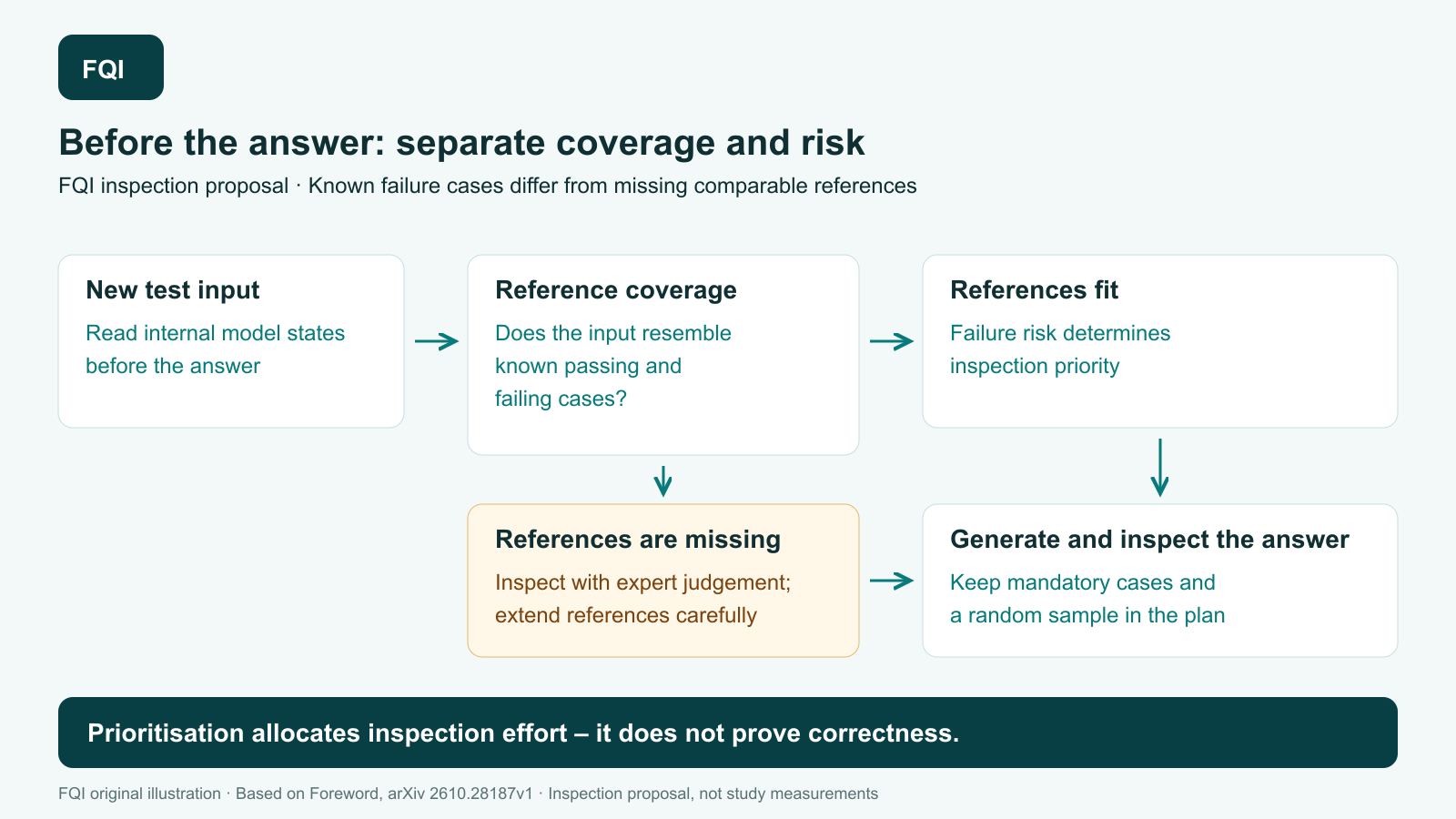
FQI inspection proposal: First specify the target task, failure criteria, model version and comparison method. Then separate reference data, threshold setting and subsequent effectiveness testing. On a held-out set, check whether the proposed order finds more consequential failures within the same budget than random ordering or a simple existing rule. Include the cost of reference assessments and internal-state extraction in the comparison.
Cases with inadequate reference coverage need a separate response: expert inspection and, where appropriate, controlled expansion of the reference base. Within the sufficiently supported region, estimated failure risk can determine the order. Mandatory cases and a random sample of lower-ranked cases remain in the plan. Finally, a named expert assesses the answers actually produced. Combining these steps is an FQI interpretation, not an industrially validated standard process established by the study.
Limitations and risks
The source is a preliminary research report without independent reproduction established here. Its findings concern the tasks and models studied. New model versions, changed input templates and different failure criteria require renewed evaluation. Reference assessment can itself be wrong: some inspected “failures” may also reflect ambiguous tasks or questionable reference labels.
Readable internal concepts do not prove a cause of failure. Even an apparently appropriate solution approach may produce an incorrect answer. Accessing internal states adds computational work. Transfer from a small inspection model to a closed service must be confirmed on the actual target system; neither general cost savings nor reliable automatic release is established.
FQI conclusion
Foreword turns test ordering into a testable proposition: known failures can help direct expensive answer inspection towards more informative cases. Quality practitioners should keep two questions separate: is the input supported by references, and what is its failure risk within that supported region? A credible pilot compares orderings, retains mandatory cases and checks the actual answers. That evidence determines whether the approach is useful. The graphic illustrates the resulting FQI inspection proposal, not a measured effect or automatic approval of model responses.
Sources & transparency
- Kim, Feldt and Yoo: Foreword, original record.
- Versioned full text v1, particularly Sections 3–7.
- Artificial intelligence (AI) assisted this article. Source findings and the FQI inspection proposal are distinguished; approved for publication by Johann Fischer on 2026-10-22.