
Executive summary
The OGPAL study examines how existing FMEA knowledge can be reused across different manufacturing lines. An LLM structures existing FMEA content in a knowledge graph, while a graph neural network also considers semantic relationships and the order of process steps. In the case study, OGPAL achieved an nDCG@20 of 0.719 when ranking potential failure causes, compared with 0.450 for a RAG baseline. The combination of language understanding and technical structure is particularly relevant to FQI.
FQI takeaway
- FMEA knowledge is relational: Failures, causes, components and process steps form technical relationships that text similarity alone represents only to a limited extent.
- RAG remains useful but is not necessarily the final stage: Ontologies and knowledge graphs can provide additional structure when knowledge must be reused across heterogeneous products and lines.
- The result is not evidence of automatic FMEA: OGPAL prioritises candidate causes within a defined research setting. Technical assessment and approval remain the responsibility of the FMEA team.
The principle at a glance
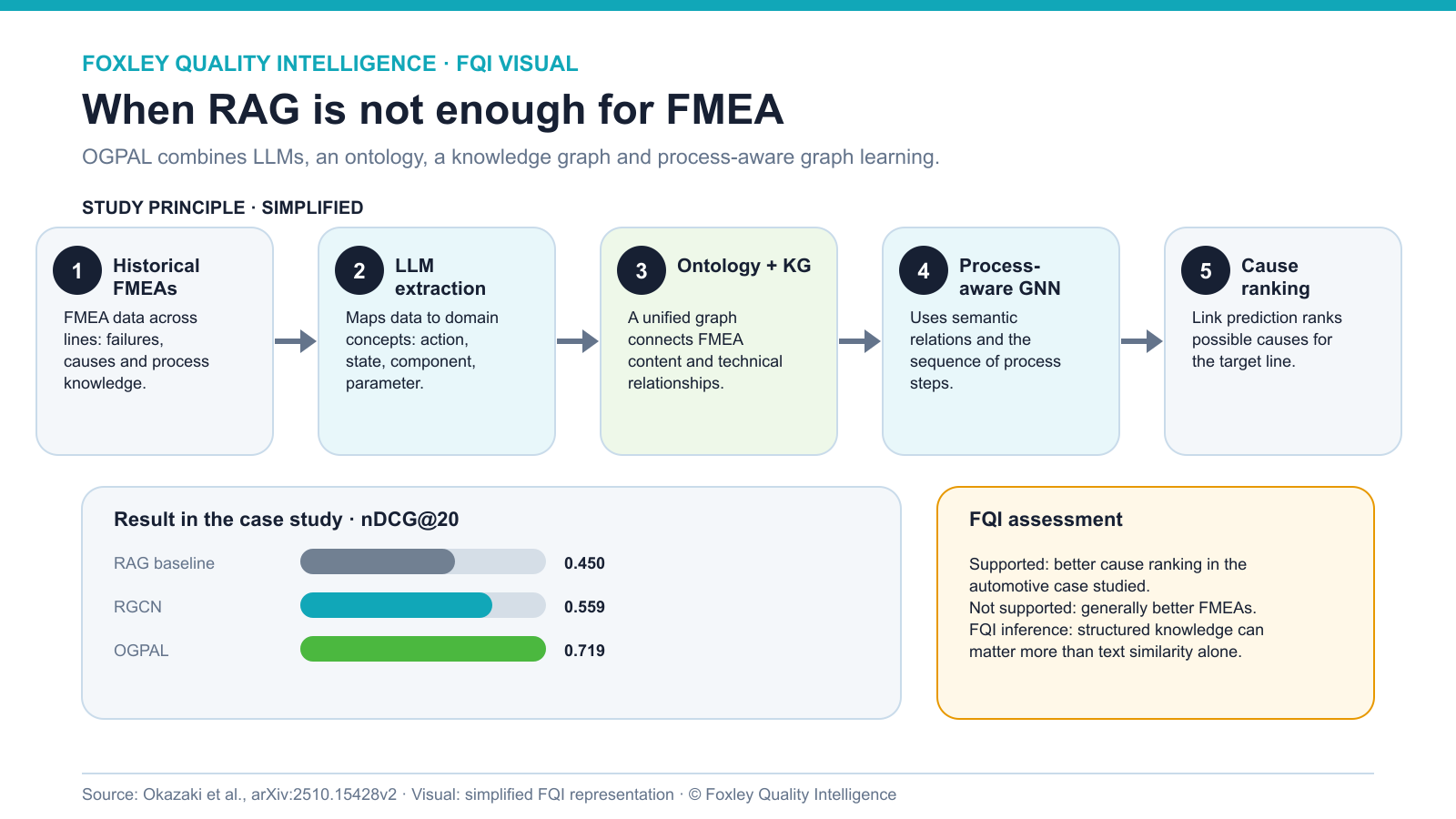
Existing FMEA data contains valuable experience but is often difficult to transfer. The same technical issue may be described using different terms; products have different structures; and process sequences vary. OGPAL therefore does more than retrieve similar texts. Using an LLM, the framework maps content to domain concepts such as Action, State, Component and Parameter and constructs a shared knowledge graph. A relational graph neural network then evaluates potential failure causes while considering process flow.
In simplified form, the chain is: FMEA data → semantic structuring → ontology → knowledge graph → process context → cause ranking.
Terms explained
- AI: Artificial intelligence; systems that derive patterns from data or support tasks automatically.
- FMEA: Failure Mode and Effects Analysis; a method for proactively assessing risks.
- RAG: Retrieval-Augmented Generation; language-model output grounded in deliberately retrieved sources.
- LLM: Large language model; a model for processing and generating text.
- 8D: Eight Disciplines problem-solving method; D1 through D8 structure the team, problem, cause, actions and closure.
- OGPAL: A research method that analyses FMEA knowledge using an ontology and the order of process steps.
Deep dive
From document to technical relationship
A conventional RAG approach retrieves information that is semantically relevant to a current query and supplies it to a language model as context. This can be highly useful for FMEA research. Technical failure analysis, however, contains a second level: what matters is not only which information sounds similar, but how it is embedded in the system or process.
OGPAL addresses this level with an ontology and a knowledge graph. The study uses FMEA worksheets from several automated assembly lines for automotive pressure sensors. Standardised concepts and relationships are extracted from the texts. A relational graph convolutional network learns representations from them, while a process-aware scoring function also considers the sequential position in the manufacturing process. Link prediction then prioritises plausible failure causes for the target line.
What do the metrics show?
Evaluated against causes identified by experts, OGPAL achieved a mean nDCG@20 of 0.719. The RGCN comparison variant achieved 0.559, while the RAG baseline achieved 0.450. OGPAL led on nDCG@20 in all three scenarios examined. The authors also report ablation studies indicating contributions from both LLM-based conceptualisation and process-aware learning.
For FQI, the architectural principle matters more than a single benchmark value. Future industrial FMEA support could combine retrieval from previous FMEAs, complaints or 8D cases with a structured representation of technical relationships. The system would then ask not only “Which texts resemble this failure?”, but also “Which known technical relationships resemble this situation?”
Limitations and risks
First, the evidence is based on a limited case study involving automotive pressure-sensor assembly lines. General transfer to other sectors, design FMEA or process FMEA has not been demonstrated. Second, the study evaluates the ranking of candidate causes within a defined dataset. It does not show that the system discovers entirely new failure mechanisms. Third, a knowledge graph shifts the quality problem into the data foundation: inconsistent terminology, incorrect relationships or methodologically weak historical FMEAs can be processed in a structured form without becoming correct. Implementation, governance and maintenance effort also rise substantially compared with a simple RAG system.
FQI conclusion
OGPAL presents a plausible next step for AI-assisted FMEA knowledge management. Conventional RAG may be sufficient for simple knowledge questions. When technical dependencies, process sequences and causal chains matter, ontologies and knowledge graphs can add value. A relevant future architecture may therefore be LLM + retrieval + knowledge graph + process structure + expert review. The central question is not whether a language model writes an FMEA, but whether existing quality knowledge can be used structurally and transparently to support better decisions.
Sources & transparency
- Okazaki, Sho; Kaminishi, Kohei; Fujiu, Takuma; Wang, Yusheng; Ota, Jun: Fault Cause Identification across Manufacturing Lines through Ontology-Guided and Process-Aware FMEA Graph Learning with LLMs, arXiv:2510.15428. First published 17 October 2025; version 2 revised 4 August 2026.
- The metrics nDCG@20 = 0.719 for OGPAL, 0.559 for RGCN and 0.450 for the RAG baseline are taken from Table 3 of version 2.
- Applying the approach to a future industrial FMEA architecture and assessing its benefits, effort and risks are FQI interpretations. This article was created with AI support, professionally reviewed and explicitly approved for publication on 10 August 2026.
- Approval status: First-use explanations and the glossary were reviewed by a human and approved for publication on 17 August 2026. Approved by: Johann Fischer.