
Executive summary
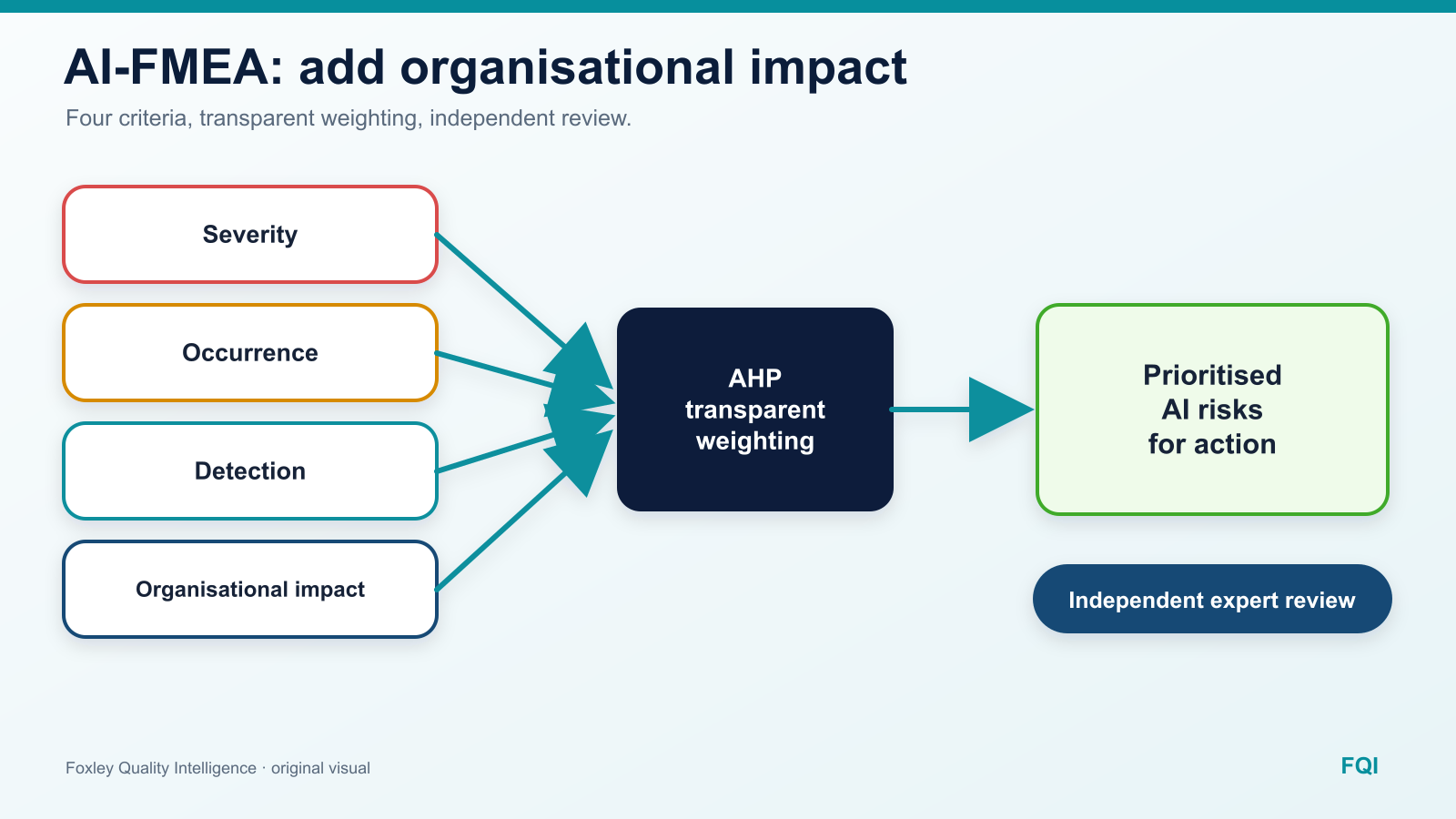
A paper in Risk Analysis combines FMEA with the AHP to prioritise risks in non-transparent AI systems. In addition to severity, occurrence and detectability, the framework introduces Organisational Impact for regulatory, reputational and systemic consequences. Three case studies, sensitivity analysis and comparisons with other methods show stable rankings within the study. The approach is intended as an auditable pre-deployment tool, not as a replacement for established FMEA. The authors explicitly identify independent expert validation as the next critical step.
FQI takeaway
- AI failure modes are socio-technical: Data, models, infrastructure and governance can jointly create failures; analysing isolated components is insufficient.
- Weighting must be traceable: AHP makes preferences and consistency reviewable, but does not automatically turn subjective expert judgement into objective risk.
- Prioritisation is not control: A higher score replaces neither root-cause analysis nor controls, effectiveness verification and a release decision.
The principle at a glance
Source facts
Gonçalves, Amaral and Pereira organise AI failure modes across four areas: data, model, infrastructure, and ethical or governance aspects. They add Organisational Impact to the conventional FMEA criteria of Severity, Occurrence and Detectability. AHP derives domain-specific weights from pairwise comparisons and checks their consistency. The framework is applied to medical imaging, fraud detection and autonomous-vehicle perception.
FQI interpretation
The fourth factor can reveal risks whose consequences extend beyond immediate technical harm. It should not be transferred uncritically into an existing FMEA form. Teams must first establish which effects are already captured in severity and where double counting may arise.
Terms explained
- AI: Artificial intelligence; systems that derive patterns from data or support tasks automatically.
- FMEA: Failure Mode and Effects Analysis; a method for proactively assessing risks.
- AHP: Analytic Hierarchy Process; a method that weights decision criteria through pairwise comparisons.
- reasoning: The processing steps an AI system uses to connect information and reach an answer or decision.
Deep dive
What the study actually shows
The authors position the method between a simple checklist assessment and full probabilistic risk analysis. Reliable component-level failure probabilities are often unavailable for non-transparent deep-learning systems. AHP is therefore used to structure expert estimates and provide an explicit consistency check.
The case studies illustrate how different domains can produce different weights. A Monte Carlo sensitivity analysis tests stability under changing weights. The authors also compare the ranking with TOPSIS, ELECTRE III and PROMETHEE II. According to the abstract, prioritisation remains stable under weight changes and alternative aggregation logic. This is evidence of robustness for the investigated cases, not proof of a universally correct risk order.
FQI practical transfer
A pilot should begin with a clearly defined analysis object: not “the model”, but a specific AI system with a purpose, data flow, users, interfaces and decisions. Failure modes can then be collected separately for data, model, infrastructure and governance. Examples include biased input data, concept drift, unauthorised tool access, missing fallback options or unclear accountability.
Organisational Impact needs its own scale and anchors. Possible dimensions include regulatory approval, compliance, reputation, multiple sites or affected stakeholders. Before scoring, the team must document how this factor differs from Severity. Pairwise AHP comparisons should come from an interdisciplinary panel; the consistency measure, reasoning and dissenting views belong in the evidence pack.
A sensitivity check must then ask whether the top risks remain stable when weights or ratings vary plausibly. If small changes reverse the ranking, an apparently exact priority is misleading. Actions still need to address prevention, detection, containment and recovery and must be verified for effectiveness.
Limitations and risks
- No independent validation: The authors themselves identify independent expert panels as an open next step.
- Possible double counting: Regulatory or reputational consequences may already be included in Severity and then counted again through Organisational Impact.
- Dependence on experts: AHP structures judgement but remains influenced by panel selection, experience and conflicts of interest.
- Three illustrative domains: The cases do not represent broad validation in industrial production.
- A ranking is not absolute risk truth: Robust prioritisation does not prove empirical failure probabilities or loss magnitudes.
FQI conclusion
The hybrid FMEA-AHP method is an interesting component for AI governance because it makes technical and organisational consequences visible together. Its value lies in explicit criteria, documented weighting and sensitivity analysis. The same features create risk: more numbers can produce false precision and double counting. FQI therefore recommends a controlled pilot comparison with an existing FMEA, independent experts and a documented decision on whether the fourth factor genuinely improves action priorities—not an immediate method replacement.
Sources & transparency
- Gonçalves, Heitor Oliveira; Amaral, Renato; Pereira, José Cristiano: A Hybrid FMEA-AHP Framework for Risk Prioritization in Nontransparent Artificial Intelligence Systems, Risk Analysis, Volume 46, Issue 7, e70297, first published 30 June 2026, DOI: 10.1111/risa.70297.
- Criteria, case studies and robustness checks are source facts. The pilot design, scale guidance and warning about double counting are FQI interpretations.
- The German source article, primary source and method description were reviewed on 14 August 2026. This AI-assisted English translation was prepared on 17 August 2026 and awaits renewed human review. Independent expert validation remains an explicit research limitation.
- Approval status: First-use explanations and the glossary were reviewed by a human and approved for publication on 17 August 2026. Approved by: Johann Fischer.