
Executive summary
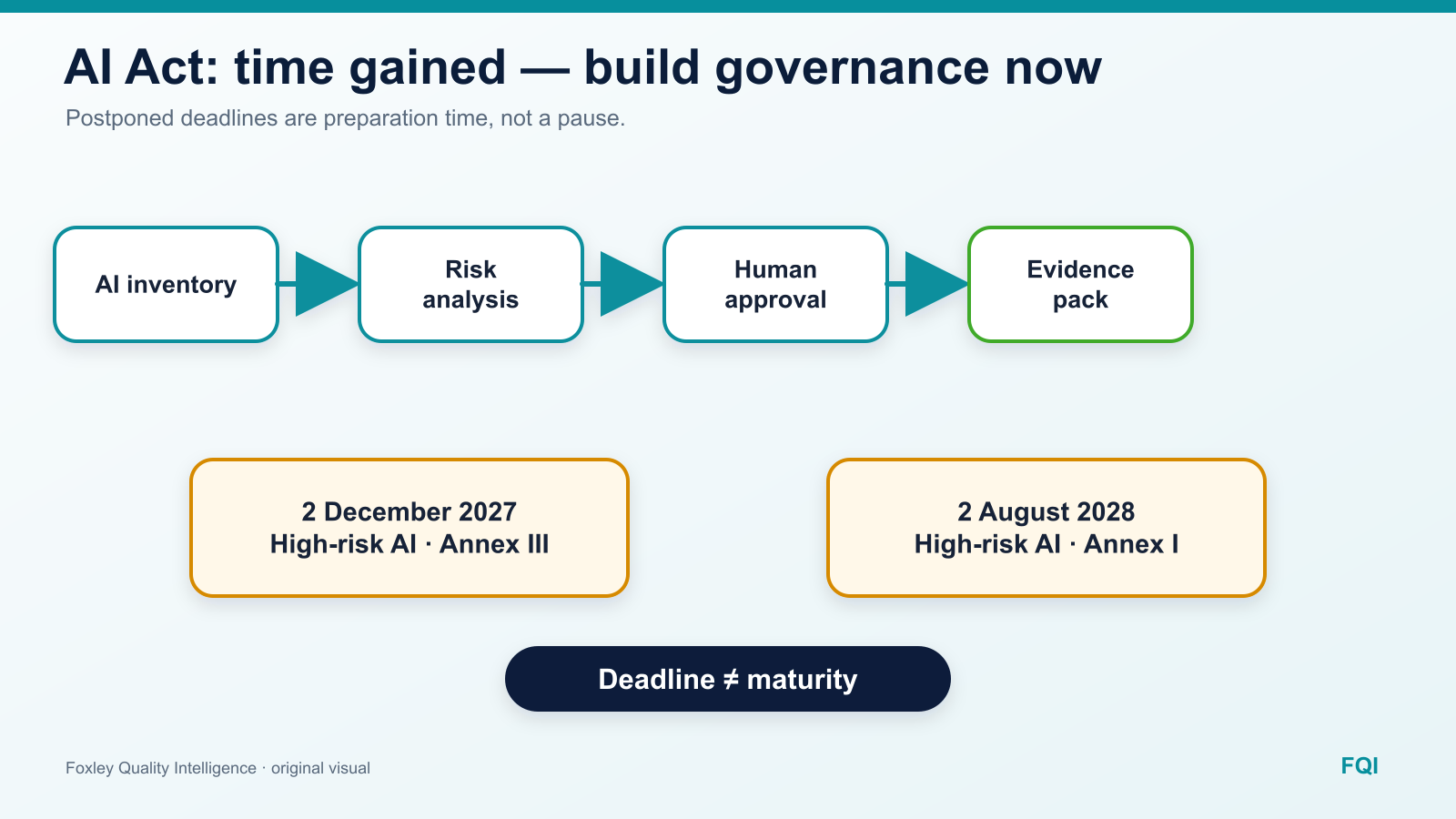
Regulation (EU) 2026/1744 postpones key high-risk obligations under the AI Act: systems listed in Annex III move to 2 December 2027, while product-related systems under Annex I move to 2 August 2028. This does not generally cancel the AI Act’s application from 2 August 2026. For quality organisations, the delay is therefore not a free pass but additional preparation time: inventory AI systems, clarify roles, assess risks, control changes and build evidence.
FQI takeaway
- Manage deadlines and maturity separately: A later legal date says nothing about whether an AI system is adequately controlled, documented and monitored today.
- Use existing quality processes: AI risks can connect to Failure Mode and Effects Analysis (FMEA), change control, Corrective and Preventive Action (CAPA), audit and supplier approval instead of creating a parallel governance system.
- Evidence before automation: Inventory, purpose, data, accountable owners, release criteria, event logs and effectiveness evidence should precede broad scaling.
The principle at a glance
Source facts
Regulation (EU) 2026/1744 was published in the Official Journal on 24 July 2026 and entered into force on the third day after publication. It amends, among other provisions, Article 113 of the AI Act. The obligations in Chapter III, Sections 1 to 3, now apply from 2 December 2027 to high-risk systems under Article 6(2) and Annex III, and from 2 August 2028 to product-related high-risk systems under Article 6(1) and Annex I. The regulation explains the postponement through delays in standards, guidance, governance structures and conformity-assessment frameworks.
FQI interpretation
An organisation should maintain two timelines: legal due date and internal control maturity. The later legal date may ease project planning. It does not justify operating systems without a defined purpose, owner, risk assessment, release criteria or monitoring.
Terms explained
- AI: Artificial intelligence; systems that derive patterns from data or support tasks automatically.
- FMEA: Failure Mode and Effects Analysis; a method for proactively assessing risks.
- CAPA: Corrective and Preventive Action; a structured process for correcting and preventing problems.
- reasoning: The processing steps an AI system uses to connect information and reach an answer or decision.
- prompt: A task instruction or input for an AI system; it describes the task, rules, context and expected result.
Deep dive
What changed according to the primary source
The Digital Omnibus postpones specific parts of the high-risk regime, not the AI Act as a whole. A blanket statement such as “the AI Act has been postponed” is therefore misleading. For each system, organisations must determine their role, the use case and which obligations apply at which time. Legal status depends not only on the model but on the complete system, its intended purpose and its operating context.
The regulation’s reasoning is notable from a quality perspective: delayed standards, missing common specifications and incomplete national structures increase uncertainty and implementation cost. That situation supports controlled preparation with traceable assumptions, versions and open questions.
FQI practical transfer
A lean starting point is an AI system inventory covering purpose, users, data sources, model or provider, possible decisions, interfaces, permissions, process owner and status. A risk-based triage follows. Critical systems receive deeper analysis, for example using FMEA elements for failure mode, effect, cause, detection and actions.
Changes to the model, prompt, data, tool access or decision logic belong in change control. Before release, test cases, acceptance limits, human intervention and rollback should be defined. During operation, event logs, deviation management and a CAPA process are needed when systematic failures occur. This creates an auditable control loop without treating a quality method as a substitute for legal classification.
Limitations and risks
- Not legal advice: This brief does not replace case-specific classification or review by qualified legal and compliance professionals.
- A deadline is not a system classification: The publication alone does not show whether a specific use falls under Annex I, Annex III or other obligations.
- Quality evidence is not automatically legal conformity: FMEA, CAPA and audit provide structure but do not cover every AI Act requirement.
- The framework remains dynamic: Guidance, standards, common specifications and national supervisory practice may further shape implementation.
FQI conclusion
The postponement of high-risk deadlines is primarily a planning window. Quality organisations can use it to establish AI governance as a controlled lifecycle rather than a late compliance project: inventory, risk assessment, release, change, monitoring and CAPA. The useful question is not “How long may we wait?” but “What evidence do we need before this system affects people, products or processes?”. Legal assessment and the quality control loop must work together without being confused.
Sources & transparency
- European Union: Regulation (EU) 2026/1744 simplifying the implementation of harmonised rules on artificial intelligence, adopted 8 July 2026 and published 24 July 2026.
- The deadlines and general regulatory status are source facts. The proposed connection to an AI inventory, FMEA, change control, audit and CAPA is an FQI interpretation.
- The German source article, primary source and professional method links were reviewed on 14 August 2026. This AI-assisted English translation was prepared on 17 August 2026 and awaits renewed human and legal-context review. This brief is not legal advice.
- Approval status: First-use explanations and the glossary were reviewed by a human and approved for publication on 17 August 2026. Approved by: Johann Fischer.