
Executive summary
DIN Media now lists DIN EN ISO/IEC 42001:2026-08 as the current German edition of EN ISO/IEC 42001:2026. The substantive foundation remains ISO/IEC 42001:2023, the international standard for an Artificial Intelligence Management System (AIMS). The new development is the European and German edition, not the concept of AI management itself. For FQI, AI governance now becomes structurally compatible with familiar management-system mechanisms for risk, control, evaluation and continual improvement.
FQI takeaway
- AI governance does not need to become a parallel bureaucracy: many control mechanisms can connect to existing quality management system (QMS), audit, Corrective and Preventive Action (CAPA) and management-review processes.
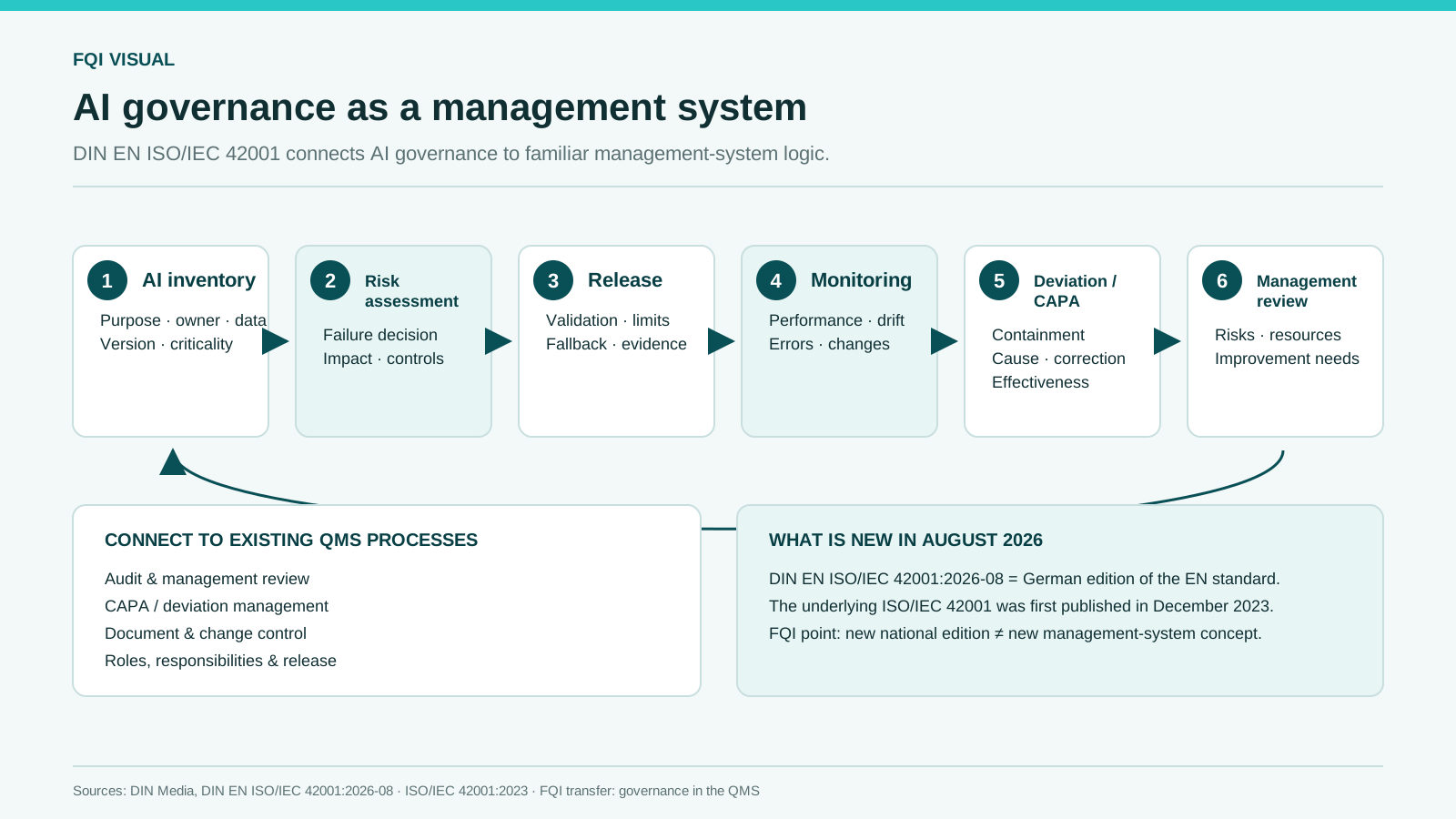
- An AI inventory is only the starting point: the real control loop is classification → risk → release → monitoring → deviation handling → reassessment.
- Conformity with a management-system standard does not replace technical validation: sound governance can establish responsibilities and evidence, but it cannot prove that a specific model performs adequately for a given use case.
The principle at a glance
ISO/IEC 42001 specifies requirements for establishing, implementing, maintaining and continually improving an AI management system. ISO explicitly describes it as a management-system standard using a Plan-Do-Check-Act logic. DIN EN ISO/IEC 42001:2026-08 adopts ISO/IEC 42001:2023 as the German version of the European EN ISO/IEC 42001:2026 and replaces the previous German draft DIN ISO/IEC 42001:2025-10.
For quality management, the logic is familiar: define objectives, assess risks, assign responsibilities, control processes, evaluate effectiveness and improve when deviations occur.
Terms explained
- CAPA: Corrective and Preventive Action; a structured process for correcting and preventing problems.
- QMS: Quality management system; the controlled organisation of responsibilities, processes and evidence.
- AIMS: A context-dependent abbreviation for Artificial Intelligence Management System or Augmented Intelligence for Manufacturing Systems; the article must state which meaning applies.
- AI: Artificial intelligence; systems that derive patterns from data or support tasks automatically.
- PDCA: Plan, Do, Check and Act; a cycle for continual improvement.
- prompt: A task instruction or input for an AI system; it describes the task, rules, context and expected result.
Deep dive
Organisations often introduce AI use case by use case: a document assistant, a vision system, a classifier or an agentic workflow. As the number of systems grows, governance quickly becomes a problem. Who owns the use case? Which data may be used? Which model version is released? Which error risks are acceptable? What happens when performance drops or a provider changes? Without a common system, these questions are answered inconsistently by individual projects.
ISO/IEC 42001 addresses this organisational layer. The standard does not focus only on individual models, but on a management system for organisations that develop, provide or use AI. ISO highlights risk management, transparency, accountability, performance evaluation and continual improvement among the core elements. Its PDCA logic connects naturally to established management-system thinking while retaining AI-specific requirements.
From an FQI perspective, this is the central transfer: AI governance should be integrated into existing control processes wherever practical. A workable loop begins with an AI inventory. Each use case records purpose, owner, data sources, model or service version, criticality and affected processes. The next step is risk-based assessment: what failure decision is possible, what is its effect and which controls prevent or detect it?
Before productive use, there should be a documented release. This should cover not only information security and privacy, but also professional validation, reference cases, permitted operating limits and fallback rules. Monitoring begins after release. Indicators may include error rate, defect escape, escalation, rework, drift or runtime. When the system exceeds defined limits, a deviation process should be triggered.
This creates a direct connection to CAPA. An AI deviation can be treated similarly to a process deviation: describe the problem, define containment, analyse the cause, implement correction and verify effectiveness. Causes may lie in data, prompt logic, retrieval, model version, tool integration or organisational use. Management review then evaluates the effectiveness of the governance system as a whole: open risks, recurring failures, resources, changes and improvement needs.
Role allocation matters. Quality management can support the system, evidence logic and auditability, but it should not become the sole owner of AI. Business functions, IT, information security, privacy and, where relevant, legal or product-safety functions need shared responsibility.
Limitations and risks
First, ISO/IEC 42001 is a management-system standard. Successful implementation does not automatically demonstrate that an individual AI system is technically reliable or suitable for every intended purpose. Second, there is a risk of reducing governance to documentation. A comprehensive register without effective controls creates evidence, not quality. Third, overlaps with existing systems must be designed deliberately to avoid parallel release and CAPA processes. Fourth, regulatory requirements for specific AI applications still need separate consideration; standards and law are not identical.
FQI conclusion
DIN EN ISO/IEC 42001 makes AI governance more tangible for German organisations. From an FQI perspective, its greatest value is not another certification project, but a controlled operating loop for AI applications. When inventory, risk, release, monitoring, deviation handling and management review are connected, organisations can use existing QMS competence while making AI-specific risks visible. Integration is the decisive point: governance should improve operational quality rather than create a second documentation world.
Sources & transparency
- DIN Media: DIN EN ISO/IEC 42001:2026-08, German version of EN ISO/IEC 42001:2026 based on ISO/IEC 42001:2023; publication edition August 2026.
- ISO: ISO/IEC 42001:2023 – AI management systems, the international Artificial Intelligence Management System standard.
- ISO: AI management systems: What businesses need to know, including the PDCA logic and governance, risk and continual-improvement context.
- The concrete connection between AI inventory, release, monitoring, CAPA and management review is an FQI assessment for integration into existing quality-management systems.
- This article was researched and drafted with AI support. Sources and professional transfers were reviewed; explicit human approval for publication was documented on 15 August 2026.
- Approval status: First-use explanations and the glossary were reviewed by a human and approved for publication on 17 August 2026. Approved by: Johann Fischer.