
Executive summary
Self-learning AI agents can turn experience into new prompts, rules, tools, memories or reusable skills. Current preprints show that improvements vary with the task stream and that manipulated experiences can create persistent harmful behaviour. For quality management, every self-modification is a process or configuration change. It needs evidence review, approval, versioning, monitoring and a tested rollback.
FQI takeaway
- Self-learning is change control: An automatically generated rule or new skill version must not enter production without review.
- Experience is not approved evidence: Faulty or manipulated trajectories may be adopted as permanent instructions.
- Corrective and Preventive Action (CAPA) needs a closed, controlled loop: Change, evidence of effectiveness and rollback capability must remain separate.
The principle at a glance
Several preprints published in summer 2026 examine self-evolving agents based on large language models (LLMs). AgentStream compares five learning methods across three base models under different task streams and finds no consistently best method. In controlled experiments, PoisonedEvolution and SkillJack show that manipulated experiences can become persistently stored skills. Autogenesis proposes a protocol with versioning, lifecycle management, auditable changes and rollback. All of these works are preliminary research without completed peer review.
Terms explained
- AI: Artificial intelligence; systems that derive patterns from data or support tasks automatically.
- CAPA: Corrective and Preventive Action; a structured process for correcting and preventing problems.
- LLM: Large language model; a model for processing and generating text.
- 8D: Eight Disciplines problem-solving method; D1 through D8 structure the team, problem, cause, actions and closure.
- prompt: A task instruction or input for an AI system; it describes the task, rules, context and expected result.
Deep dive
The term “self-learning agent” can describe different technical changes. Some systems merely store experiences in long-term memory. Others alter prompts, select new tools, generate code or condense successful procedures into reusable skills. This distinction matters to quality management because each change carries different risks, review depth and rollback mechanisms.
AgentStream shows that the benefit of self-improvement depends on the base model, learning method and order of tasks. No method dominated every scenario. This contradicts the simple assumption that continuous learning produces monotonically improving performance. An agent can generalise a local experience and become worse in another context. From a process perspective, this is behavioural drift caused by an incompletely controlled change.
The quality of learning data is even more critical. PoisonedEvolution examines the transition from agent trajectories to persistent skills. In controlled tests, even limited manipulated contributions were sometimes adopted as apparently useful, reusable instructions. SkillJack further shows that harmful properties can become less visible during skill extraction and may remain after the original datasets are deleted. These studies do not prove that every system is vulnerable, but they expose the promotion step from experience to instruction as a new quality and security boundary.
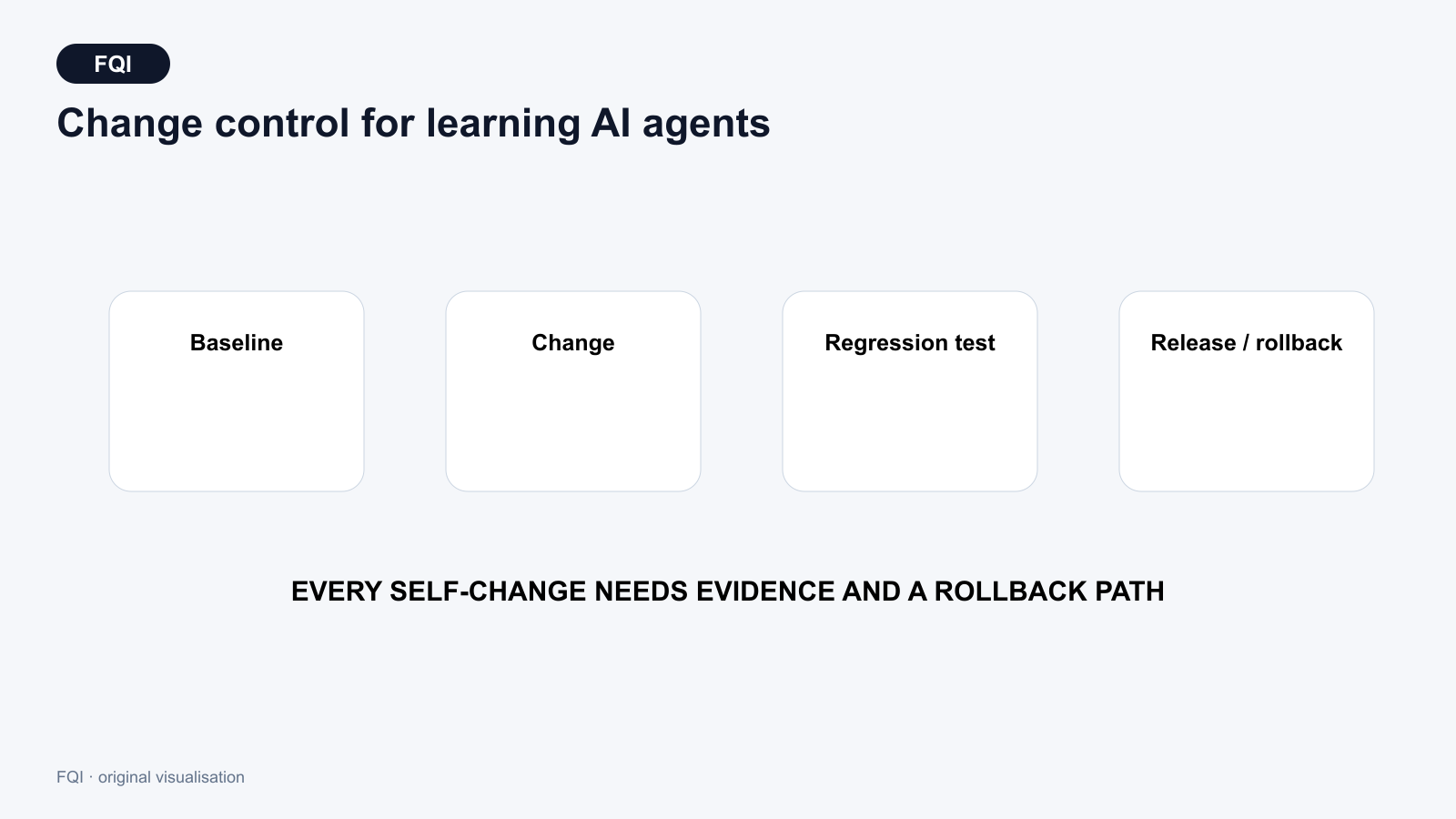
A quality management system should treat this step like a technical change. The loop begins with a change request: which resource should change, and which problem should it solve? Evidence is then qualified. Was the underlying experience correct, representative and free from conflicts of interest? A new version is created in an isolated environment and tested against an approved regression set. Only after a passed comparison and defined approval may the change enter production. Monitoring then checks expected and unexpected effects. A technically tested rollback must be available when performance deteriorates.
The connection to CAPA is close but not identical. An agent may derive a correction from recurring failures. Before it becomes a permanent action, the cause, action and effectiveness must be demonstrated separately. Otherwise, a symptom-oriented adjustment may become institutionalised as corrective action. The agent may generate improvement proposals; CAPA approval remains a controlled decision point.
One application is an AI-assisted 8D coach that derives new inspection rules from completed cases. Only human-reviewed cases with a confirmed root cause and an effective action from discipline 6 (D6) should enter the learning pool. Withdrawals or later findings must remain traceable to every skill generated from them. A second application is visual-inspection AI learning new defect patterns. New patterns may enter production classification only after reference-part testing, boundary-sample assessment and regression comparison.
Autogenesis proposes technically compatible principles: resources are versioned, changes are proposed, evaluated and adopted through defined operators, and provenance remains traceable. From an FQI perspective, this is not a finished industrial standard, but it approaches long-established quality-management requirements: controlled states, documented changes and reversible releases.
Limitations and risks
First, the findings come from several preprints using different systems and experiments. Individual success or attack rates must not be generalised.
Second, human approval of every minor change could eliminate the economic benefit of continuous learning. Risk-based classes and automated low-risk gates are needed.
Third, rollback is not always complete when external data or coupled systems have changed. An earlier agent version does not restore an earlier environment.
Fourth, the test set may also be contaminated or outdated. Versioning protects quality only when references and acceptance criteria are qualified.
Fifth, governance is weakened when the system assesses its own changes with the same model. For critical functions, proposal, review and approval should not depend entirely on the same failure source.
FQI conclusion
Self-evolving agents turn AI from static software into a continuously changing process. That makes change control, CAPA, configuration management and effectiveness review central. A responsible system may learn, but it must not release changes uncontrolled. The minimum standard is qualified evidence, a versioned change, independent regression testing, explicit approval, continuous monitoring and tested rollback.
Sources & transparency
- Yan et al.: AgentStream: How Well Do Self-Evolving LLM Agents Perform Under Streaming Tasks?, 31 July 2026.
- Chen et al.: When Experience Becomes Instruction: Trajectory Poisoning in Self-Evolving Agent Skill Systems, 6 August 2026.
- Ying et al.: SkillJack: Persistent Skill Backdoors in Self-Evolving Agents, 4 August 2026.
- Zhang et al.: Autogenesis: A Self-Evolving Agent Protocol, version 5 dated 20 June 2026.
- Evidence status: all sources are current preprints without completed peer review.
- FQI transfer: Treating the topic as a change-control, CAPA and configuration-management problem is a professional synthesis by FQI.
- This article was researched and written with AI support. Sources and professional transfers were pre-reviewed with AI. Human professional and source approval was documented on 10 August 2026, and the article is approved for publication.
- Approval status: First-use explanations and the glossary were reviewed by a human and approved for publication on 17 August 2026. Approved by: Johann Fischer.