
Executive summary
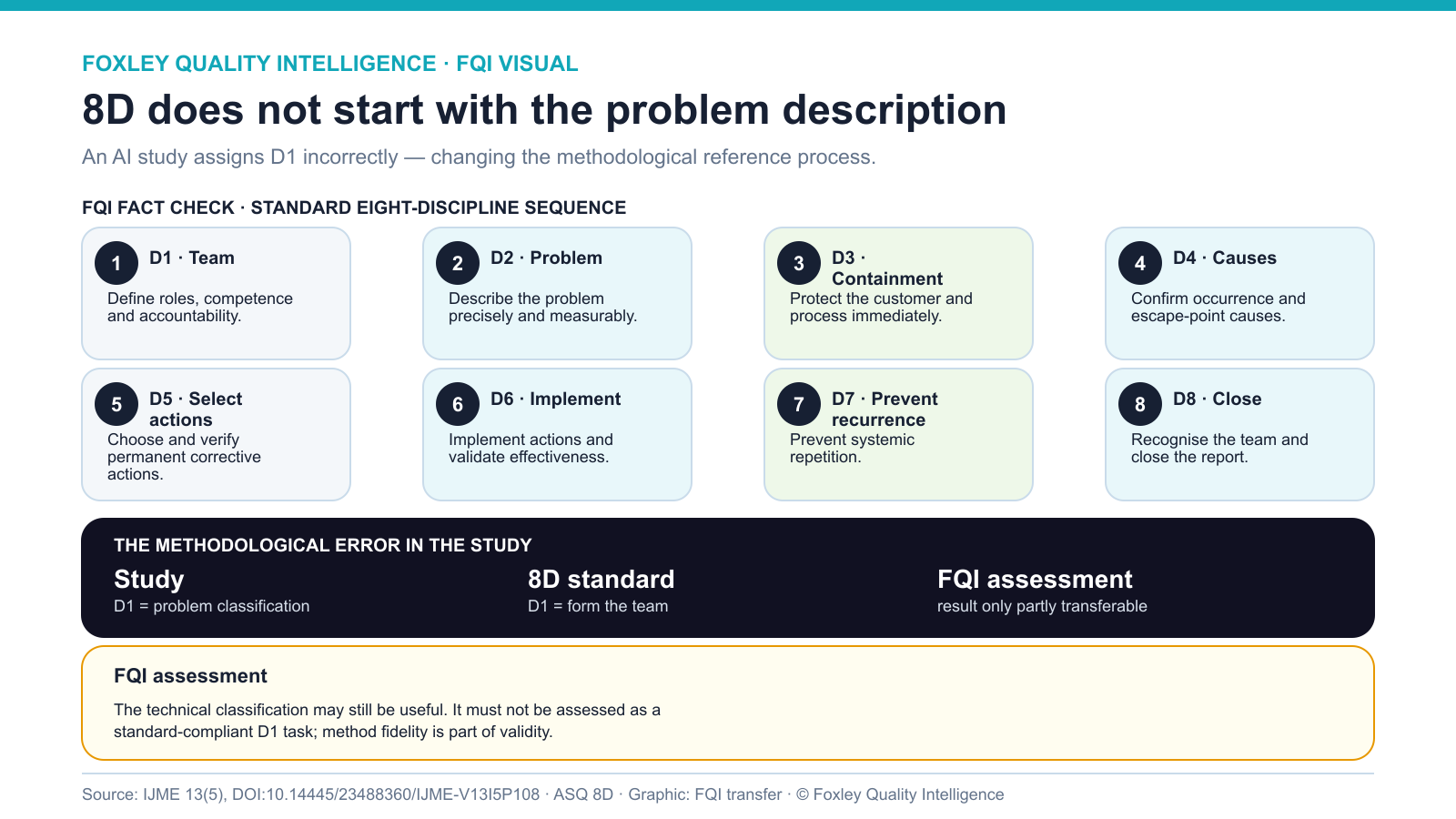
A May 2026 case study applies AI to 67 manufacturing problem descriptions and reports 89.7% accuracy, 87.3% precision, 92.1% recall and an F1 score of 0.895. It also reports a reduction from four working days to 30 minutes for classification and a total 8D lead-time reduction from 63 to 41 days. The paper contains a central methodological error: it labels problem description and classification as discipline D1. In the established 8D sequence referenced by ASQ, D1 forms the team and D2 describes the problem.
FQI takeaway
- Method fidelity is part of validity: automating the wrong process step makes performance numbers difficult to interpret.
- The result is better described as D2 triage: AI may structure incoming problem descriptions, suggest categories and flag incomplete information.
- Speed does not prove better problem solving: classification time, 8D lead time and confirmed root-cause quality must be measured separately.
The principle at a glance
The standard 8D flow is D1 team formation, D2 problem description, D3 interim containment, D4 root-cause and escape-point analysis, D5 selection of permanent corrective actions, D6 implementation and validation, D7 prevention of recurrence, and D8 closure and team recognition. Problem classification may support D2, but it neither forms a competent cross-functional team nor establishes shared responsibility.
This distinction is not cosmetic. When a paper defines the automated task as D1, the reference process changes. The reader can no longer tell whether the claimed improvement concerns problem description, team composition or the full discipline.
Terms explained
- AI: Artificial intelligence; systems that derive patterns from data or support tasks automatically.
- 8D: Eight Disciplines problem-solving method; D1 through D8 structure the team, problem, cause, actions and closure.
- prompt: A task instruction or input for an AI system; it describes the task, rules, context and expected result.
Deep dive
The study used 67 descriptions labelled by consensus among three experienced quality engineers. Its manual comparison of roughly 62% accuracy appears to come from a parallel classification by the company’s quality manager. This compares an expert consensus label with a single manual assessment, which may be useful for an initial case study but is not a robust general comparison of humans and AI in 8D.
The reported time reduction also needs scope clarity. The AI component included around 42 seconds of inference and 28 minutes of human review. It is not clear whether the four-day manual baseline covered exactly the same information access, work content and approval status. Faster classification is plausible, but a 99% reduction in this task must not be presented as an equivalent reduction in the entire problem-solving process.
The paper further reports that total 8D lead time fell from 63 to 41 days, with the largest effect attributed to more focused D4 hypotheses. Because only one real manufacturing case was assessed, the influence of the AI cannot be separated cleanly from process changes, team learning or the corrective actions themselves.
There are nevertheless useful design ideas: structured JSON, two independent model runs, a completeness score, consistency checks, human escalation below a threshold and change logging. These features can support controlled D2 triage. A stronger follow-up study would compare experienced 8D teams, less-experienced users with AI and less-experienced users without AI under identical cases, time budgets and evaluation criteria.
Limitations and risks
The D1/D2 misassignment must be visible before any result is transferred to practice. The effectiveness assessment covers only one manufacturing case, the manual baseline is weak, and model, prompt and data-access details are not sufficiently reproducible for broad transfer. Correctly labelling the task also does not prove that AI improves later root-cause confirmation or corrective-action effectiveness.
FQI conclusion
The study is an interesting signal for AI-assisted problem triage, but not a standard-compliant blueprint for 8D. Its most valuable lesson is that AI results require reviewers who understand the method being automated. Sound digitalisation begins with the correct process architecture; speed and model metrics only become meaningful afterwards.
Sources & transparency
- Kamble et al.: Artificial Intelligence Integration in the Eight Disciplines (8D) Problem-Solving Methodology, SSRG International Journal of Mechanical Engineering, May 2026.
- ASQ: Eight Disciplines 8D, reference for the established sequence of D1 and D2. The methodological comparison is an FQI analysis.
- This article and its original visualisation were created with AI support, professionally reviewed and explicitly approved for publication on 10 August 2026.
- Approval status: First-use explanations and the glossary were reviewed by a human and approved for publication on 17 August 2026. Approved by: Johann Fischer.