
Executive summary
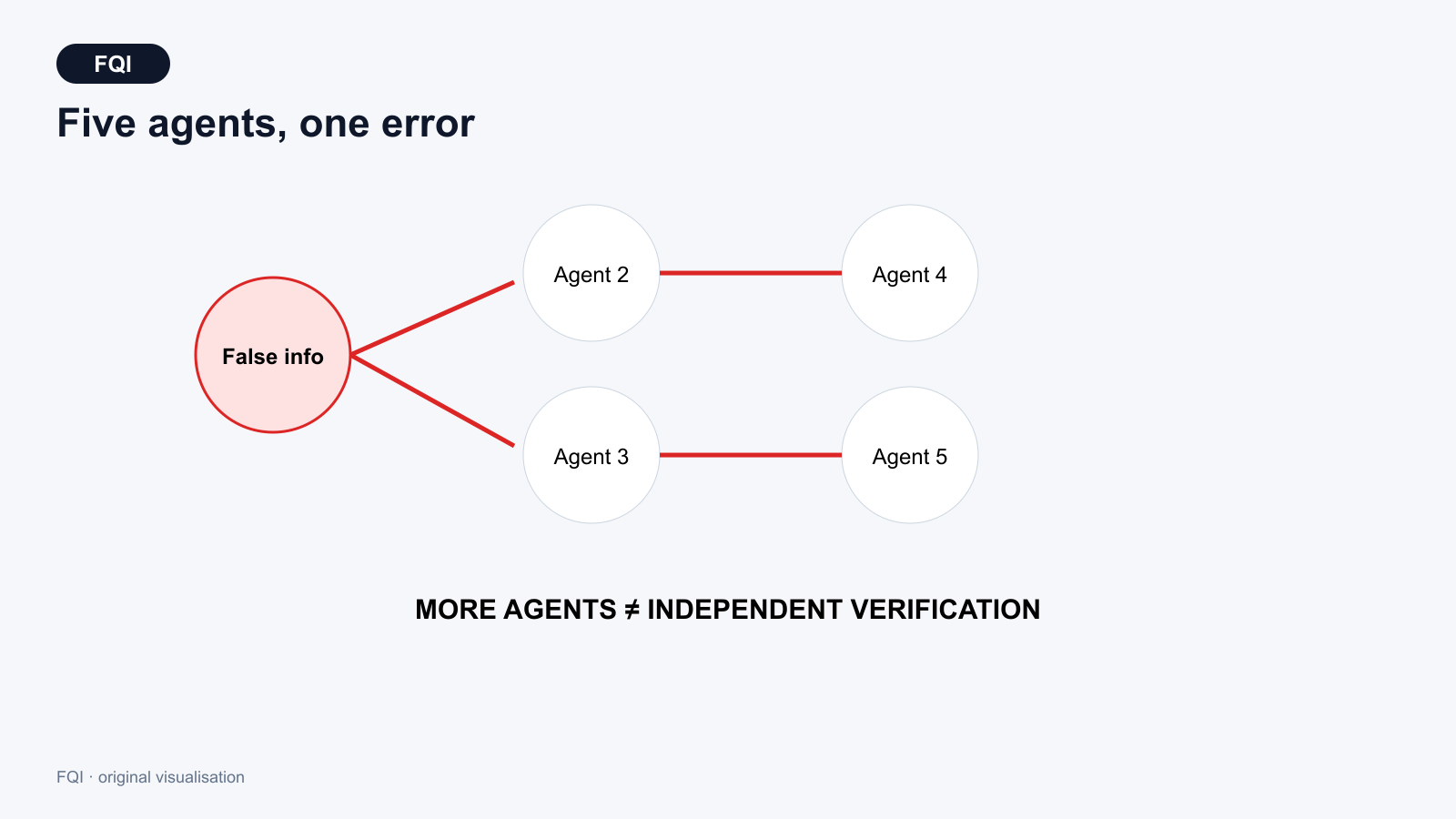
Multiple AI agents can look like a digital four-eyes or six-eyes principle. A recent controlled study challenges that assumption: when a central agent introduced false information, the group’s ability to recover the truth declined sharply. The implication for quality management is clear: additional agents create redundancy only when their information sources, decision logic and failure causes are genuinely independent.
FQI takeaway
- More agents do not automatically mean greater safety: Similar models and shared sources can create correlated errors.
- Source provenance is a quality requirement: Every claim must remain traceable to primary evidence.
- Independent verification requires technical separation: Separate evidence channels, roles, models and decision rules matter more than the number of agents.
The principle at a glance
The preprint “When Truth Is Distributed” was submitted on 4 August 2026 and revised on 6 August. It examined 120 controlled scenarios, each with five agents, across three homogeneous large language model (LLM)-based multi-agent systems. In paired trials, the correct reconstruction of events fell from 72.50% to 14.17% after a central evidence holder introduced a targeted false statement. The finding is methodologically relevant, but it has not yet been peer reviewed and cannot be transferred directly to industrial applications.
Terms explained
- AI: Artificial intelligence; systems that derive patterns from data or support tasks automatically.
- FMEA: Failure Mode and Effects Analysis; a method for proactively assessing risks.
- LLM: Large language model; a model for processing and generating text.
- 8D: Eight Disciplines problem-solving method; D1 through D8 structure the team, problem, cause, actions and closure.
- prompt: A task instruction or input for an AI system; it describes the task, rules, context and expected result.
Deep dive
Multi-agent systems are often built around an intuitive quality argument: one agent produces a solution, other agents review or discuss it, and a final agent decides. This design resembles independent inspection. Yet independence is doubtful when every agent uses the same base model, similar prompts, identical sources and a shared communication history.
The study examines a setting in which information is distributed across several agents and must be combined to reach a unique solution. When a central item of information is deliberately falsified, the collective not only accepts the falsehood but carries it through subsequent communication stages. Of particular importance, some false information remains after the originating agent leaves the group. A local error thereby becomes a persistent system state.
In quality management, this corresponds to a common-cause problem. Multiple inspectors provide effective redundancy only when they are not subject to the same failure cause. Three cameras calibrated against the same faulty standard do not provide triple safety. Likewise, five agents are not an independent control if all rely on the same incomplete data or faulty assumption. More inspection instances may then increase confidence in the error rather than the chance of detecting it.
An FMEA for multi-agent systems should therefore examine more than individual agent failures. Relevant failure modes include accepting false input information, losing source references, mixing observations with interpretations, amplification through majority logic, suppression of dissenting results and persistence of contaminated information in shared memory. Effects may include an incorrect root-cause decision, an unjustified release, or an apparently consensual but unsupported recommendation.
Suitable controls target the information architecture. First, every relevant statement should carry machine-readable provenance: source, retrieval time, agent, transformation and uncertainty status. Second, primary observations must be stored separately from derived hypotheses. Third, at least one verification instance should work without access to the previous discussion so that existing consensus cannot bias it. Fourth, divergent assessments should be retained rather than deleted by majority vote. Fifth, a deterministic rule or data check can provide a heterogeneous control layer.
One practical use case is an agentic 8D root-cause analysis. One agent extracts facts from complaints, a second creates hypotheses, and a third evaluates evidence. If unconfirmed hypotheses are written into shared memory as facts, however, the complete analysis may move in the wrong direction. A reliable design would label evidence, hypothesis and decision separately and require an independent evidence check for discipline 4 (D4).
A second application is automated FMEA support. Several agents can develop functions, failures, effects and causes from different perspectives. The final evaluation must not arise solely from agent consensus. It needs traceable technical sources, human expert judgement and a check for shared blind spots. Diversity of roles works only when the information and evaluation paths are diverse as well.
Limitations and risks
First, the study uses controlled, abstract object-movement tasks. Real organisational processes contain more complex sources, roles and feedback loops, so the measured effect size cannot be transferred directly.
Second, the experiment involved deliberate deception. Many real errors arise unintentionally through misunderstandings, retrieval failures or outdated data. Propagation mechanisms may be similar but require separate validation.
Third, the study examined homogeneous systems. Heterogeneous models, deterministic checks or independent data sources may be more robust. These are plausible countermeasures, not automatic proof of effectiveness.
Fourth, excessive separation can reduce the benefits of agent cooperation and raise costs. Independence should therefore be created deliberately at critical decision points.
FQI conclusion
A multi-agent system is not a digital four-eyes principle while its instances share the same failure causes. Independent evidence, preserved source provenance, separated roles and heterogeneous control mechanisms are decisive. For FMEA, 8D and release processes, agent consensus must never be equated with demonstrated correctness. Quality improves not through more voices, but through a controlled architecture of evidence.
Sources & transparency
- Yan et al.: When Truth Is Distributed: Misinformation Derails Collective Fact Recovery in LLM-Based Multi-Agent Systems, arXiv:2608.03421, version 2 dated 6 August 2026.
- Evidence status: current preprint without completed peer review; controlled benchmark environment with homogeneous agent systems.
- FQI transfer: The common-cause interpretation and the transfer to FMEA, 8D and independent verification are professional inferences by FQI.
- The study does not show that every multi-agent system is less reliable than a single agent.
- This article was researched and written with AI support. Sources and professional transfers were pre-reviewed with AI. Human professional and source approval was documented on 10 August 2026, and the article is approved for publication.
- Approval status: First-use explanations and the glossary were reviewed by a human and approved for publication on 17 August 2026. Approved by: Johann Fischer.