
Executive summary
HaGen uses historical aviation reports to generate new hazard scenarios with large language models and trace them back to similar real cases. The principle is particularly relevant to industrial FMEA: retrieve experiential knowledge, formulate additional risk hypotheses, expose the underlying evidence and let experts decide. AI would not become an automatic FMEA author, but a traceable sparring partner for the accountable team.
FQI takeaway
- Activate experiential knowledge: 8D cases, complaints, lessons learned, previous FMEAs, and inspection and field data could feed more systematically into new risk analyses.
- Traceability rather than a black box: An AI proposal becomes more valuable when the historical cases or reliable sources behind it remain visible.
- Human in the loop remains mandatory: Technical plausibility, causality, assessment and actions remain the responsibility of the FMEA team.
The principle at a glance
An LLM can formulate plausible failure scenarios very quickly. That alone does not create a reliable risk analysis. Support becomes useful when the system deliberately retrieves relevant experience, derives hypotheses and exposes the underlying evidence for every important proposal.
What hazard could occur—and which experiences from the past support it?
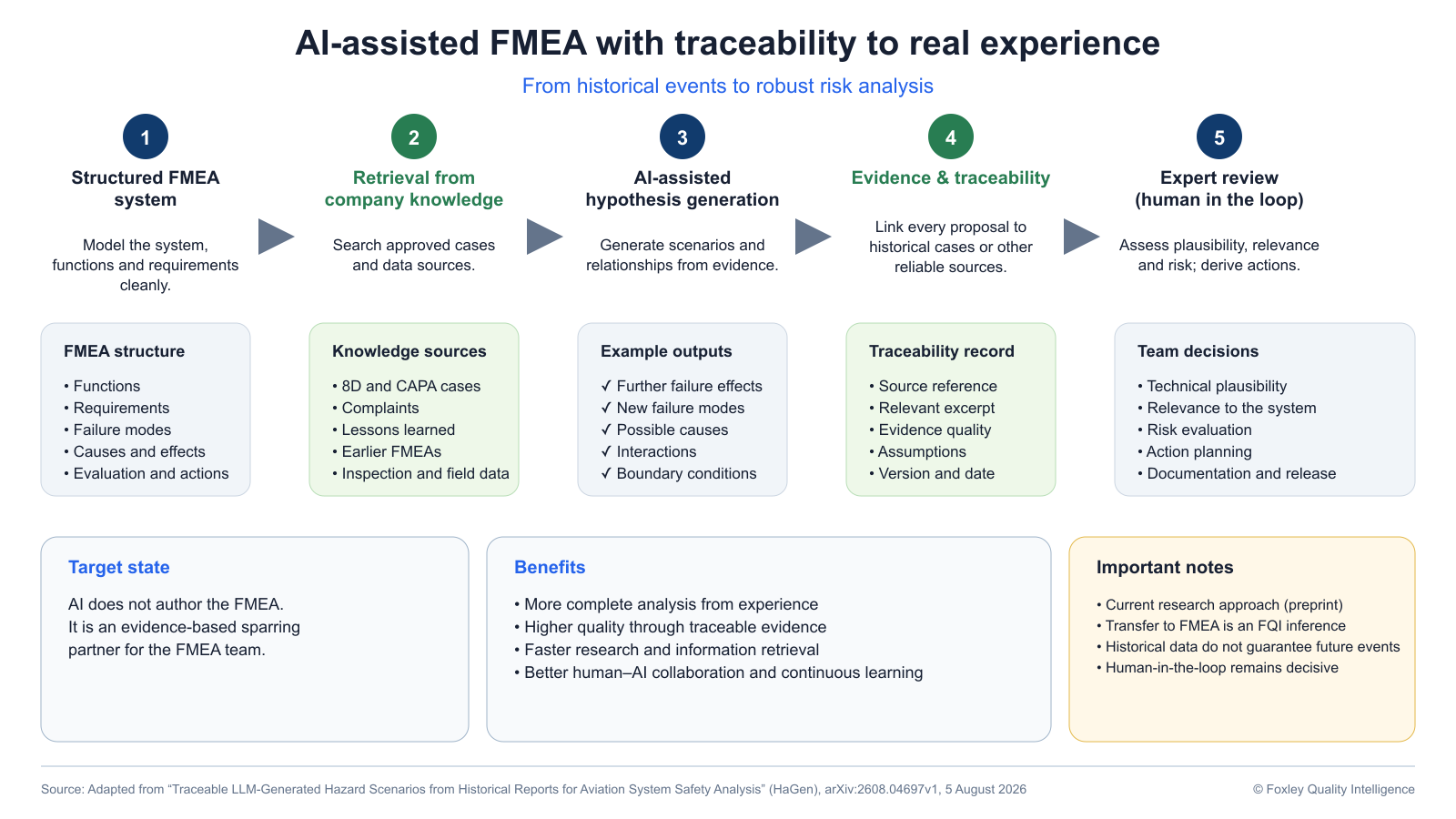
The benefit shifts from pure text generation towards a form of preventive quality memory. Historical quality data is not merely archived but actively fed into new risk analyses. Potential knowledge sources include 8D and CAPA cases, complaints, lessons learned, previous FMEAs, inspection and field data, and quality notifications.
Terms explained
- AI: Artificial intelligence; systems that derive patterns from data or support tasks automatically.
- FMEA: Failure Mode and Effects Analysis; a method for proactively assessing risks.
- CAPA: Corrective and Preventive Action; a structured process for correcting and preventing problems.
- LLM: Large language model; a model for processing and generating text.
- 8D: Eight Disciplines problem-solving method; D1 through D8 structure the team, problem, cause, actions and closure.
- ASRS: Aviation Safety Reporting System; a US database of voluntary reports about aviation safety events.
Deep dive
The problem: Have we considered the relevant failures?
Completeness is a central challenge in every FMEA. Organisations often hold extensive experiential knowledge in complaints, 8D reports, CAPA cases, inspections, field data and earlier FMEAs. The knowledge exists, but new risk analyses do not necessarily find and consider it systematically.
What does HaGen do differently?
HaGen—short for Hazards Generator—was developed for operational safety analysis in aviation. It uses historical reports from NASA’s Aviation Safety Reporting System. For a specified undesirable outcome, the system generates a structured hypothesis based on categorical influence factors and a corresponding narrative scenario. It also provides a plausibility value derived from historical co-occurrences and references to particularly similar held-out ASRS reports.
Generation is therefore only part of the contribution. Linking proposals to historical events gives analysts a traceable basis for review and prioritisation. The authors explicitly position the system as analyst-in-the-loop support, not as a prediction of an event’s probability.
Transfer to industrial FMEA
A comparable industrial system could identify relevant historical cases during a new FMEA and derive additional candidates for failure effects, failure modes or causes. Every proposal would link to the underlying cases or other reliable sources. The FMEA team would then assess technical plausibility, relevance to the system, severity, occurrence and detection, and derive actions where appropriate.
The target model is therefore a structured FMEA process, retrieval from approved organisational knowledge, AI-assisted hypothesis generation, evidence and traceability, followed by expert review. This chain distinguishes a professionally controlled approach from simply asking a language model to write an FMEA.
Limitations and risks
The study examines operational hazard scenarios in aviation, not industrial design or process FMEA. Applying it to quality management is therefore an FQI inference, not evidence of effectiveness for FMEA. The work is also a preprint and has not completed peer review.
Similarity is not causality. Historical cases can look linguistically or structurally similar despite involving different technical mechanisms. Past data also cannot fully cover novel failures that have never occurred. Data quality, access rights, confidentiality and careful selection of approved knowledge sources become essential prerequisites. Plausible analogies must remain recognisable as hypotheses at all times.
FQI conclusion
The decisive question is not whether AI can automatically create an FMEA. It is whether AI can make organisational experience available in a way that helps teams identify additional risks earlier and review every proposal transparently. The reliable division of roles remains clear: AI generates hypotheses, data provides evidence and experts make the decision.
Sources & transparency
- Mascia, Cristian; Pietrantuono, Roberto; Rodriguez, Daniel; Russo, Stefano: Traceable LLM-Generated Hazard Scenarios for Operational Safety Analysis of Aviation Systems Using ASRS Reports, preprint, arXiv:2608.04697v1, 5 August 2026.
- Open research artefacts on Zenodo.
- Applying the research approach to industrial FMEA, 8D and CAPA, and the FQI assessment presented here, are professional inferences. This Research Brief was prepared with AI support from the supplied FQI reference material and explicitly approved for publication on 10 August 2026.
- Approval status: First-use explanations and the glossary were reviewed by a human and approved for publication on 17 August 2026. Approved by: Johann Fischer.