
Executive summary
A success rate for artificial intelligence (AI) can be created by the software that measures success. In one study, a scoring function changes the database state under evaluation. A subsequent assessment then reads the reference solution and credits the agent with too many successful tasks.
The original scoring function itself still returns the correct value. The defect arises when it is combined with the additional assessment. This illustrates why state changes, call order and repeated execution of evaluation software need qualification.
FQI takeaway
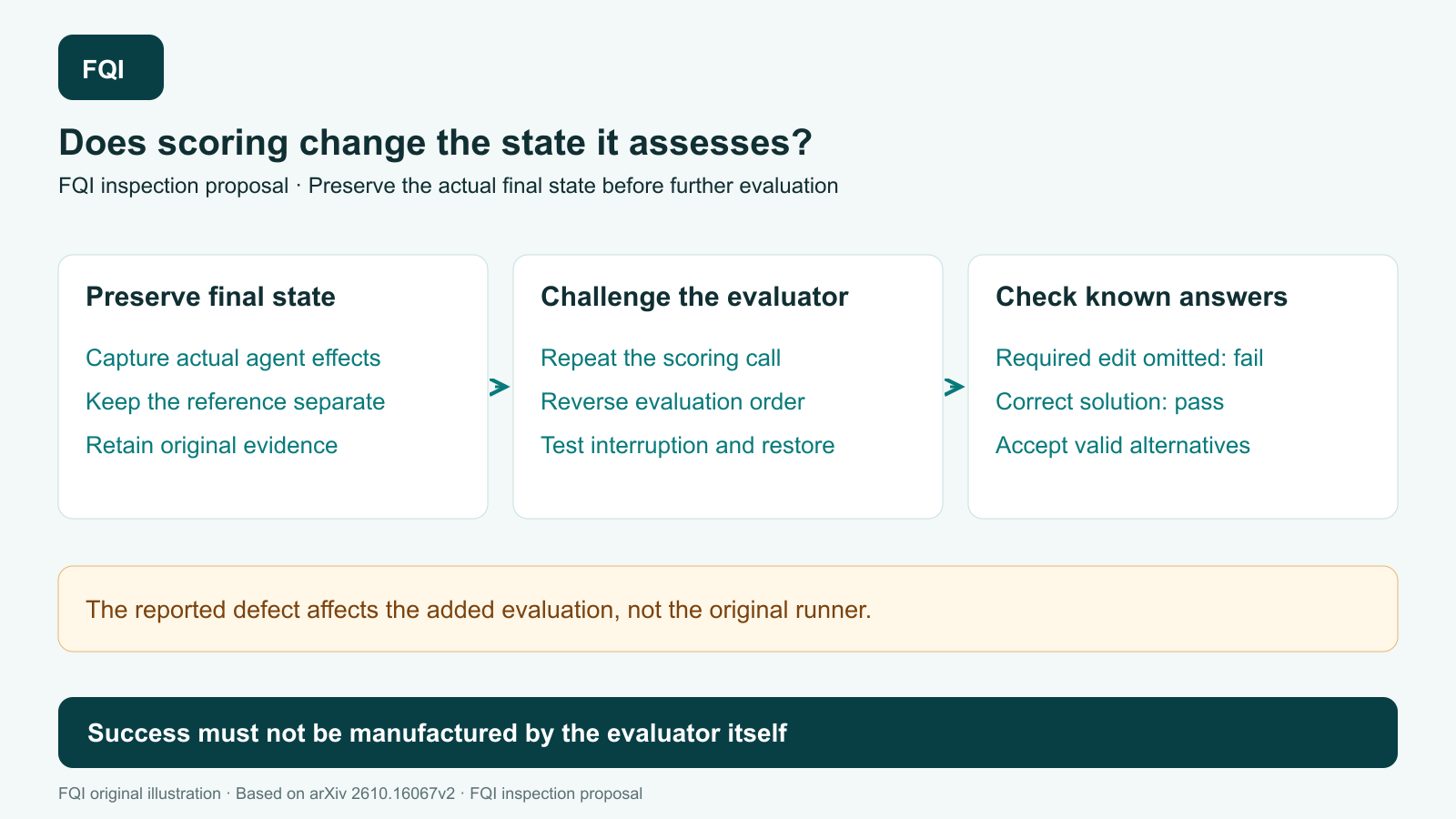
- Preserve the actual final state of an agent task before additional evaluations can alter it.
- Test whether scoring calls affect state, repeatability or the results of subsequent checks.
- Qualify the evaluator with known failing and passing cases and deliberately introduced scoring defects.
The principle at a glance
A simplified FQI example: an assistant must correctly update a record. Evaluation compares its state with a reference. If generating the reference overwrites the same database, a later check encounters the desired state already in place. The evaluator has produced what it then attributes to the assistant.
Researchers call this decision component a test oracle. It determines whether an observed result meets the requirements. It therefore needs an auditable contract: which data may it read or change, and what must remain intact after it returns?
Deep dive
The work describes a specific integration defect. The scoring function first calculates a check value from the actual final state. It then resets the environment, creates a reference state and calculates a comparison value.
Its own return value is correct because it uses the previously captured check value. However, the original state is not restored.
The authors’ experimental setup reads the environment again after the session ends. That second assessment therefore encounters the reference solution. Attribution matters: according to the paper, the benchmark’s original runner consumes the correct returned value and is unaffected. The reported failure concerns the added integration, not all original results from that benchmark.
The researchers replay recorded tool calls against a clean database. Across 4,320 archived episodes, the reported overall success rate falls from 94.3 to 65.5 percent. The effect differs between tested agent configurations and consequently changes their relative comparisons. This correction does not rerun the language models and is not a general ranking of model capability.
The authors derive checks for evaluation software, including unchanged input state, stable results on repetition, independence from call order and restoration after exceptions. Known-answer cases complement these properties: omitting a required change must fail, while a correct reference solution must pass. Valid alternative solutions should not fail simply because they differ from one particular reference implementation.
FQI recommends treating these counterchecks as a separate acceptance assessment of the evaluator. The evidence should capture database states before and after scoring. Fault tests deliberately interrupt the evaluator and inspect restoration.
The order of multiple assessments is then reversed. If the verdict changes without a change in agent performance, the evaluation integration is not yet dependable.
The proposed method itself remains bounded. In the study, the controls detect 54 of 57 separable deliberately introduced defect cases. This demonstrates usefulness within the examined catalogue and also exposes a remaining detection gap.
Limitations and risks
The size of the correction belongs to this archived experimental collection. It cannot be transferred to other agent evaluations. The defect catalogue also does not cover every possible evaluator failure.
An attempted transfer to another benchmark fails because the required interface is absent. Teams must first establish whether state capture, restoration and independent scoring are actually available. Stable verdicts alone also do not prove that the expected outcome is technically correct.
FQI conclusion
For FQI, the evaluator is a quality-critical component of the AI test process. It should be qualified before model differences are interpreted. Especially useful are counterchecks that must detect an apparently successful run without the required real state change.
A concrete next step is a documented assessment of the local scoring integration for side effects and repeatability. Once these properties are established, observed improvements can be attributed more credibly to agent performance rather than a changed measurement procedure.
Sources & transparency
Primary source: original study on agent test-oracle failures, original full text v2, particularly Sections 3–4 and transfer limitations. Research manuscript; no independent reproduction by FQI. The database example and acceptance proposal are FQI interpretations. AI-assisted article, approved for publication by Johann Fischer on 2026-10-23.