
Executive summary
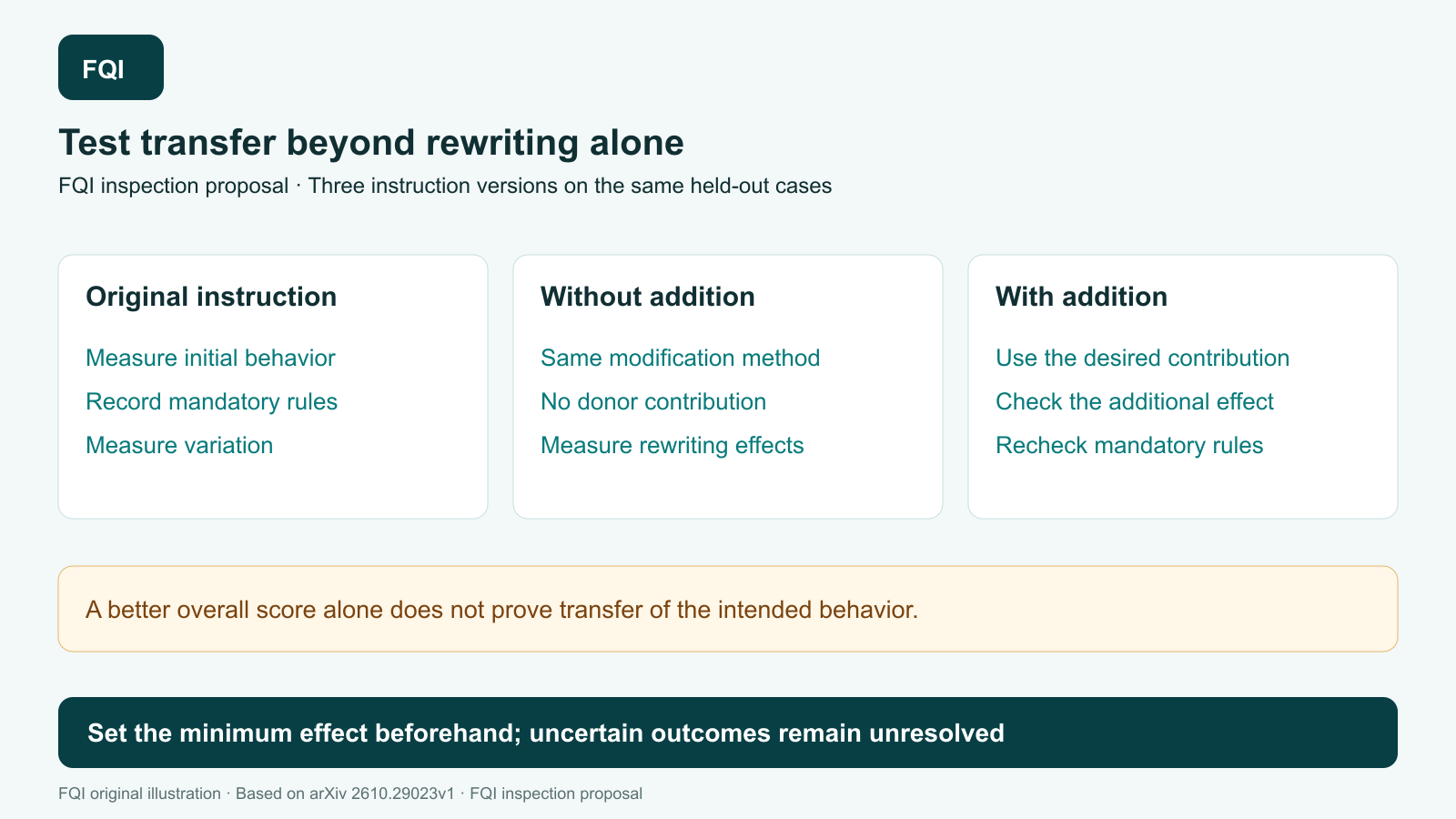
Combining one AI (artificial intelligence) agent’s instructions with another agent’s experience can change its behavior. That does not yet show that the intended experience was transferred: rewriting without that experience may itself cause a shift. A research paper therefore examines a zero-dose control using the same modification procedure without the intended donor contribution.
FQI derives a concrete change assessment that separates intended behavioral transfer, unintended drift and actual usefulness on independent test cases. Each needs its own observable evidence.
FQI takeaway
- Compare each transfer method with its own variant without the intended transfer.
- Specify beforehand which behavior should change, in which direction and by at least how much.
- Check the desired effect separately from preservation of other mandatory requirements.
The principle at a glance
A prompt is an input instruction given to an AI system. When merging prompts, a language model can rewrite an existing instruction or append individual rules. The paper calls the existing agent the recipient and treats another agent’s observed behavior as the donor contribution.
In a simplified FQI example, an assistant should ask more consistently for missing evidence in inspection reports. Helpful behavior from another assistant is incorporated. If responses change, the team must determine whether those examples caused the change or whether rewriting the existing instruction was sufficient.
Terms explained
- Zero-dose control: The same modification process without the intended additional contribution.
- Behavioral profile: Results on predefined test situations used to compare instructions.
- Minimum effect: A justified threshold set in advance for a change to be useful for its purpose.
Deep dive
The study compares instruction-merging methods in a negotiation simulation. It asks whether behavior moves toward the donor beyond the shift caused by the method’s own zero-dose control. A positive lower bound against a predefined minimum effect matters more than a changed final score. Free rewriting fails the investigated admission test; certain append-based methods perform better.
These results apply to one model, one task and a small controlled collection. The effect also does not consistently increase with requested dose. Neither a universally optimal method nor a universal threshold follows. The transferable contribution is the comparison design.
FQI recommends starting with a narrowly specified change. In the inspection-report example, the objective is to request the missing calibration record, rather than simply to “improve the assistant.” Correct handling of complete reports remains a separate requirement. Better requests for evidence must not cause unnecessary blocking of valid cases.
Preserve three versions: the unchanged instruction, the method’s zero-dose version and the version with the desired contribution. Run them on the same held-out cases. Keep model version, available tools and scoring as constant as possible. Repeat cases to expose variation under an unchanged configuration.
Evaluate observable actions first. Was the correct missing record requested? Was a complete report processed appropriately?
Did new unjustified demands appear? Wording becomes a quality characteristic when it affects such a domain decision. A higher general score alone does not answer the transfer question.
Describe the intended effect separately from other changes. A difference against the old instruction may chiefly reflect rewriting. The additional zero-dose comparison exposes that possibility.
If uncertainty remains too large, the claim is unresolved. Failure to demonstrate harm does not positively establish the desired improvement.
Derive the minimum useful effect from the intended use and fix it before testing. Do not adopt the study’s dose threshold as an operational standard. Check preservation of unchanged requirements with separate reference cases. This change-assessment procedure is an FQI proposal, not a demonstrated industrial application.
Limitations and risks
The investigation uses 16 pairs in the open-loop comparison, eight fixed probe situations and a small number of repeated development runs. One model and a negotiation game limit transferability. Instructions are not linear mixtures: a requested contribution need not produce a proportional behavior change.
A strong task score does not establish transfer of a particular capability, and the admission test does not prove preservation of every previous rule. FQI performed no independent reproduction.
FQI conclusion
Changes to AI instructions need a named effect and a suitable comparison. The zero-dose control helps establish whether apparent experience transfer exceeds the effect of rewriting alone. Unchanged mandatory requirements and independent test cases remain necessary for acceptance.
A small experiment focused on clear actions supports a more defensible change decision than the hope of producing generally better text. Uncertain outcomes should remain open instead of being made acceptable through thresholds relaxed after observing the results.
Sources & transparency
Preliminary research; no independent reproduction. The inspection-report example and operational change assessment are FQI interpretation. AI-assisted article, approved for publication by Johann Fischer on 2026-10-24.