
Executive summary
An AI (artificial intelligence) system for image analysis can respond almost identically internally to visibly different images. If the difference matters to the inspection task, this suggests a possible blind spot. A research paper searches for such cases using generative models that produce image variants.
For quality practitioners, a second assessment is crucial: the generated variant must satisfy the intended internal similarity and be suitable as a test image. FQI separates evidence about the vision model from generator errors and unsupported reference judgments.
FQI takeaway
- Define which image features must matter to the domain decision.
- Check internal representation similarity separately from the suitability of generated images.
- Confirm suspected blind spots against domain references before using them in a release decision.
The principle at a glance
Artificial intelligence compresses an image into an internal representation. Ideally, this ignores irrelevant changes, such as suitable lighting variations, while preserving decisive features. Invariance here means that an image change leaves the representation essentially unchanged.
A simplified FQI example concerns surface inspection. Similar internal representations may be desirable when only an irrelevant background changes. If a relevant crack disappears, the same response needs explanation. A generated image pair alone, however, establishes neither a real crack nor an actual incorrect decision.
Terms explained
- Representation: The internal numerical description of an image used by the model.
- Invariant set: Different inputs assigned the same or approximately the same representation.
- Generative prior: The image generator’s learned view of plausible images, which limits the variants it can produce.
Deep dive
The paper’s second version investigates generating images within invariant sets. It separates fidelity to the intended internal representation from consistency of the generated distribution. Controlled colored-digit images allow targeted checks of these properties. More complex natural and medical images illustrate possible applications without establishing industrial or clinical effectiveness.
The approach is a search method for possible weaknesses. It is neither an exhaustive assessment of every variation nor an automatic domain diagnosis. The true distribution of complex images is not fully known, internal representations match only approximately, and an additional comparison model can itself be wrong.
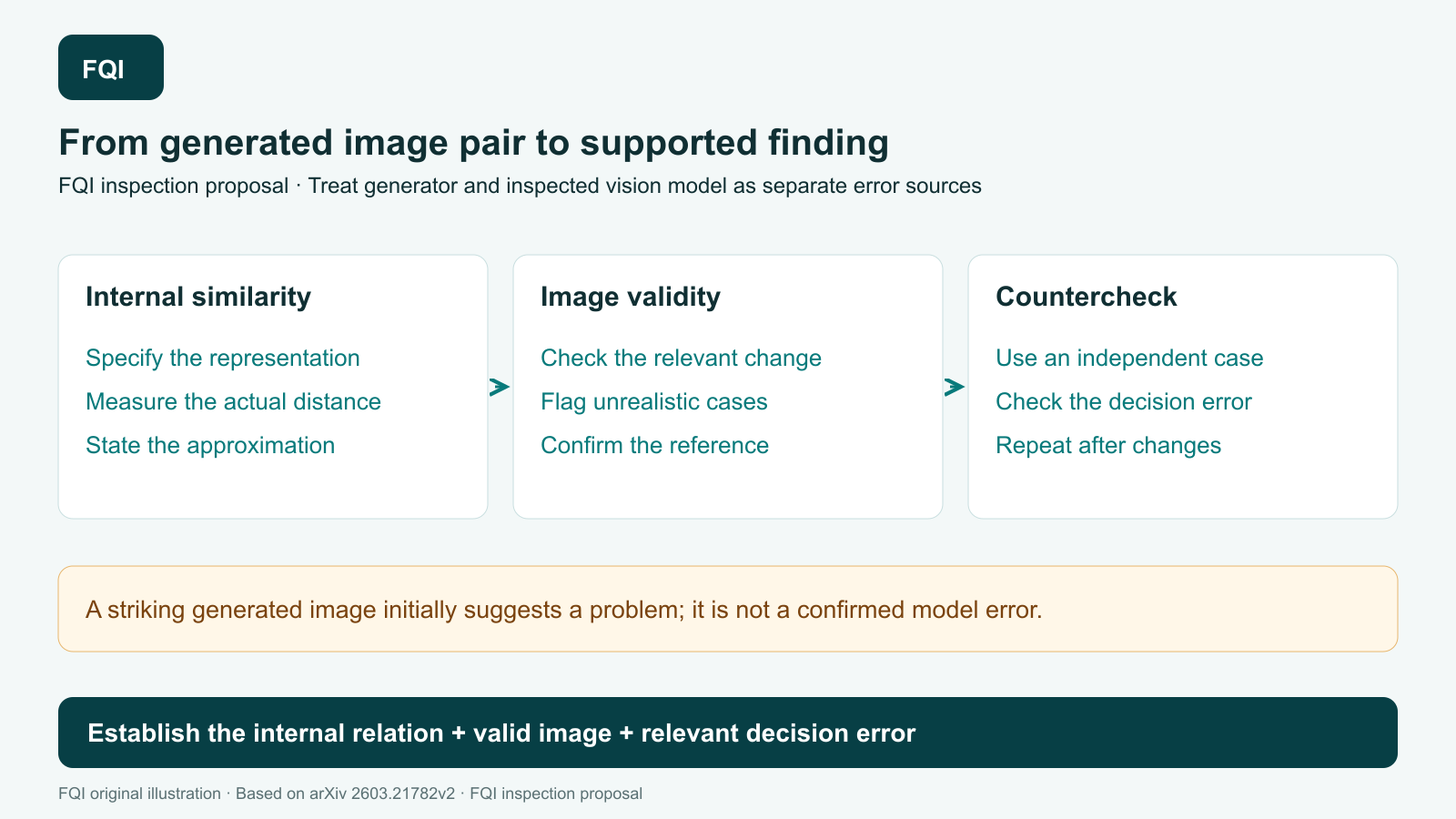
For an FQI pilot, first create a domain feature list separating tolerable variations from changes that require a different decision. In surface inspection, background and permitted lighting may vary while the location and relevant extent of a defect must remain identifiable. The inspection task determines this list; the generator does not.
Next, qualify the search method on simple, controlled images. Create known variants and check whether the internal distance measure reacts as expected. Also examine which image types the generator favors or rarely produces. Without this preliminary check, striking variants might chiefly expose properties of the generator.
Domain experts then review the resulting image pairs. They see the original and variant, identify the relevant change and decide whether the correct task judgment should actually differ. Record unclear or unrealistic variants explicitly. They do not automatically enter an error rate for the inspected vision model.
Confirmed suspicions receive independent counterchecks. A deliberately created or domain-controlled physical variation can establish whether the suspected issue recurs outside the generator. Keep the initial suspicion, image assessment and countercheck result as separate evidence items so their individual support remains traceable.
After a change to the vision model, repeat the relevant cases. Retain an independent test set to ensure improvement on discovered blind spots does not obscure other errors. This limited learning and assessment procedure is FQI interpretation. The source does not establish production approval for it or complete removal of all blind spots.
Limitations and risks
A generator may misrepresent rare features or features outside its training distribution. Good internal similarity does not establish physical plausibility; a plausible image does not establish a valid internal comparison. Medical examples are not treated here as clinical evidence.
The original discloses public and foundation support. FQI performed no independent reproduction. Suitability and cost for industrial defect images remain questions for a local pilot.
FQI conclusion
Searching for different images with the same internal representation can complement vision-model assessment. Reliable interpretation requires three separate questions: was the intended internal relationship achieved, is the image change valid, and does it produce a relevant task error? Documenting these independently keeps an interesting generated image as a testable suspicion. Suitable references and counterchecks can then turn that suspicion into evidence for correction or acceptance without attributing generator mistakes to the inspected model.
Sources & transparency
- Rousselot, Wendebourg and Köthe: Show Me What You Don’t Know; version 2, 22 October 2026, methods 3, experiments 4.1–4.5 and conclusion.
Preliminary research; no independent reproduction, industrial validation or clinical validation. The surface example and pilot are FQI interpretation. AI-assisted article, approved for publication by Johann Fischer on 2026-10-24.