
Executive summary
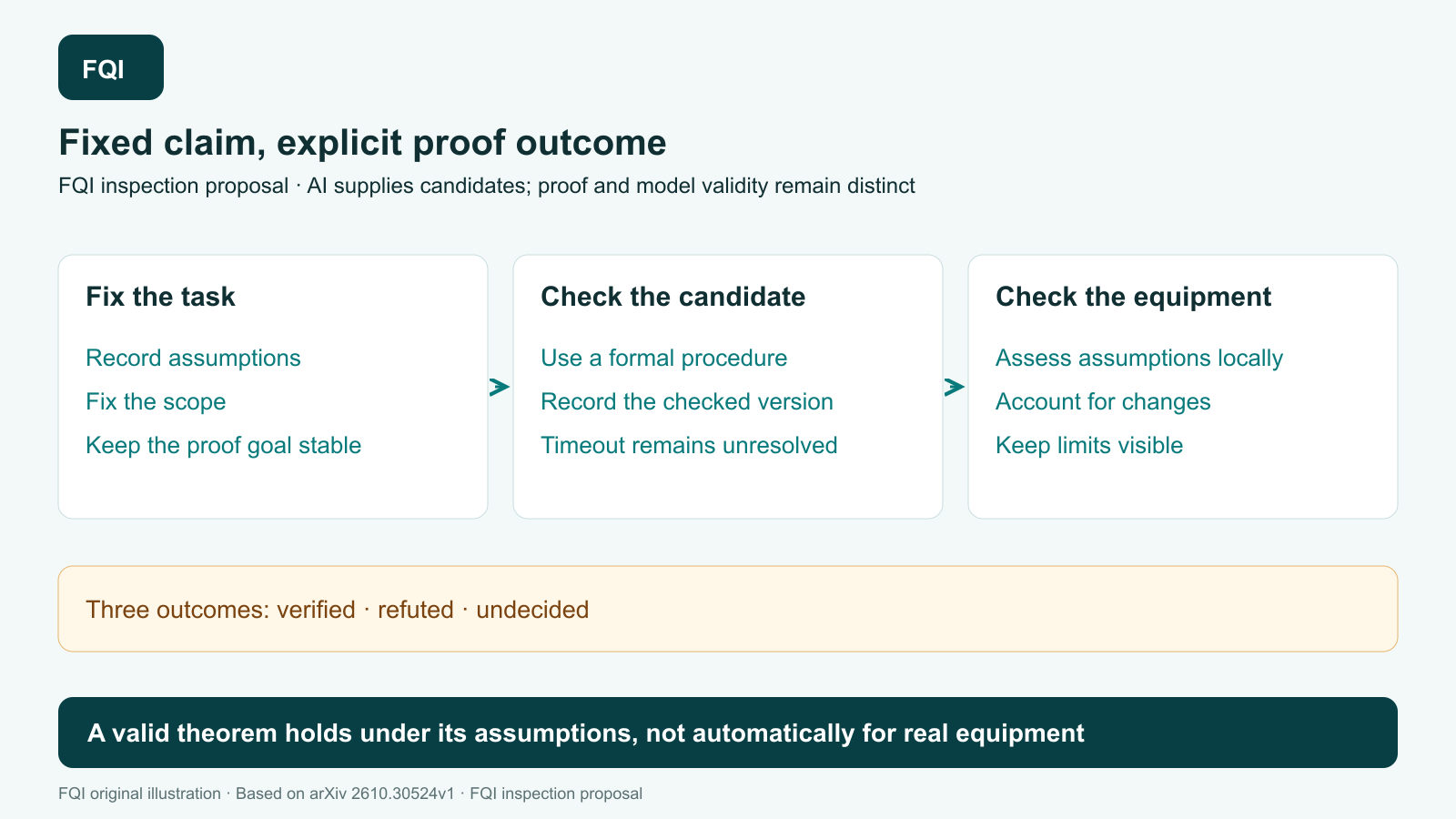
AI (artificial intelligence) can propose mathematical evidence, but a separate procedure must determine whether it holds. LLM2Cert combines generation of stability and safety certificates with formal checking. For quality practitioners, keeping the task unchanged is particularly important: a difficult proof must not become easier through an unnoticed weakening of its conditions.
FQI derives a protocol separating verified, refuted and undecided claims. Whether the mathematical model adequately represents the physical system remains a further prerequisite requiring its own evidence.
FQI takeaway
- Fix model assumptions, scope and proof conditions before checking starts.
- Record verified, refuted and undecided statements as separate outcomes.
- Link mathematical evidence to an independent assessment of whether the model fits its intended use.
The principle at a glance
A mathematical certificate here is not an institutional quality seal. It is a function or statement supporting a particular property of a dynamic system. A Lyapunov function can establish stability; under suitable conditions, a barrier function can exclude unwanted states.
A large language model (LLM), a text-generating model, proposes a candidate. A formal procedure checks the resulting conditions. New candidates may be proposed, but the statement and assumptions within a particular proof check must remain fixed.
Terms explained
- AI: Artificial intelligence; here systems generating mathematical proposals that require verification.
- LLM: A language model whose plausible output still needs a substantive check.
- NIST: National Institute of Standards and Technology; its voluntary framework guides AI risk assessment.
- Proof obligation: A precise statement that must hold for the proposed evidence to establish the intended property.
- SMT: Satisfiability Modulo Theories; formal methods checking logical statements with mathematical relationships.
- Lean: A proof assistant that mechanically checks mathematical proofs.
Deep dive
LLM2Cert distributes proof obligations across SMT methods and Lean. An undecided solver result can trigger another proof attempt. An approximately satisfiable checking formula is not treated as an exact proof.
The paper reports verified certificates for 81 of 105 curated problems. A separate backend analysis uses already successful certificates; this selected group must be distinguished from the complete task collection.
The findings support a limited methodological account of separate proposal and verification stages. They are not a safety rate for real equipment. Even a correctly verified theorem covers only its stated assumptions. Unmodelled disturbances and incorrect parameters can remain outside that scope.
An FQI pilot should begin with a small, already understood dynamic model. Document state variables, parameter ranges, permitted interventions and the desired property. The responsible expert confirms what must actually be proved before generated candidates are admitted.
Assign each check a fixed combination of candidate, conditions, data version and checking software. A changed assumption creates a new version. Retain failed attempts instead of allowing them to disappear after silently simplifying the statement. This distinguishes a better proof from an easier task.
The result sheet records three outcomes. “Verified” applies only to the checked statement. “Refuted” points to a violated condition or defensible counterexample. “Undecided” means that the checking procedure did not reach a decision within its capabilities. Exhausting a time budget is therefore neither evidence of an equipment defect nor a passed proof.
Assess model validity in parallel. In a simplified FQI temperature-control example, a mathematical argument might assume particular heat losses and actuator limits. Operational testing must establish that those assumptions adequately hold in the intended range. Changing the equipment or range can break this connection even while the old mathematical proof remains valid.
Acceptance thus connects mathematical verification with domain responsibility for the assumptions. The voluntary guidance from the US National Institute of Standards and Technology (NIST) supports documented validity and transfer limits. It does not confirm LLM2Cert performance or replace equipment-specific assessment.
Limitations and risks
The study mainly examines deterministic models and curated tasks. Unknown disturbances, other system classes and different operating ranges are not automatically covered. One author discloses an affiliation with Gigaton Technologies; the NIST source provides additional normative context.
FQI read the work but did not execute or independently reproduce its proofs. In particular, success rates for selected certificates must not be generalized to all possible tasks.
FQI conclusion
The practical value lies in a traceable boundary between proposing and confirming. AI can supply candidates; accepting the evidence requires a fixed claim, checkable assumptions and an explicit outcome. Quality practitioners must also ask whether the mathematical description adequately captures the intended operation.
A useful protocol connects both levels without confusing them. It keeps open proof cases visible and prevents a verified statement from being extended into an unjustifiably broad approval of the physical system.
Sources & transparency
- LLM2Cert; version 1, sections 3, 5 and appendix A.
- NIST: AI RMF Core, MEASURE 2.5 and 2.13.
Preliminary research; no independent reproduction. The protocol and temperature example are FQI interpretation. AI-assisted article, approved for publication by Johann Fischer on 2026-10-24.