
Executive summary
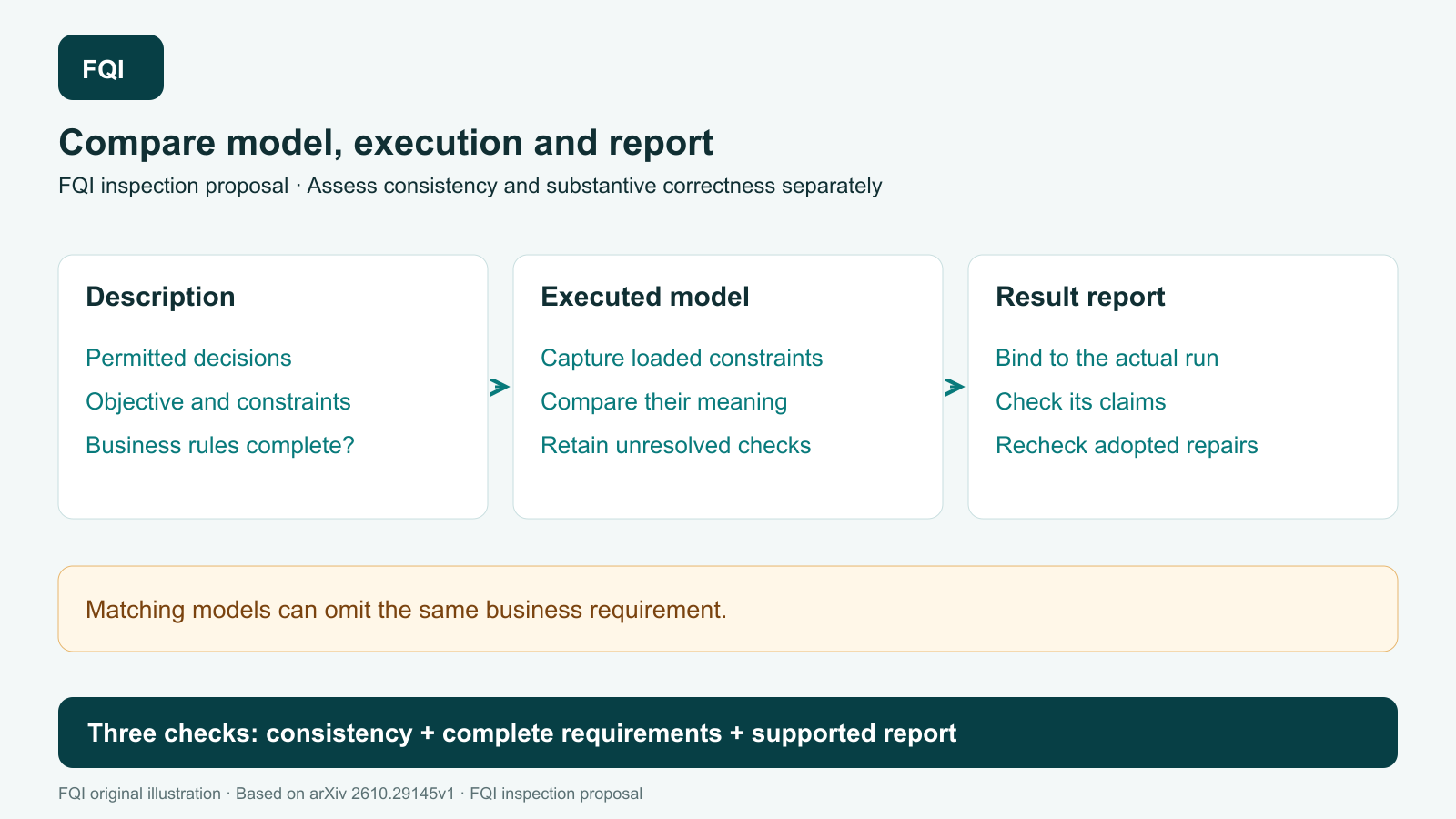
When AI (artificial intelligence) formulates an optimization problem, it can produce a mathematical description, executable code and a result report. Agreement between these outputs needs its own test. ORSMT investigates formal comparisons between them while keeping the original requirements separate.
For quality practitioners, the key distinction is between consistent outputs and a correct solution to the real task. FQI proposes documenting these judgments independently, including comparisons that remain undecided. A plausible final number cannot establish all of them.
FQI takeaway
- Compare allowed decisions and objective criteria across the description and executed model, rather than only the final number.
- Keep unresolved comparisons visible; a timeout or missing access to the model does not constitute a passed test.
- Bind every accepted correction to renewed checks of requirements, executable model and result report.
The principle at a glance
A simplified FQI example concerns allocating inspection jobs to measuring machines. The description requires calibration before a machine handles particular parts. Generated code could omit that condition yet report the same total cost as a correct solution. The cost alone would hide the difference.
A solver is software that solves a mathematical problem using the variables and constraints it actually receives. The relevant comparison therefore includes this executed model. A semantic comparison checks meaning: identical wording is neither necessary nor sufficient for equivalent decisions.
Terms explained
- Artifact: A concrete work product, such as a formula description, computational model or report.
- Feasible region: All decisions that satisfy the stated constraints.
- Semantic comparison: A check that different representations express the same decisions and objectives.
Deep dive
ORSMT compares generated optimization artifacts through formal queries. One question is whether a decision is allowed by one model but excluded by another. Auxiliary variables are considered without confusing them with observable business decisions.
The work also addresses objective relations, binding a report to its result and separate source requirements. Queries that cannot be decided remain open.
Across the full study population, reported model–code agreement increases from 43.2 to 88.2 percent. The share that is both correct and matched reaches 40.2 percent. These are different measures: agreement does not imply a correct answer to the task. The figures describe the study population and are not a forecast for operational performance.
For a limited pilot, FQI first proposes a requirements table. Each business rule receives an identifier, a scope and at least one case it should permit or exclude. A calibration rule could permit a machine assignment with valid evidence and forbid the same assignment with expired evidence. A responsible expert confirms these references before the model comparison.
Next, archive the generated description together with the computational model actually loaded. Reviewing program text alone is insufficient if libraries or imported data create constraints at runtime. The check needs the exact state underlying the reported result. Units, integer restrictions and boundary values also belong in the comparison.
Record three judgments separately: are the models consistent, do they fully represent the confirmed requirements, and does the particular computation support the report? State the scope and unresolved points for each. A single green overall result would obscure these distinctions.
Treat proposed repairs as new versions. Repeat the affected comparisons after a change and retain the business counterexamples. This pilot is an FQI proposal; the paper does not establish its effectiveness in an operational inspection-planning process.
Limitations and risks
The research supports particular mathematical model classes. Translation, variable correspondence, runtime model capture and formal checking software remain part of the trusted basis. Consistent downstream artifacts do not automatically reveal a requirement omitted during translation.
A mathematically correct result can also rely on incorrect input data. FQI has not independently reproduced the study; its improvement rates provide no general guarantee.
FQI conclusion
An AI-assisted optimization should be accepted as a chain of testable work products. Comparing the description, executed model and report can reveal errors hidden by a plausible final number. Domain experts must separately determine whether the rules fully describe the actual assignment.
A small, understood task with known counterexamples and explicit unresolved outcomes is a useful starting point. Both demonstrated consistency and suitability for the business task are needed before a result can be adopted.
Sources & transparency
Preliminary research; no independent reproduction. The requirements table, measuring-machine example and pilot are FQI interpretation. AI-assisted article, approved for publication by Johann Fischer on 2026-10-24.