
Executive summary
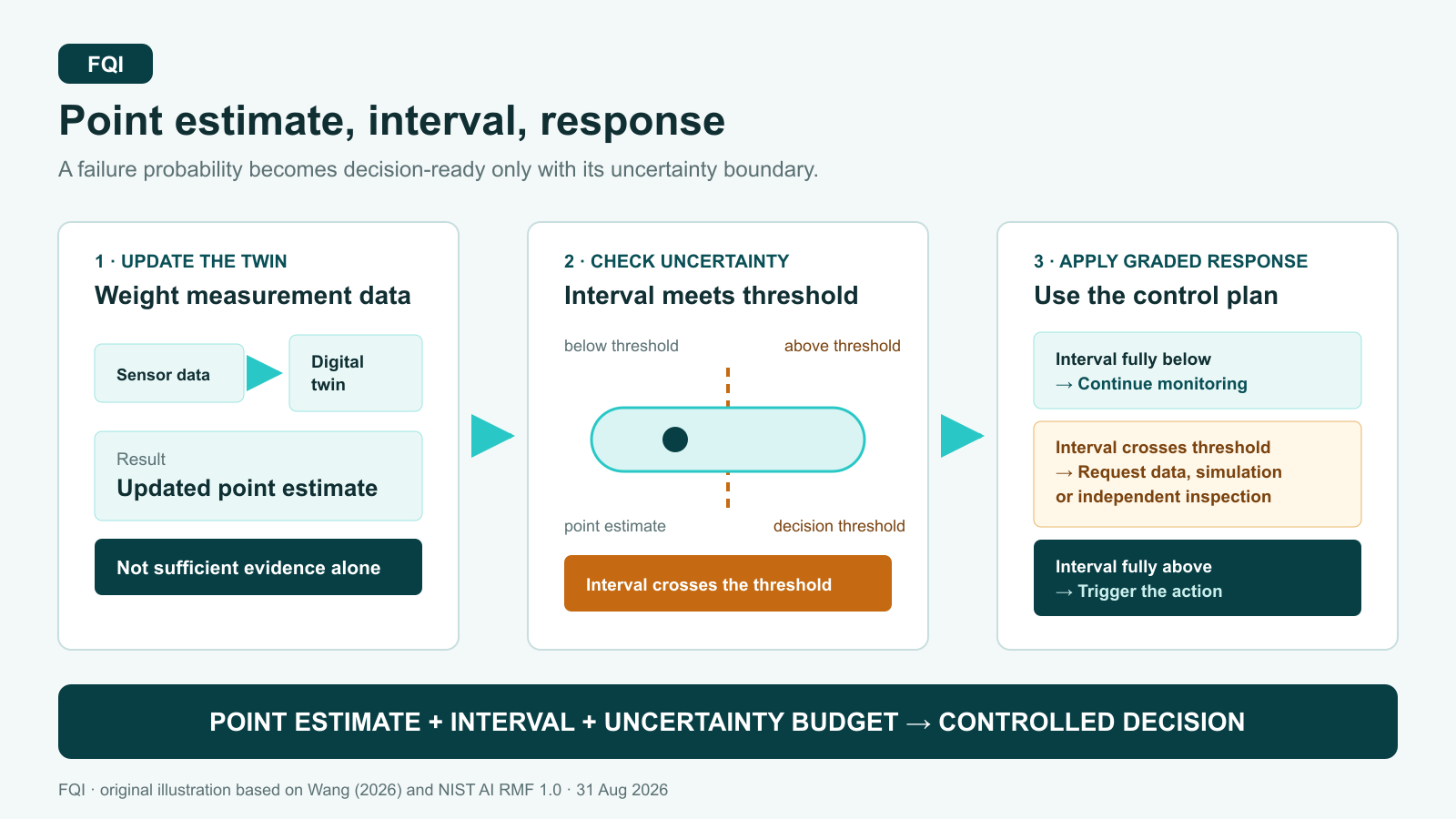
A digital twin can update a failure probability when new sensor data arrives. If the result is shown only as one percentage, the decision may appear more precise than the surrogate model really is. A new paper in Reliability Engineering & System Safety adds conditional confidence intervals and diagnostics to Kriging-based reliability updating. For FQI, this yields a clear approval rule: the point estimate, interval, covered uncertainty source and deliberately excluded uncertainties must be documented together.
FQI takeaway
- A point estimate is not complete evidence: an updated failure probability needs a statement about its computational uncertainty.
- The interval has a system boundary: measurement model, candidate sample, model form and hyperparameters may sit outside the calculated interval.
- Boundary cases need a response plan: if an interval crosses an intervention or release threshold, additional data or an independent check is required.
The principle at a glance
Kriging is a statistical surrogate for expensive simulations. Instead of running a complex finite-element model millions of times, it learns from selected evaluations and provides an estimate plus model uncertainty for additional points. In reliability updating, new observations such as measured stress, vibration or displacement provide weights. States that fit the observation well have more influence on the updated failure probability.
The paper shows how uncertainty about whether these weighted states are classified as safe or failed can be propagated into a confidence interval. One version ignores correlation between classifications; a second version retains it. The National Institute of Standards and Technology (NIST) is the US institute for standards and technology. Its framework for artificial intelligence (AI) risk management also expects suitable uncertainty measures, comparisons and documented results in testing and evaluation.
Terms explained
- Kriging: a statistical surrogate model that provides an estimate and model uncertainty for points that have not been evaluated in full.
- Confidence interval: a range expressing a defined computational uncertainty around an estimate.
- Likelihood: a weight indicating how well an assumed system state agrees with an observation.
- Hyperparameter: an adjusted or learned parameter controlling the structure and smoothness of a surrogate model.
- Digital twin: a digital model of a physical system that is updated with operating or measurement data.
- NIST: National Institute of Standards and Technology; the US institute for standards and technology.
- AI: artificial intelligence; systems that infer patterns from data or automate parts of a task.
Deep dive
The central quality question is: which random quantity does the interval actually describe? The paper therefore distinguishes the continuous target, a finite candidate set, the Kriging classification of those candidates and an alternative auxiliary-variable procedure. Only then is the variance calculated. This order prevents a mathematically correct formula from being applied to the wrong estimator.
Concentrated evidence weights are particularly critical. A few candidates may agree very strongly with the sensor data, and precisely those points can lie near the failure boundary. A surrogate that performs well globally may then be inadequate for the specific update decision. Correlation between neighbouring Kriging predictions can change the interval further; ignoring it can make the result systematically too narrow.
An FQI pilot first defines the decision: observation, maintenance planning, operating restriction or release. The failure boundary, sensor data, observation model, candidate set and model version are then frozen. The result record should contain at least the updated point estimate, the conditional interval, weight concentration, a diagnostic for the normal approximation and a comparison between calculations with and without correlation.
A separate uncertainty budget is also required. The proposed interval is conditional on the selected candidate set, calculated evidence weights, fitted Kriging hyperparameters and training data. According to the paper, it does not automatically cover candidate quadrature, observation-model uncertainty, hyperparameter uncertainty or model-form error in the underlying finite-element simulation. Sensitivity analyses, reference simulations, additional measurements or conservative allowances are needed for these sources.
A control plan connects the result to action. If the point estimate and the entire interval remain below an observation threshold, the normal cycle may continue. If the whole interval exceeds an intervention threshold, the defined measure is triggered. If the interval crosses the threshold, the apparently precise mean must not decide: the process requests more data, a higher-fidelity simulation or an independent inspection.
Limitations and risks
The paper develops a conditional interval for a narrowly defined uncertainty source. A narrow range therefore does not prove that the physical system model is correct. The wind-turbine application uses a deterministic, finite-element-informed response wrapper and is explicitly not presented as field or high-fidelity aeroelastic validation. Fixed likelihood weights and fitted hyperparameters are assumptions, not side details. With concentrated weights, the normal approximation can also fail. Finally, every failure boundary is application-specific; statistics cannot repair a wrongly defined limit state.
FQI conclusion
Failure probabilities do not become more trustworthy through extra decimal places. A quality-capable digital twin shows which uncertainty its current value contains, which sources the interval covers and which remain open. The new method provides an auditable computational layer for that purpose. Actual process control comes from combining the interval with an uncertainty budget, a reference check and a predefined response at the decision threshold.
Sources & transparency
- Wang: Evidence-weighted confidence intervals for adaptive Kriging reliability updating, Reliability Engineering & System Safety, available online 21 August 2026, DOI 10.1016/j.ress.2026.113329.
- NIST: Artificial Intelligence Risk Management Framework 1.0, 2023.
- Evidence status: analytical derivation, simulation verification and a deterministic numerical example without field validation. The three-stage response plan and separate uncertainty budget are FQI interpretations. This Research Brief was prepared with AI support and reviewed by a human for subject matter and source accuracy on 30 August 2026.