
Executive summary
A measurement can be technically correct and still be damaged on its way into the enterprise system through retyping, inconsistent file formats, missing identities or an interrupted upload. An industrial field study therefore links optical fibre measurements to enterprise resource planning (ERP) through one canonical record. At one site, mean cycle time fell from about 240 to 45.7 seconds; across 1,000 automated records, the authors observed no field differences between the measurement source and ERP. For FQI, the decisive idea is not the “digital twin” label but a controlled evidence chain after measurement.
FQI takeaway
- A canonical record limits translation drift: the measurement, production identity, inspection status and target-system values are structured once and reused from that source.
- An interface needs an evidenced transaction state: persist locally, mark a transfer complete only after acknowledgement and reconcile source with target.
- Automation does not replace measurement-system control: the field study shortens work after measurement; the unchanged physical test still needs separate qualification.
The principle at a glance
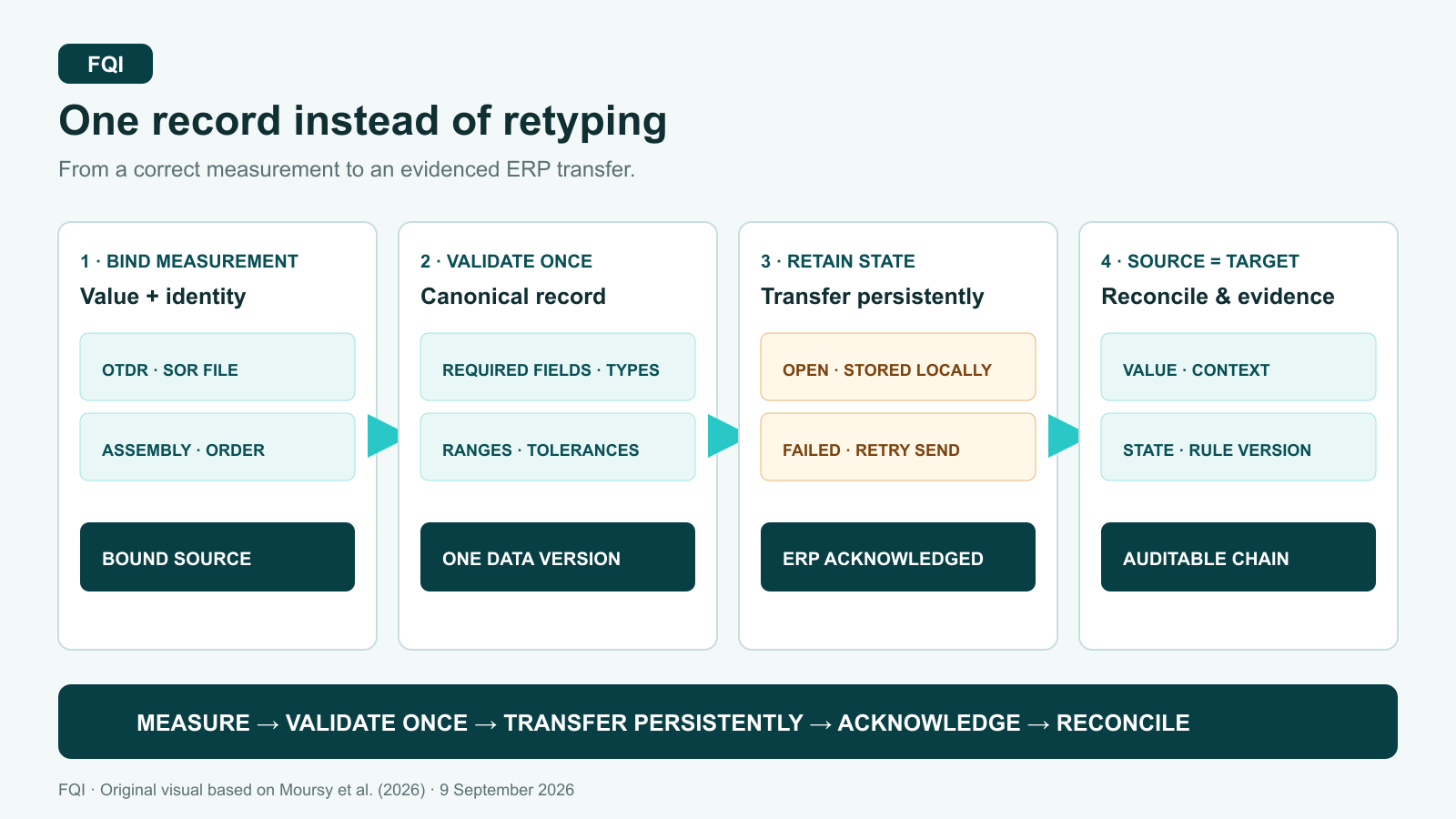
The study concerns optical time domain reflectometry (OTDR), a method that checks optical fibre links by analysing reflected light. The instrument saves results in Standard OTDR Record (SOR), a format for traces and events. The workflow reads the required fields locally, joins them to production identifiers, validates them with deterministic rules and creates one canonical record. CSV files, JSON messages, a database entry and the ERP transaction all derive from the same checked source. A persistent queue retains the transfer state when connectivity fails.
Terms explained
- Canonical record: one authoritative structured representation from which every target format is generated.
- ERP: enterprise resource planning; the central system for orders, materials, production and related records.
- Digital thread: an end-to-end digital information chain connecting the physical process, measurement and business systems.
- Source-to-target reconciliation: a systematic check that the measurement source and ERP contain the same releasable values.
- Shadow mode: a test phase in which a system runs alongside operations but does not trigger automatic decisions.
Deep dive
The work examines a plant for optical-fibre cable assemblies with ten Viavi MTS-8000 stations, a local edge controller and an Oracle ERP workflow. The sample contains 500 assemblies and 1,000 fibre ends. The physical OTDR test took about 45 seconds in both variants. The change concerns the following steps: saving, transferring, registering values and completing the ERP transaction.
According to the publisher preview, mean end-to-end time fell from about 240 to 45.7 seconds, a reduction of 80.96%. Of the 194.3 seconds saved, 119.5 seconds came from result transfer, 59.8 seconds from ERP registration and 15 seconds from saving or export. Excluding the unchanged measurement time, observed post-measurement work fell from 195 to 0.7 seconds. Across 1,000 automated records, the study reports no field differences between the canonically derived SOR values and their corresponding ERP values.
The architecture is the quality-relevant part. Required fields, data types, ranges, identifier bindings and tolerance rules are checked before transfer. The record remains stored locally until the target acknowledges the transaction. Measurement, production context, validation decision, ERP state and audit log form one record. A fault becomes visible: not yet transferred, rejected, pending retry or acknowledged.
An FQI pilot should first measure the current media break: transfer time, manual entries, missing identifiers, field differences, repeated work and unresolved states. The new chain then runs in shadow mode, a test phase without automatic decisions. For every inspection record, the pilot logs a source hash, product and order link, rule version, validation result, send attempts and target acknowledgement. Acceptance criteria cover more than speed: complete assignment, evidenced restart, controlled error messages and source-to-target agreement.
Limitations and risks
The results come from one plant, one instrument family, ten stations, one ERP system and a bounded workload. There is no multi-vendor, multi-site or high-load validation. “No observed field differences” across 1,000 records is not a guarantee against rare faults or later software changes. The study evaluates only the SOR fields needed for the workflow, not every complete trace. It deliberately calls the solution digital-twin-oriented: predictive simulation and an autonomous control loop are not implemented. Access control, key management, timestamps, master-data quality and change control also require separate qualification in the operating environment.
FQI conclusion
The paper makes an overlooked quality point measurable: a separate process chain lies between a passed test and a documented release. A canonical record, deterministic validation, persistent transfer and source-to-target reconciliation can make that chain faster and more auditable. The single-site findings justify a controlled pilot, not a general productivity promise. Automation should preserve the exact measurement record, its context, transfer state and target acknowledgement as one coherent body of evidence.
Sources & transparency
- Moursy et al.: M0N0viAvi: a digital-twin-oriented edge virtualization platform for secure OTDR/SOR fiber monitoring and ERP-integrated industrial measurement, Measurement, volume 290, article 123061.
- DOI metadata record 10.1016/j.measurement.2026.123061.
- Evidence status: the architecture, sample, timing results and limitations come from the detailed publisher preview. The transfer to a general FQI pilot with predefined acceptance criteria is editorial interpretation. The full text is paywalled, so this draft makes no detailed claims beyond the accessible preview.
- This draft was prepared with support from artificial intelligence; human subject-matter and source approval are still pending.