
Executive summary
An inspection robot can collect measurements and images where they originate. A digital twin—an up-to-date digital representation of the real operation—brings this information together and can expose deviations earlier. For quality teams, however, the value does not come from visualisation alone. It depends on qualified measurement equipment, unambiguous limits, traceable data and a responsible person who assesses every alert.
FQI takeaway
- Design the digital twin as an auditable information flow, not merely as an attractive dashboard.
- Validate sensors, cameras and recognition models against defined references and error rates.
- Start in a controlled test operation in which specialists confirm alerts and measure their effect.
The principle at a glance
According to its title, the selected paper announced for November 2026 in Measurement develops a digital twin for chicken-farm monitoring with inspection robots. Its full abstract and article text were not accessible to the automated editorial review. Specific technical statements therefore come only from an openly accessible precursor study that includes several of the same researchers.
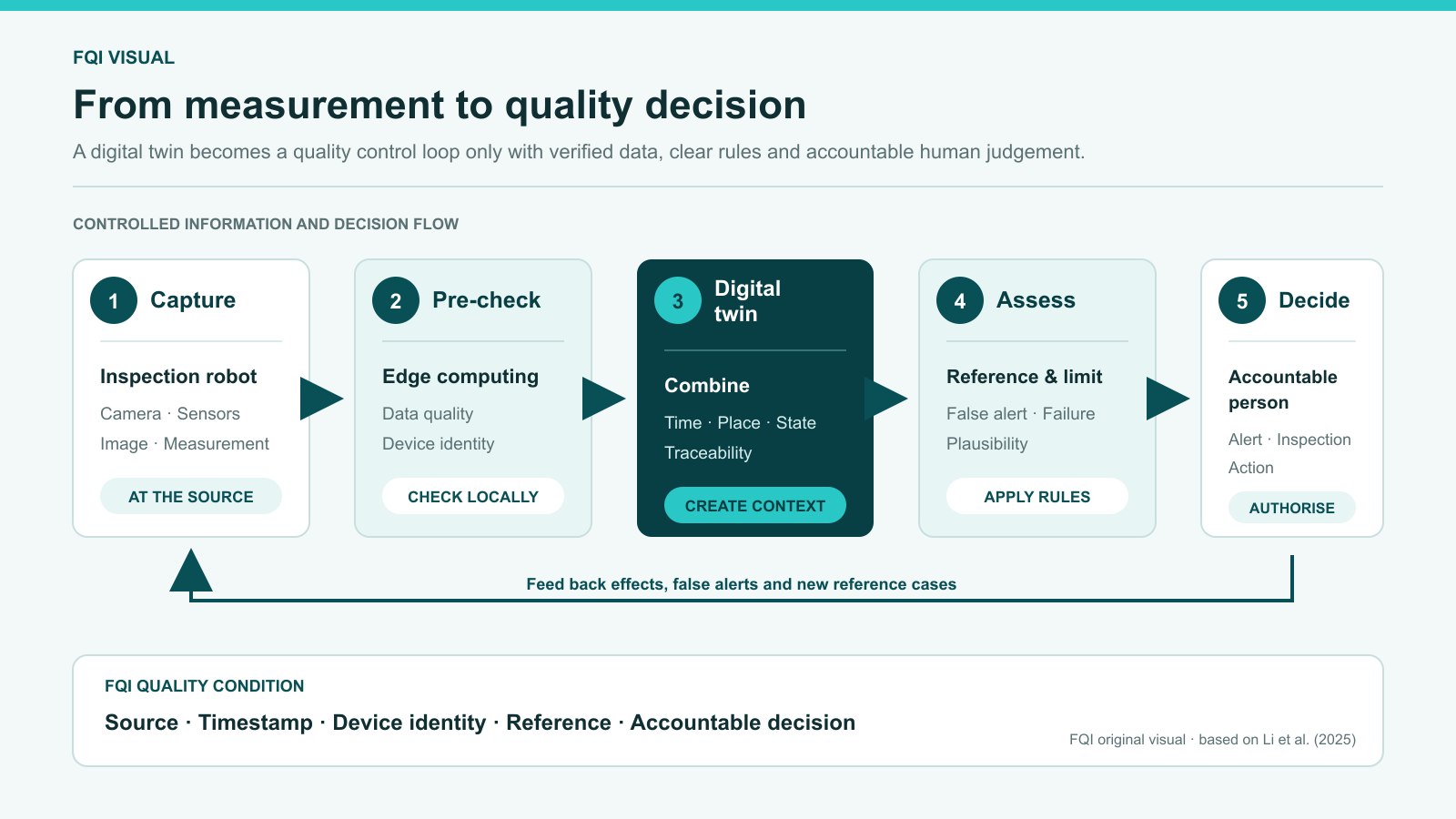
In that study, a mobile robot moves through a poultry-house environment and captures image and environmental data. A computer on the robot processes images close to their source. The results travel to a central platform that represents the physical state in a digital model. This creates a control loop: capture, assign, display, assess and act.
Terms explained
- Digital twin: A digital representation of a real system connected to current operational data.
- Inspection robot: A mobile platform that visits defined areas to capture images or measurements.
- Edge computing: Processing data on or near the device before sending results to a central platform.
- Real-time monitoring: Continuous observation with sufficiently little delay for responsible people to react promptly.
Deep dive
The open 2025 study by Li and colleagues provides a concrete architecture. The robot uses a camera and local computing to classify the beak shape of laying hens as normal, mildly abnormal or severely abnormal. The researchers captured images from 11 to 17 December 2024 during morning hours under natural light. This context matters because lighting, viewing angle, movement and occlusion can affect recognition.
The recognition model ran on a compact computer attached to the robot. Results were packaged in a common data format, sent through a messaging protocol to a server and displayed in a three-dimensional operational view. The study reports 91% precision, 91% recall, a 93% F1 score and 19 processed images per second for the improved model. These metrics belong exclusively to the 2025 study and must not be presented as results from the announced 2026 paper.
For quality practitioners, the transferable control logic matters more than the specific poultry application. Every measurement needs a source, timestamp, device identity and traceable processing step. An alert must point to a defined inspection object and a response rule. Without those links, abundant data create an impressive display but not auditable evidence.
Before operational use, the team should define reference cases: what is normal, what triggers a warning and what requires immediate intervention? False-positive alerts cause unnecessary inspection; false-negative results miss real problems. A pilot should record both error types, data loss, latency and the response of accountable people. Automatic escalation should only be considered after this evidence chain proves stable.
Limitations and risks
The selected 2026 paper cannot yet be fully verified before its announced publication date. Its method, sample and results therefore remain open. The numerical results in this brief come from the linked 2025 precursor study. They concern a bounded application for detecting beak abnormalities and cannot be transferred directly to other animal species or industrial inspection processes.
The precursor study also describes scaling concerns. Larger deployments may challenge computing capacity, stability and cost. Changing light, occluded features, network outages and changes in the physical environment add further risk. Responsible operation must also address privacy, cyber security, animal welfare and clear intervention rights. A digital twin replaces neither professional inspection nor human accountability.
FQI conclusion
Combining mobile inspection with a digital representation can create a powerful quality control loop. Its value appears only when the full chain from sensor to decision is measurable and auditable. FQI therefore recommends a bounded pilot with reference cases, documented error rates and human confirmation. The announced 2026 article should be checked in full when it becomes available, and this brief should be updated if new evidence changes the assessment.
Sources & transparency
- Li et al.: Development of a digital twin system for chicken farm monitoring using inspection robots—announced paper in Measurement (2026)
- Li et al.: Deep Learning-Based Detection and Digital Twin Implementation of Beak Deformities in Caged Layer Chickens—Agriculture 15(11), 1170 (2025)
This article was prepared with artificial intelligence support and editorially checked against the accessible sources. The announced 2026 paper was not yet fully accessible at the time of review; all specific technical statements therefore come exclusively from the linked open 2025 precursor study.