
Executive summary
Additional calculations on the same audit data cannot replace missing decision evidence. Post-Audit Mirage constructs verification situations for artificial intelligence (AI) with identical visible evidence but different risks after a change. A decision rule using only that evidence cannot reliably distinguish both cases.
The work therefore also examines fresh observations of harm for specified groups after the change. For quality assurance, the central question is whether existing data support the intended release decision and under which conditions new operational observations can resolve it.
FQI takeaway
- Define the risk, affected group and operational state to be bounded before analysing results.
- Check whether identical audit evidence could be compatible with opposite answers to the release question.
- Distinguish insufficient statistical clarity from data collection that fails the assumptions required for the claim.
The principle at a glance
A simplified FQI example: two versions of an AI assistant pass the same archived permission checks. After an update, however, they use role records maintained in different ways. The old audit report alone does not reveal the resulting error rate.
The missing link is between the evidence and the target claim. More indicators calculated from the same archived cases do not create an observation of the changed state. The test plan must establish that link or collect suitable new evidence.
Deep dive
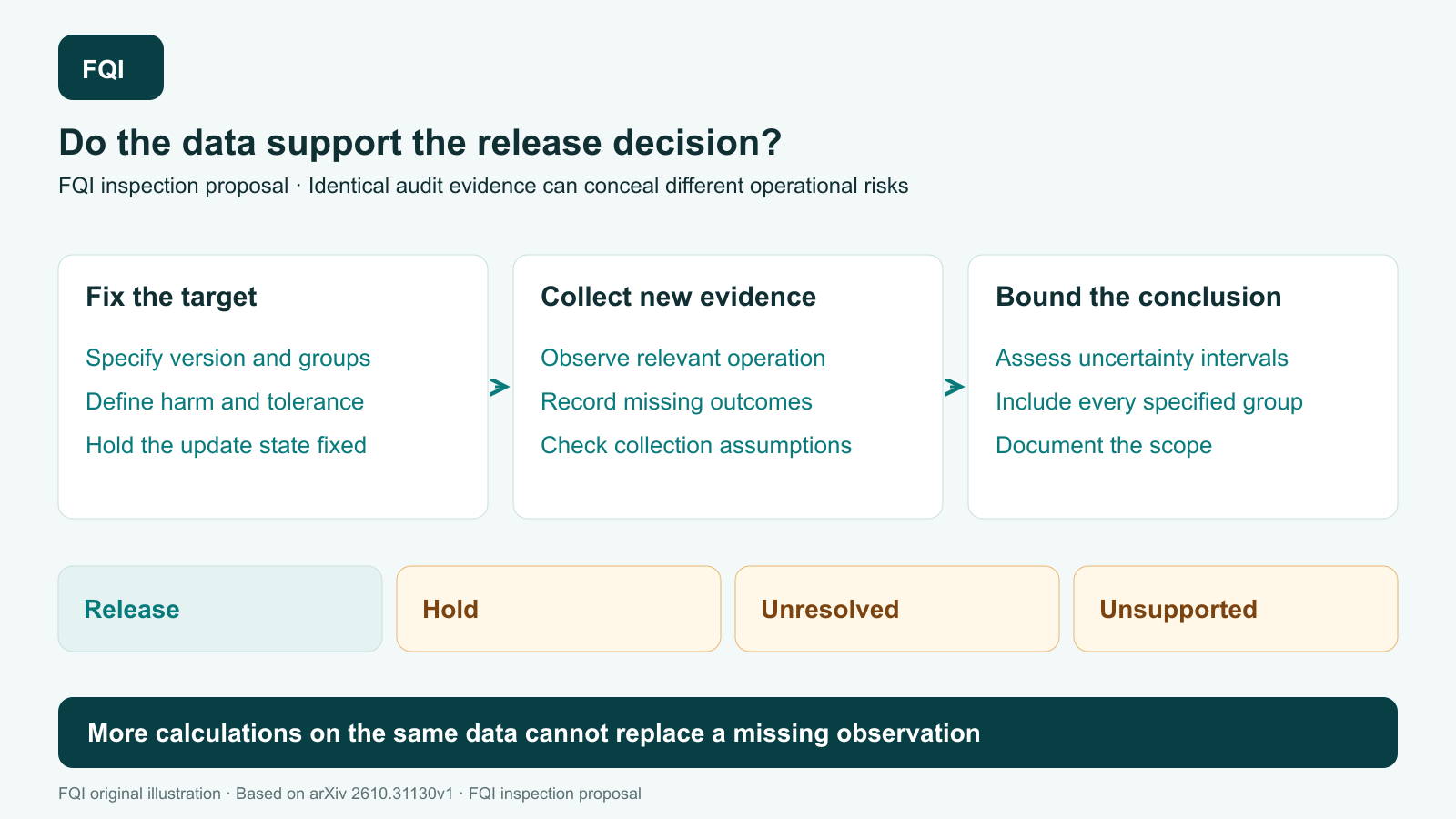
The researchers construct 272 pairs of artificial lifecycles across three task families. Available verification observations match within each pair, while the outcome the verification is intended to protect differs after the change. The tested decision procedures therefore receive the same information when different decisions are required.
This is a deliberately constructed limit of observable information. The work does not claim a new universal argument against audits. Its practical contribution is to separate the target claim, visible evidence and subsequent state explicitly. The evaluated procedures are local diagnostic abstractions, not a ranking of commercial AI products.
The study also examines monitoring based on fresh harm observations assigned to specified groups. With the update held fixed, it constructs uncertainty intervals for each group’s harm rate. If every upper bound falls below the predefined tolerance, the bounded release rule may be satisfied.
If any lower bound exceeds the tolerance, the rule supports holding the update. Between those outcomes, the question remains unresolved.
A fourth situation is distinct: the observations do not meet the declared collection conditions. The claim is then unsupported by the method. For example, simply ignoring missing outcomes is inadequate when problematic cases are more likely to go unreported. Additional volume does not automatically remove that selection bias.
FQI proposes documenting the AI version, fixed update state, affected groups, harm definition, tolerance and observation window in the release record. The record should also explain missing outcomes and any further changes during measurement. Only then can a team judge whether the statistical procedure fits the decision.
The simulation also illustrates the effort needed for a clear result. In one controlled investigation, only four of 18 configurations meet the studied release condition within 20,000 observations. That condition uses a Hoeffding bound, which limits statistical uncertainty under specified assumptions.
Rare groups and missing observations can considerably delay resolution. The figure belongs to this experiment and is not a universal sample-size requirement.
Limitations and risks
The study uses synthetic lifecycles and simulated observations. It does not estimate how often the constructed evidence gap occurs in organisations. The monitoring rule assumes, among other things, independent binary outcomes, stability within each group and a fixed target state.
Even satisfying the rule bounds only the defined harm for the included groups. Usefulness, other harms and technical feasibility remain separate questions. A continuously changing AI system or systematically missing feedback can fall outside the promised scope of the conclusion.
FQI conclusion
For FQI, every AI release decision should explain why its evidence supports the specific operational question. If that connection is missing, another calculation cannot substitute for new evidence. The useful distinction is between release, hold, unresolved and unsupported by the collection process.
It shows whether a team needs more suitable observations or must first change its test plan. A complete report should therefore not be treated as proof that the release question has actually been answered.
Sources & transparency
Primary source: Post-Audit Mirage, original full text v1, main text and Appendices B–D. Research manuscript; no independent reproduction by FQI. The role-record example and proposed release record are FQI interpretations. AI-assisted article, approved for publication by Johann Fischer on 2026-10-23.