
Executive summary
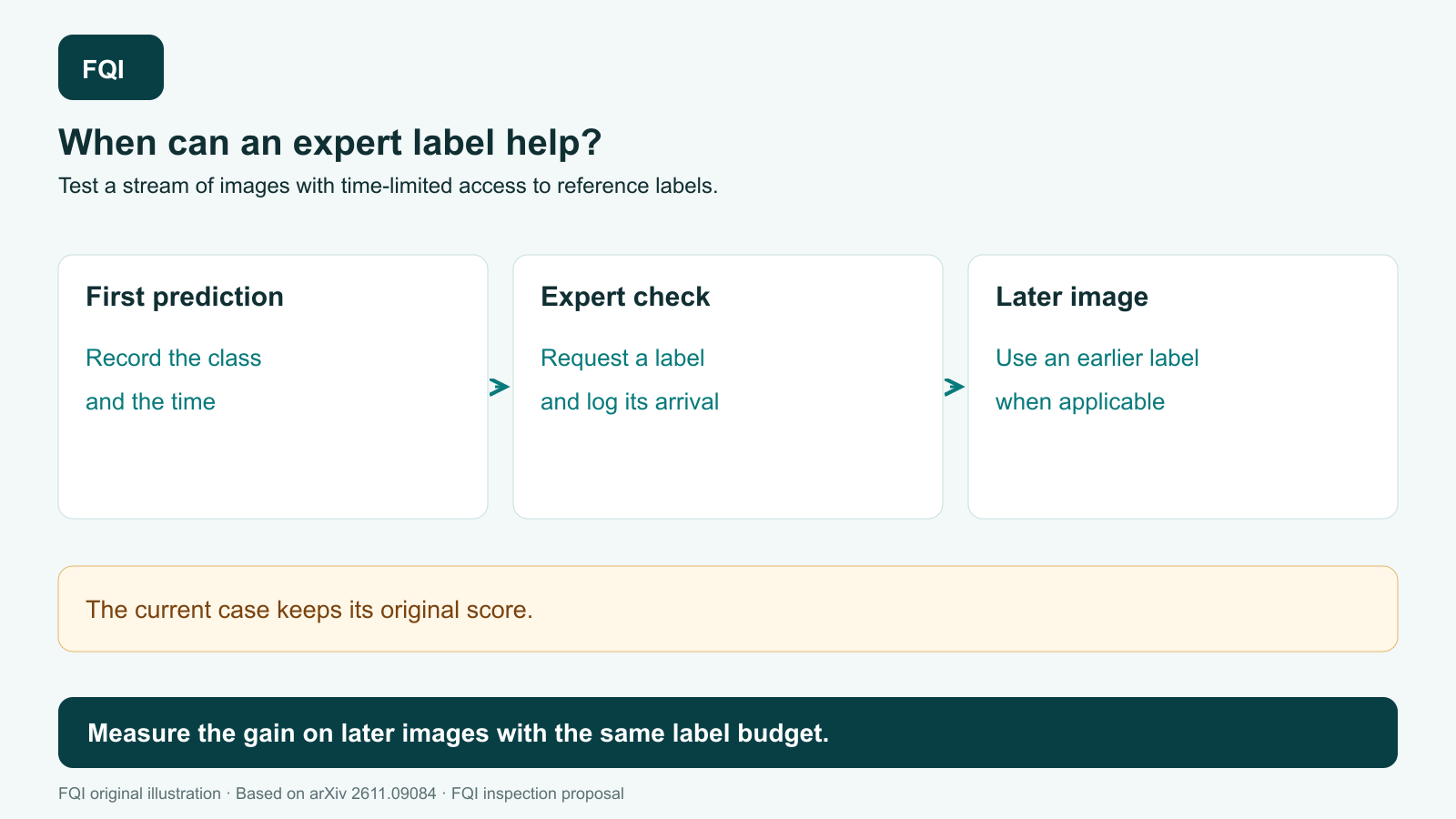
An inspector can correct a wrong classification after the event. Whether the correction helps with the next case is a separate question. The developers of ACTOR investigate it with models that assign images to classes described in words. Every prediction is recorded before the corresponding reference label may enter memory. This arrangement measures the benefit of occasional queries for later cases while keeping the original decision visible.
FQI takeaway
- Timestamp every initial prediction before the reference class becomes available.
- Count expert queries as a limited resource and compare methods with equal access to labels.
- Record when a previous case changed a prediction and whether that change helped or hurt.
The principle at a glance
A vision-language model compares image features with descriptions of possible classes. The assignments can become uncertain when imaging conditions change. ACTOR supplements a frozen model with a memory of previously requested reference labels. The model weights stay fixed during use. Additional information becomes available as labels for earlier cases arrive.
For an uncertain image, the procedure looks for similar images in memory. It checks whether those examples support a consistent assignment and whether the class is plausible for the current observation. Depending on the evidence, it keeps the base prediction, uses earlier cases to correct it or requests a reference label. A newly requested label is available only for subsequent images. Even an expert who settles a difficult case conclusively cannot retrospectively improve its scored first prediction.
Deep dive
Timing is part of the experimental method. If the reference immediately replaced the current prediction, a procedure could raise its score simply by asking more questions. That would leave its ability to transfer knowledge to the next case unresolved. The authors therefore also compare methods that use the very same requested labels in different ways. Across 15 datasets, ACTOR beats two methods that train the text descriptions used to represent classes with those references by 2.50 and 2.45 percentage points on average. These differences apply to the comparisons reported in the preprint.
FQI proposes reproducing the timing constraint in a continuous visual inspection. Suppose lighting changes as painted parts pass the camera. An inspector reviews selected uncertain images. The log records the image number, the time of the first prediction and the time the inspector’s judgement arrives. For every later image it is then possible to identify which labels the procedure could already use. Replaying the same sequence without the memory provides a reference.
It also matters which predictions change direction. A correct decision spoiled by an earlier label deserves attention alongside a mistake that the procedure corrects. Separate counts reveal the surfaces or lighting conditions for which consulting earlier cases helps. They can also show whether a few common classes consume most of the available expert attention. The team can use that information when choosing a query budget for its own trial.
Limitations and risks
The method depends on accurate references and enough similar cases in memory. An incorrect label or sparse coverage of a rare class can propagate a bad assignment. Once the query budget is exhausted the system loses access to fresh evidence. The published datasets do not establish a query rate for a particular production line or acceptance limits for its most consequential errors. A local trial should preserve the actual case order and feedback delays.
FQI conclusion
A team using expert feedback during operation needs to measure two services. A review can settle an individual case, while the system’s later predictions may benefit from the label that review supplies. A chronological record, a fixed budget and a comparison under equal information make the second benefit measurable in its own right. The distinction matters even when none of the underlying model weights changes during the inspection.
Sources & transparency
The experiments are reported in the preprint. The proposed workplace check is FQI interpretation.
Artificial intelligence assisted preparation. Johann Fischer approved this article package for publication on 2026-11-09.